
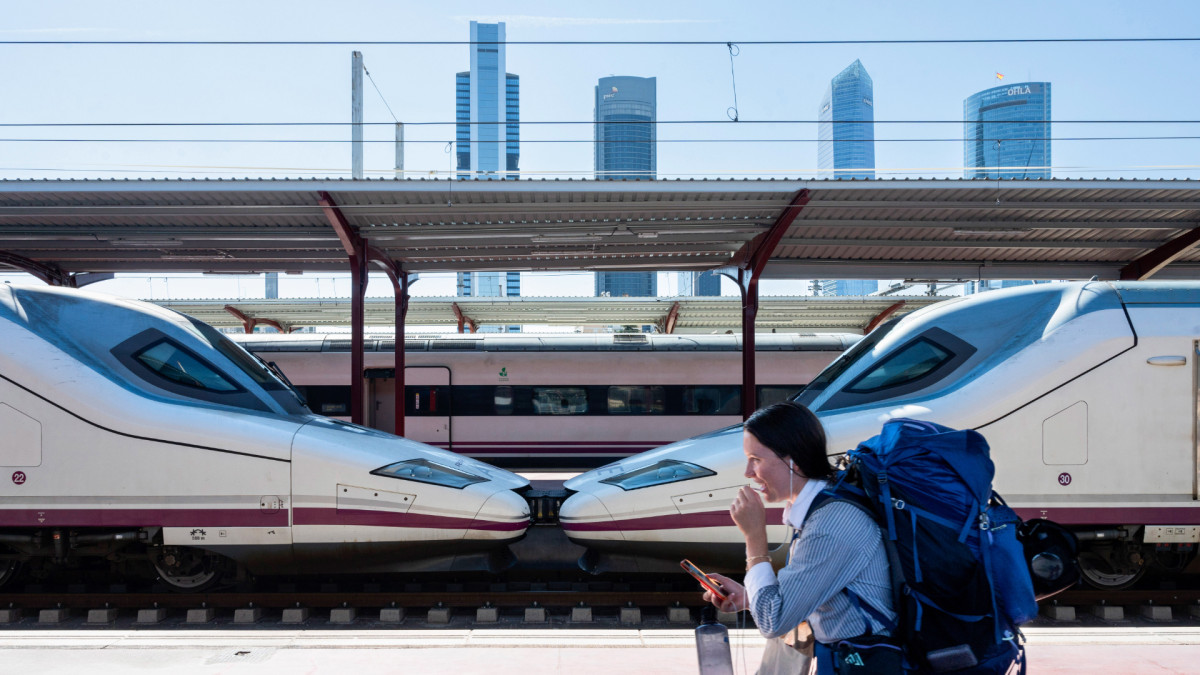
Never had so many Spaniards travelled by high-speed train, nor had it been so affordable. And yet, 2026 will be remembered as one of the darkest years in Spanish rail. The derailment at Adamuz (Códoba) in January, and the collision between two high-speed trains at Urda (Toledo) in October, left 115 dead. In Gelida (Barcelona), a Rodalies train collided with a wall that had fallen onto the track, killing a trainee locomotive driver.
That this sequence of accidents arrives barely five years after the liberalization of high-speed rail has reopened a fundamental debate: whether opening high-speed to competition has degraded safety and service, or whether the problem is older and of another nature. The answer depends on where the focus is placed: on who operates the trains or on the state of the track they run on. In Spain, that track is almost entirely state-owned and managed by Adif, regardless of the competences some regions have over services like Rodalies. The data allow separating these two questions.
Three accidents, three causes
Investigations remain open, but the initial conclusions point to different causes. In Adamuz, the Railway Accident Investigation Commission locates the origin in a rail break on a stretch that Adif had renewed in May 2025 and which, according to the Ministry of Transport, had passed all subsequent checks. In Gelida, the trigger was the detachment of a wall after heavy rains. In Urda, early reconstructions point to a failure of the LZB protection system, installed on the Madrid-Seville line in 1992 and due for replacement by the European standard ERTMS, followed by an authorization from the control center to resume movement that the minister himself called “inexplicable.”
From what is known, none of the three points to the entry of new operators. In all three cases, however, the issue involves infrastructure or its management: a rail, an embankment, and a signaling system more than three decades old.
What competition brought
The debate also carries a confusion of terms. What has been done in Spain is not privatization, which would entail transferring ownership of the infrastructure or the public operator to private hands, but liberalization, that is, allowing several companies to compete to provide the service on a publicly owned track. Adif remains state-owned, Renfe as well, and two of the three high-speed operators are subsidiaries of foreign public companies. Ouigo belongs to the French SNCF, and Iryo is backed by Trenitalia, of the Italian state-owned Ferrovie dello Stato.
“Ninguno de los tres accidentes apunta a la entrada de nuevos operadores. En los tres interviene, en cambio, la infraestructura o su gestión”
Spain opened high-speed to competition in December 2020, in line with the European Fourth Railway Package. It was not an exception. The same rules require France, Germany or Austria, where historic operators remain public. There, however, the spark of competition has barely taken hold: in Germany it accounts for less than 5% of the market, in Austria it is limited to the Vienna-Salzburg axis and in France SNCF keeps more than 99%. Spain, by contrast, allocated high-speed capacity among several operators, and Renfe has fallen to 72% in just four years.
Effects on demand and prices have been rapid. Rail carried in Spain 547 million passengers in 2025, according to the National Commission on Markets and Competition (CNMC), and more than eight in ten did so on Cercanías. Competition affects a smaller, but growing, share of that total. Long-distance commercial services, the only ones open to new operators, carried 49 million people in 2024, 42% more than in 2019. Eight in ten, 39.6 million, traveled on high speed, and the remainder on conventional long-distance or international trains. In 2025, high-speed added 44.5 million travelers, twice what there was before liberalization. What a traveler pays on average in the corridors with competition fell by 33% between 2019 and 2024, and by 44% after inflation adjustment.
“Lo que paga de media cada viajero en los corredores con competencia bajó un 33% entre 2019 y 2024, y un 44% descontando la inflación”
La puntualidad, en cambio, ha caído. En las rutas con competencia, la proporción de trenes que llegaron con menos de cinco minutos cayó nueve puntos porcentuales hasta el 85,8% entre 2019 y 2024, y en los servicios de ancho variable, los que combinan vías de alta velocidad y convencionales, se desplomó hasta el 54%. La CNMC atribuye parte de ese deterioro al elevado número de obras en la red. Los viajeros ganaron en precio y en frecuencias, y perdieron en puntualidad por razones ligadas a la vía, no a los trenes ni al carácter público o privado de quien los opera. La competencia también ha aportado recursos. Los ingresos de Adif Alta Velocidad por el canon que pagan los operadores pasaron de 611 millones de euros en 2019 a 783 millones en 2024.
What other countries teach
If operator ownership determined service quality, the European experience would reflect it. That is not the case. Since the 2018 Eurobarometer there is no comparable cross-country satisfaction survey, but available indicators, such as national surveys, punctuality and the very use of the train, an indirect sign of trust, point in the same direction. Italy was a pioneer in opening high-speed to competition, with Italo entering in 2012. According to a European Commission study, ticket prices fell by 31% between 2012 and 2024, and demand responded. Italo has gone from 4 to around 25 million travelers per year, and Trenitalia ranked among the best-rated operators in the European ranking prepared in 2024 by the organization Transport & Environment. France, where the public SNCF barely has competition, was in 2025 the second EU country for train kilometers travelled per capita.
Two other cases stand out: Switzerland and Germany, because both have public operators and opposite outcomes. Switzerland is the European country where most travel by train occurs, 2,544 kilometers per person per year, more than triple Spain’s. In 2025, 94.1% of its trains arrived on time and its users rated SBB 77.7 out of 100 in the government-supervised survey. That year, the state invested 594 euros per person in its rail network. In Germany, by contrast, the punctuality of Deutsche Bahn’s long-distance trains fell to 60.1% in 2025, and its customers give it only an intermediate rating in satisfaction surveys. The company itself attributes this mainly to works on an aging network after years of underinvestment. The state spent 56 euros per capita a decade ago, versus 222 in 2025. Austria, where the public ÖBB manages the track and concentrates virtually all passenger traffic, invested 359 euros per capita, achieving a 94.1% on-time rate for its passenger trains, hit a record in passengers and was in 2025 the third EU country for kilometers travelled by train per capita. These figures, calculated by the German association Allianz pro Schiene, cover state investment across the entire rail network, not just high-speed. In Spain, public investment in the sector amounts to around 100 euros per capita, according to the Ministry of Transport, and that including new line construction.
“Los dos casos más reveladores son los de Suiza y Alemania, porque ambos tienen operadores públicos y resultados opuestos”
La conclusión es nítida. Sistemas públicos ofrecen resultados excelentes, como el suizo o el austriaco, y malos, como el alemán; mercados abiertos han logrado más viajeros y precios más bajos, como el italiano o el español. Lo que separa a los que mejor funcionan del resto no es quién vende el billete, sino cuánto y con qué regularidad se invierte en la vía.
Build before maintaining
La inversión pública en el ferrocarril español ha seguido una trayectoria de montaña rusa. Según el Ministerio de Transportes, alcanzó 8.772 millones de euros en 2009, cayó a 1.652 millones en 2016 y se ha recuperado hasta unos 5.000 millones en 2025, casi el triple que en 2018. Aun así, descontada la inflación, sigue siendo menos de la mitad que en 2009. Una red ferroviaria no se conserva a trompicones, sino con un flujo constante de inversión, y la AIReF advirtió en 2020 de que, desde 2012, lo invertido en infraestructuras de transporte no cubría siquiera su desgaste. Según la Fundación BBVA y el Instituto Valenciano de Investigaciones Económicas, entre 2016 y 2022, lo invertido en la red no bastó para compensar su depreciación, de modo que su valor se redujo.
The problem is not only how much has been invested, but where. Spain has the largest high-speed network in Europe, about 3,300 kilometers, and it has been built prioritizing expansion over maintenance. Between 2018 and 2022, only 16 of every 100 euros spent on high-speed rail were allocated to maintaining and renewing existing lines; the other 84 went to building new lines, according to the European Commission. In France, maintenance accounted for 34 of every 100 euros; in Germany, 36.5, and in Italy, 40. In 2024, the proportion had hardly changed: Adif Alta Velocidad invested 1,781 million and the Ministry puts maintenance of that network at 475 million, a ratio still far lower than in France, Germany or Italy.
Furthermore, maintenance investment has not kept pace with traffic. Between 2017 and 2025, spending to maintain each kilometer of high-speed rail rose by just 6% in real terms, according to Adif data. In a similar period, between 2019 and 2024, the number of trains running per kilometer grew by 42%, according to the CNMC. Put differently, each train today on the high-speed network carries roughly a quarter less maintenance spending than six years ago. Traffic has grown, but public investment in upkeep has not kept pace.
“Cada tren que pasa hoy por la red de alta velocidad cuenta, de forma aproximada, con una cuarta parte menos de gasto en mantenimiento que hace seis años”
In the entire rail network, which adds high-speed, conventional lines and Cercanías, maintenance spending has indeed risen in recent years, from 720 million euros in 2017 to 1,120 million in 2025, according to Adif, though part of that rise was absorbed by inflation, which over that period (2017-2025) ran around 25%, according to INE. But it started from a very low base: in 2022, the last year with comparable EU data, Spain allocated about 95,900 euros per kilometer to maintaining, renewing and improving its network, half the EU average.
The imbalance is even more striking among services. According to AIReF, between 1990 and 2018 55,888 million euros were invested in high-speed and “only” 3,600 million in Cercanías. In other words, for every euro spent on Cercanías, more than fifteen went into high-speed. And yet, Cercanías carries today ten times more travelers. The pattern has not changed entirely: the Valencia Community Cercanías Plan 2017-2025 was executed at less than half of what was planned.
Kilometres to fill
One might think the Spanish network is saturated. However, the data indicate otherwise. On high-speed lines, according to the CNMC, in 2024 there were 58 trains per day per kilometer of line, compared with 96 in France and 248 in Italy. On the entire rail network, Spain moves 15% fewer travelers per kilometer of track than the EU average.
This low intensity has a cost, because high-speed is an expensive technology. In Spain, each kilometer cost on average 14.7 million euros, according to AIReF, and the European Court of Auditors estimated in 2018 that a line should carry about nine million travelers per year to justify the investment. In Spain, with the traveler figures published by the CNMC, only two lines meet that threshold. The first is Madrid-Barcelona, with 14.4 million travelers in 2025. The second is the Madrid-Seville line, but for a special reason: between Madrid and Córdoba, the trains bound for Málaga also run on its tracks, so that stretch totals around 12 million travelers, 5.9 million to Seville and 5.8 million to Málaga. The rest are below. Madrid-Valencia carried 6.2 million and Madrid-Alicante, 4.5. The northern and northwestern lines, according to AIReF, show even lower demand.
“En la alta velocidad, según la CNMC, circulaba en 2024 el equivalente a 58 trenes diarios por kilómetro de línea, frente a 96 en Francia y 248 en Italia”
The Spanish high-speed rail carried in 2025 about 13,000 travelers per kilometer of line, or about 17,000 if medium-distance services are included, compared with nearly 59,000 in France in 2024. Only the Tokyo-Osaka line, 552 kilometers long, carried 158 million travelers in 2023, more than triple all of Spain’s high-speed rail in 2025. Hence AIReF’s conclusion that the socio-economic profitability of Spanish corridors hovered “between zero and minimal.”
The low occupancy, however, has two readings. On one hand, the Spanish network does not wear out more than others due to excessive traffic. Countries with more trains per kilometer are also the ones that invest the most in it. And on the other hand, liberalization has begun to fill that idle capacity, though, as seen, maintenance did not grow at the same pace.
The track, not the ticket
No. The data do not allow attributing the problems of the past year to a fault in the model. The problems are not attributable to liberalization. Competition has doubled high-speed travelers, has reduced tickets by around 40% in real terms, and has begun to fill an underutilized network. What it does reveal is an irregular investment, biased for years toward opening new lines rather than maintaining the existing ones, a maintenance spend per kilometer that is half the European average, and a high-speed network expensive to build and to maintain that still does not carry the number of travelers that would justify it.
“La competencia ha duplicado los viajeros de la alta velocidad, ha abaratado los billetes en torno a un 40% en términos reales y ha empezado a llenar una red infrautilizada”
Those same data, however, also hold an opportunity. Spain has one of the most extensive high-speed networks in the world, with growing demand year after year, and operators willing to compete to fill its trains. What it lacks is a policy that puts that network to work at full capacity. The data suggest four priorities.
Maintain, Expand, Connect
The first is to give maintenance stable funding, growing at the pace of traffic. This is what the Swiss and Austrian systems share: multi-year commitments that are not renegotiated with every budget. Switzerland, in addition, links that funding to the state of the network. Germany shows the cost of reacting late. Today it invests four times more per capita than a decade ago and its trains continue to accumulate delays due to the works.
The second is to expand the network with discernment. Spain does not need more high-speed kilometres per system, but to invest where demand justifies it. That is, in Cercanías, which moves eight in ten travelers, and in the hubs and corridors where the network is already at its limit. The 2025 Sustainable Mobility Law conditions new state investments on a study of economic, social and environmental profitability and provides for reviewing its results five years after commissioning. Its effectiveness will depend on those evaluations truly weighing in on decisions, something AIReF says was missing in earlier plans.
“España no necesita más kilómetros de alta velocidad por sistema, pero sí invertir allí donde la demanda lo justifica”
The third is not to confuse financial profitability with social profitability. That a line does not cover its costs does not mean there is waste. Many inland towns depend on rail to reach a hospital, a university or work, and keeping them connected is part of the territorial cohesion that justifies public investment. In most of those journeys, the question is not whether to preserve the line, but how: a modernized conventional line, with reasonable frequencies and good connections, offers more service per euro than a high-speed line with few trains a day.
From port to interior
The fourth priority is freight. Rail moved in Spain 9,822 million ton-kilometers in 2025, up 6.7% from the year before, according to CNMC. Yet, its share in land freight transport hovers around 4%, according to Adif, vs about 17% in the EU, according to Eurostat. Distance responds less to demand than to network limitations: un-electrified segments, single-track lines, too-short yards for long trains common in Europe, and a track gauge different from the European one, which, except for the Figueres connection, forces a container transshipment at the border.
The most visible case is the port of Algeciras, the largest in Spain by total volume, with 100.7 million tons and 4.7 million containers in 2025. It sits beside the Strait of Gibraltar, through which much of Asia-Europe maritime trade passes. However, the line connecting it to the rest of the network, the 176 kilometers between Algeciras and Bobadilla, remains non-electrified; Adif awarded the electrification of the Ronda-Algeciras stretch in May 2026, with a timeline of almost three years. On the other side of the Strait, the Moroccan port of Tangier Med, which has continued to expand, moved 11.1 million containers in 2025, more than Algeciras and Valencia combined, and Morocco plans to launch by the end of this year a second major port at Nador, with initial capacity for five million containers.
Much of Algeciras’ traffic is transshipment. That is, containers that change ships without entering the Iberian Peninsula. Turning this into inland logistics and industrial activity requires competitive rail connections. If the Mediterranean and Atlantic corridors are completed, something the EU set for 2030 but which the European Court of Auditors already regards as unlikely within that timeframe, the southern and eastern ports could compete with those in northern Europe as entry points to the continent, and inland logistics platforms would gain weight as distribution hubs. This may be the greatest opportunity offered by Spain’s geographic position, and it depends, as with passenger traffic, on the track.
A backbone for the country
The four priorities require infrastructure policy that treats rail, road, ports and airports as a single system: maintain what has been built before inaugurating new lines, invest where travelers and freight justify it, keep less-populated areas connected and take advantage of the hubs Spain already has instead of multiplying them.
“Las cuatro prioridades requieren una política de infraestructuras que trate tren, carretera, puertos y aeropuertos como un solo sistema”
Investigations will determine what failed in Adamuz, Gelida and Urda. If Spain turns the recent investment push into a stable policy, guided by demand and conceived as a system, rail could become what it has always promised: a backbone that threads the country together and enables it to capitalize on its position between Europe, Africa, and the Americas.