
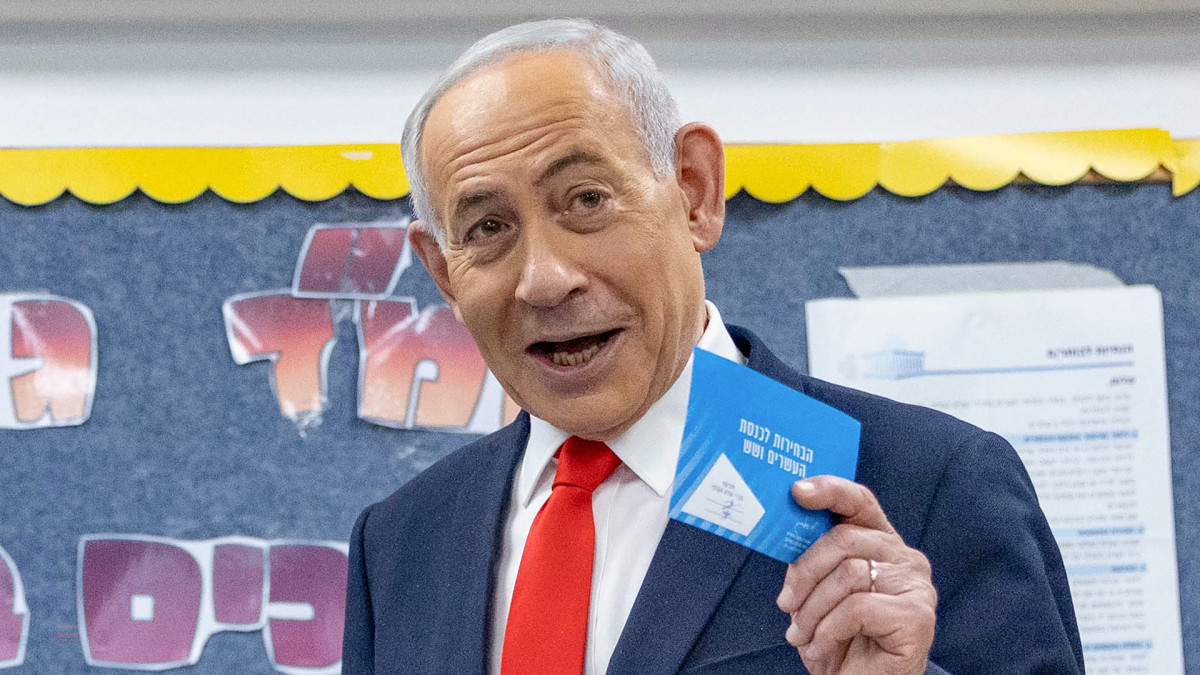
After the latest elections in Israel, it is not clear which bloc can govern the country, but the consequences of the electoral result extend far beyond its borders. The possibility that Netanyahu will remain at the head of the Government, in an interim capacity for a few months, coincides with pressure to resume the war against Iran. Europe faces that uncertainty after bearing an extraordinary energy bill that threatens its industrial competitiveness, strains the budgets of member states, and reduces citizens’ purchasing power.
By the end of September, the member states had spent more than €100 billion extra on energy imports since the start of the war. They have not received more oil or more gas in return, but have simply had to pay more for the same resources. The disruption of maritime traffic through the Strait of Hormuz, a route through which about a fifth of world oil trade passed before the conflict, has been a decisive factor in the spike of international prices.
And that figure does not represent the entire cost of the war. In addition to the import bill, there are public measures to contain energy prices, as well as difficulties faced by industries most exposed to gas and oil prices. All this, without forgetting the effects on inflation, as present in Europe as in, for example, the United States.
In this regard, the European Commission estimated that the higher cost of imported fossil fuels was about €500 million a day. If that premium were to persist for a year, it would amount to €182.5 billion, a figure equivalent to 96% of the European Union’s entire annual budget for 2026.
This energy and economic context is intimately linked to the political deadlock in Israel. Likud, the party of Prime Minister Benjamin Netanyahu, has secured 27 seats and remains the largest in the Knesset, but the governing bloc has been reduced to 53 seats, eight short of a majority. The Jewish opposition, led by Gadi Eisenkot, gathers 48 seats and the Arab parties, another 19. The sum of both would reach 67 seats, enough to form a government, but the ideological differences and commitments made during the campaign make that alternative difficult. For the moment, President Isaac Herzog has asked Eisenkot to try to win a parliamentary majority to become the new prime minister.
“If that premium were to persist for a year, it would amount to €182.5 billion, a figure equivalent to 96% of the European Union’s entire budget for 2026”
The Forecasting Machine assigns a 53% probability that Israel will have to hold new elections before the spring of 2027. The estimate, based on the political scenario as of October 31, reflects the difficulties of building a parliamentary majority. This forecast from the tool used by Agenda Pública shows that the possibility of extending political provisionality for months is sufficiently significant to be included in an analysis of Israel’s foreign policy.
The Continuity of Netanyahu
The first possibility is that Netanyahu can attract some of his opponents. He needs eight additional seats, but those eight seats are not interchangeable. It must be explained well. Avigdor Lieberman, leader of the Israel Beiteinu party and former minister, maintains deep differences with the ultra-orthodox parties, especially over military service exemptions, while Naftali Bennett has built much of his political stance on the need for an alternative to the current prime minister. In order to achieve some kind of agreement, these public commitments would have to be revisited and a number of disputes resolved that go far beyond the distribution of ministries.
The second possibility involves Eisenkot and the Arab parties. As Ruth Ferrero-Turrión explained in her electoral analysis published in Agenda Pública, Arab representation has acquired decisive parliamentary leverage, despite resistance to recognizing it as an interlocutor. Mansour Abbas, leader of Ra’am, also has an important precedent: his party participated in the Bennett-led coalition in 2021. That experience showed that cooperation was institutionally possible, although it also exposed its fragility.
“That experience demonstrated that cooperation was institutionally possible, though it also exposed its fragility”
Now, the problem is more complex because Eisenkot would need to reconcile that support with the positions of leaders like Lieberman, who reject relying on the Joint List. The sum of seats does not automatically translate into a political majority.
Subsequent events after the elections have added another difficulty. Netanyahu and Likud have alleged an alleged fraud related to Arab voting, without presenting evidence of widespread manipulation. The electoral authorities have indicated that results will stand even if specific irregularities are proven. The controversy introduces a dimension that transcends parliamentary negotiations: the political legitimacy of representatives of roughly a fifth of the Israeli population.
There is also a third option: a national unity government that brings together Likud and part of the opposition. It would not be an absolute novelty in Israeli history, accustomed to broad coalitions in exceptional circumstances. But such a pact would raise questions about the executive’s leadership, a possible rotation in the premiership, security policy, and the relationship between the institutions. Eisenkot would have to justify an agreement with the leader he has promised to replace. Netanyahu, for his part, could be obliged to modify the alliances that defined his last mandate.
Until an agreement is reached, Netanyahu retains a decisive institutional advantage: he will continue to serve as prime minister in a caretaker capacity. And that means that losing the parliamentary majority does not prevent him from maintaining responsibilities over national security and foreign policy.
Trump and the Risk of a New War
This continuity takes on an international dimension particularly because of the relationship between Netanyahu and Donald Trump. According to the Financial Times, the Israeli prime minister asked the American president, during a telephone conversation on October 31, to resume attacks on Iran after the United States’ November 3 midterm elections.
“The loss of the parliamentary majority does not prevent Netanyahu from maintaining responsibilities over national security and foreign policy”
Trump has not yet made a decision. Washington is keeping diplomatic negotiations with Tehran open, with Qatar mediating, to explore an agreement that would allow reopening the Strait of Hormuz and advance toward a settlement on Iran’s nuclear program. But the talks face important differences and the possibility of a new military offensive remains on the table.
The relationship between the two leaders raises a political question that deserves attention. Netanyahu has lost the parliamentary majority, but retains the ability to influence Israel’s security decisions and to seek U.S. military backing. Trump, for his part, must decide whether to accompany a new offensive or to pursue the diplomatic track.
The concern over the Iranian nuclear program cuts across much of the Israeli political spectrum and is not limited to Likud. But it cannot be ignored that a large-scale military crisis could alter the negotiations to form a government, shift party priorities, and reinforce the arguments for a national unity executive.
Security and political survival are not necessarily conflicting objectives. They can coexist, though that does not imply that one causes the other.
For Europe, however, the internal motivations of Netanyahu do not change the economic problem. If Israel and the United States decide to launch a new strike against Iran and this triggers another disruption of energy supply, the consequences will be felt in European economies again.
The paradox is that the European Union bears part of the costs of a conflict whose evolution it has limited influence over. No: it does not decide the military strategy of Israel, it does not control Washington’s decisions, and it cannot determine Tehran’s response. But it must confront the consequences of energy market volatility, of trade disruptions, and of higher fuel costs that it still needs to import.
“The paradox is that the European Union bears part of the costs of a conflict over which it has limited influence”
The war against Iran has shown that European strategic autonomy is not only a matter of defense. It also depends on the ability to reduce exposure to decisions taken outside the continent. Renewable energy, the electrification of the economy, and the diversification of supplies take on, in this context, a geopolitical dimension. The less dependent on imported fossil fuels, the less vulnerable will be to new international crises.
A country that could go back to the polls
The Israeli constitutional calendar now sets a sequence of decisions. The results were formally presented to President Isaac Herzog on November 4 and the new Knesset is convened for November 10. Herzog consulted the parliamentary forces and entrusted the formation of a government to the member of parliament he deemed best placed to secure a majority. The first term has 28 days, extendable in certain circumstances, and there are subsequent procedures to explore other candidates. If all fail, the legislation contemplates a new election.
Israel knows well the consequences of this situation. Between April 2019 and November 2022 it held five legislative elections, in a cycle during which the difficulty of building majorities turned provisionality into a recurrent feature of its political system. The experience shows that repeated elections do not necessarily resolve the incompatibilities that prevent forming a government.
“The first mandate has 28 days, extendable in certain circumstances, and there are procedures to explore other candidates”
The forecast from The Forecasting Machine should be read within this mix of factors. The 53% attributed to a new election reflects parliamentary fragmentation and cross vetoes, but it also leaves open the possibility that institutional pressure and security circumstances favor agreements that currently appear difficult. Repeated elections are a real possibility, not a certainty.
As we have analyzed in Agenda Pública based on the reflections of Emma Sky, Israel’s military superiority has not by itself provided a stable security environment. Relations with Iran, the Palestinian issue, and Israel’s position in the Middle East will continue to condition the decisions of any government. The formation of an alternative government would not automatically resolve those tensions, just as Netanyahu’s continuity does not necessarily imply a new war.
But there is a difference between the uncertainty faced by Israeli citizens and the one faced by Europeans. The former will have the opportunity to decide again at the polls if their representatives fail to form a government. The latter do not participate in those decisions, though they can be affected by their economic consequences.
The October 27 elections left Netanyahu without a majority, but not without power. His continuity will depend on parliamentary negotiations that can drag on for months and end in another call for elections. In the meantime, the prime minister keeps open the possibility of a new offensive against Iran with U.S. backing.
Europe has already paid more than €100 billion in additional costs due to the war. If the escalation resumes, the bill could continue to rise. The question is not whether Europeans should decide who governs Israel, something that falls exclusively to their citizens, but how to prevent the European economy from remaining so vulnerable to the military decisions of other countries. Israel can go back to voting. Europe can go back to paying the bill.
