
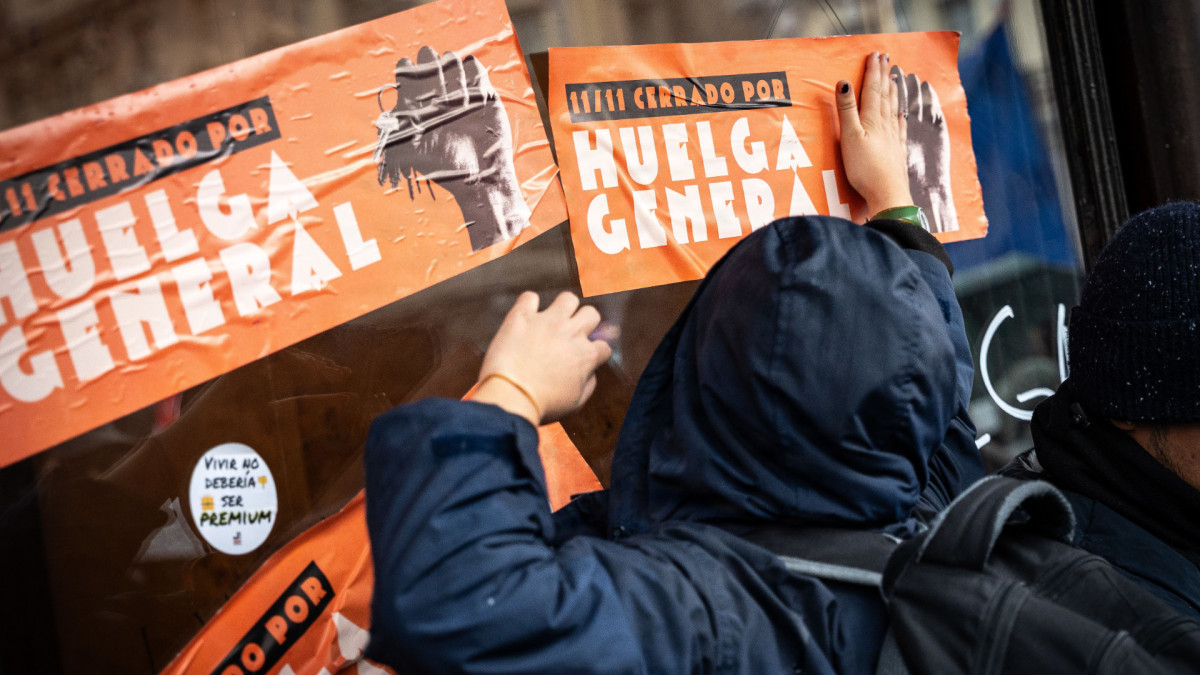
Spain experienced this Wednesday its first general strike with the joint backing of the two major unions, UGT and CCOO, since 2012. As evening fell, each actor had its own turnout figure. The unions spoke of strikes around 90% in the automotive sector and ports, while the CEOE and Cepyme talked of a day of normalcy. The November 11 vote carried something more difficult: who would bear the blame for the housing crisis ahead of the general elections on November 29.
A strike with an agenda
General strikes in a democratic era have served to veto the sitting executives at the time. The 1988 strike was directed at Felipe González, with a UGT led by Nicolás Redondo breaking with the PSOE. The 2002 and 2010 strikes were against José María Aznar and José Luis Rodríguez Zapatero, while the two strikes in 2012 were carried out against the austerity measures of Mariano Rajoy’s governments. In all these cases, the logic was to push back against a government that, as perceived, was legislating against workers.
The general strike day of November 11 reverses that logic. The demands, from wage hikes to rent control, align with the government of Sánchez’s agenda that he could not push through due to existing parliamentary arithmetic. In early October, the PP, Vox, and Junts defeated in Congress the two housing-related decrees. This underscores that it has been an agenda-driven strike. In other words, it is a strike aimed at setting the terms of the conversation, who should respond, and which measures must be approved.
“The unions have spoken of stoppages around 90% in the automotive sector and ports, while the CEOE and Cepyme have spoken of a normal day.”
Looking back, voters punish those in power for failing to resolve their demands through public policies. Until now, , because it is a grievance that hits first of all its own electorate, the youngest and the one most dependent on renting. In this sense, the strike changes that equation by shifting the question and seeking accountability on those who blocked housing measures.
A conflict born from social discontent
The November 11 did not originate at the headquarters of CCOO and UGT. It was propelled by a housing movement that had been pushing all year, which found its peak in the May demonstration in Madrid and found its symbol in the eviction of Maricarmen Abascal. After the decrees were voted on, with the encampment occupying Puerta del Sol, the march “Towards the general strike” drew 70,000 people in Madrid, according to the Government Delegation. It was then that the two major unions decided, under the banner “Wages, housing, and prices,” to call the general strike.
That origin, in turn, undermines the main argument of the right. Antonio Garamendi, president of the CEOE, announced he would challenge the strike on electoral grounds, but the employer association subsequently withdrew the appeal three days later. Consequently, it is hard to present a protest that began in tenants’ assemblies and that has ended up being called by the same unions that previously went on strike against González and Zapatero as a partisan maneuver.
The right’s perspective
The PP has found itself within the frame of the organizers. After the Urda railway accident, which left 69 dead, Alberto Núñez Feijóo urged canceling the strike and warned the unions that, if they did not, they would completely tie their image to Pedro Sánchez. Meanwhile, Santiago Abascal demanded withdrawal with a particular argument: there was no sense in a strike aimed at the opposition. The cost could be greater than it seems for the right, because housing cuts across all blocs. According to a poll by Ateneo del Dato, six in ten voters for PP and Vox supported the rent extensions that their parties opposed voting against. It appears that the right, in addition to clashing with the unions, is also at odds with a portion of its own voters.
“The right, in addition to clashing with the unions, also clashes with a portion of its own voters”
In any case, Vox has understood it better, as it mainly debates about style, and in that sense the day has given it some material, since more than forty arrests had been recorded by early afternoon. The right’s stance always centers on the frame of public order, which allows addressing the working-class voter who shares the discontent without needing to defend large property owners or businesspeople.
The map of a citizen-led strike
The data from the day confirm its own character. The strike was strongly supported where there are shifts, large workforces, and works councils, such as Seat, Nestlé, or the Port of Barcelona, where workers stopped from the night shift. By contrast, it was lower in commerce, hospitality, and dispersed services, which today concentrate the bulk of employment. Asturias, Catalonia, Euskadi, and Galicia, with social movements and region-specific union activity, led the mobilization. Unai Sordo himself had anticipated substantial but uneven support.
Meanwhile, the electrical comparison with 2012 used by the employers is weaker than expected. In fourteen years the productive structure has changed and solar self-consumption has spread, something the grid does not record. Moreover, and this is crucial, measuring this strike in kilowatts is using the wrong instrument. Its success depended on occupying the political and media conversation.
What November 11 decides begins on Friday
The campaign kicks off on Friday the 13th with three strategies at stake. The progressive bloc needs housing to return to the central axis of the debate and for the responsibility for the lack of current measures to fall on those who toppled the decrees. The PP needs to change the subject and find its place. Vox, by contrast, needs the issue interpreted in terms of immigration and public order.
“The progressive bloc needs housing to again be the central axis of the debate and for the responsibility for the lack of current measures to fall on those who toppled the decrees”
Meanwhile, the strike has achieved something that a year ago seemed very unlikely: that the campaign would begin by talking about rents. This strike, however, has a limit: it sets the question, but not the answer. Turning the attribution of responsibilities into votes requires the left to offer a solid proposal, not just a scapegoat. Thus, the open question left by November 11 is whether those who bear the price of rent will be able to identify who voted to keep rents rising.
