
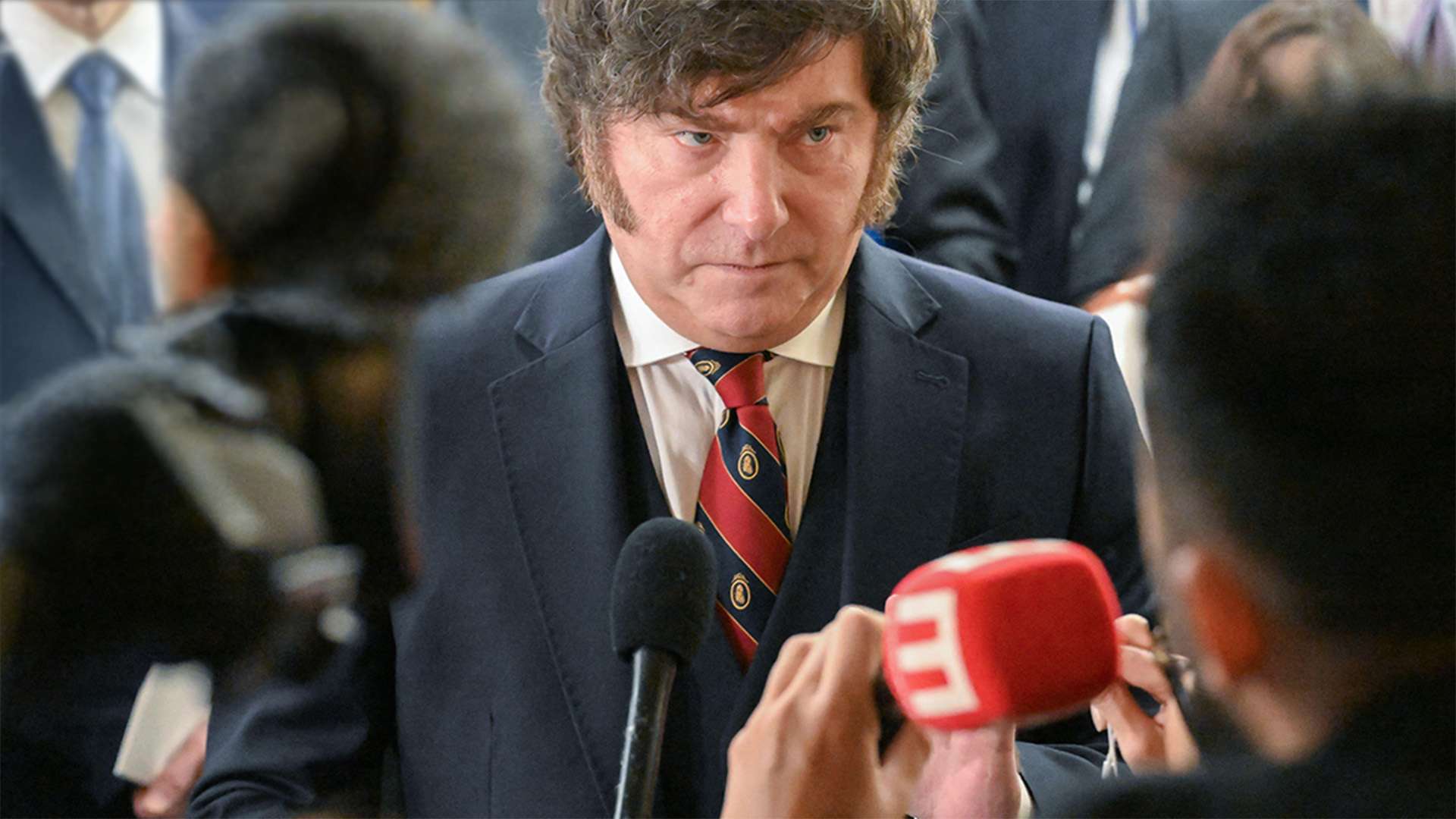
The Argentine leader’s pledge of a smaller state has wavered when it comes to defending free expression.
The December 2026 issue of Reason examines Argentine President Javier Milei’s achievements and what remains on the agenda.

President Javier Milei observed all seven of Argentina’s World Cup matches from the presidential residence, keeping the same jacket for the sake of luck. Yet when Messi and his squad faltered in a way that drew worldwide notice, Milei’s temper flared red.
During a radio interview, the president asserted that the U.S. Democratic Party and the governments of Brazil and Mexico had bankrolled an “anti-Argentina” campaign during the World Cup. Apparently, he believed that nothing less than state authority could vindicate the nation’s sullied honor. On the evening of July 29, Milei issued an emergency decree—bypassing Congress—that authorizes the government to deport or bar entry to foreigners who have “directed hate messages, orally or in writing, or incited violence against the Argentine people as a whole, or against an Argentine citizen, motivated by that person’s nationality,” as well as anyone who has “desecrated national symbols or incited others to do so.” The decree allowed exceptions for “legitimate” political, ideological, and academic criticism, but it gave no direction on how to separate legitimate critique from “hate messages.”
An official statement signed by Milei declared that “in light of recent displays of hostility toward the Argentine Republic and Argentines, the national government reaffirms that the defense of the nation, its citizens and its symbols is non-negotiable. Anyone who attacks the Argentine Republic is not welcome in our country.”
Regrettably, that was not a momentary outburst by a sports fan who momentarily strayed from his principles. Although Milei embraces the maxim “as the state shrinks, liberty grows,” he also appears to view people who disagree with him as legitimate targets for state power.
In a much-anticipated address to the United Nations General Assembly in 2024, Milei offered a bold defense of liberty against collectivism and proclaimed, “we believe in freedom of speech for all.” Since then, however, he has filed multiple criminal complaints against critics, seeking to punish them for their speech. He has done so by attempting to weaponize articles 109 and 110 of Argentina’s penal code, which criminalize “slander or false accusation” and the “intentional dishonor[ing] or discredit[ing]” a person.
The initial wave of defamation complaints went out in May 2025 against three journalists and commentators, including the well-known Argentine historian and journalist Carlos Pagni. According to Milei’s complaint, Pagni harmed his “honor and reputation” by statements that “attributed to me the same conduct as that of the Nazi dictator Adolf Hitler to gain power.” In reality, Pagni did not compare Milei’s ascent to Hitler; he referenced broader global instability and cited Henry Ashby Turner’s Hitler’s Thirty Days to Power to illustrate the peril when world leaders fail to communicate and listen. Milei’s insistence that these remarks equated him with Hitler indicates characteristics ill-suited for a leader who seeks to curb rather than broaden state power.
The other two complaints targeted remarks that were more explicit. One involved Viviana Canosa, a conservative TV and radio host—who had once supported Milei but had become a vocal critic—who used her platform to label the president “authoritarian and despotic,” likening him to “dictatorial leaders” and saying Milei aimed to keep Argentines “enslaved and subjugated.” The second targeted Ari Lijalad, who wrote a lengthy piece on Milei’s tirades against journalists and accused him of treating “anyone who thinks differently as a virus to be eradicated from society—the same rhetoric the Nazis used to justify the murder of millions of Jews.”
Milei has long portrayed journalism as corrupt, “depraved, and violent.” He often launches extended diatribes with the refrain “WE DON’T HATE JOURNALISTS ENOUGH,” accompanied by the hashtag #NOLSALP (the Spanish acronym for the phrase). In remarks at a September conference co-sponsored by Reason Foundation, Milei described journalists as “scumbags with microphones” and “hit men.” In other words, the journalists were already engaged in a harsh mudslinging match with Milei, who himself wields the bully pulpit with gusto. Yet as the media fight with words, Milei has fortified his position with the coercive power of state sanctions.
The complaints against Pagni and Lijalad were eventually dismissed, with judges ruling that the statements in question were opinions or related to public officials. (As of late September, Canosa’s case remained unresolved.) Such expressions receive heightened protection under Argentina’s constitutional right to freedom of expression and Article 13 of the American Convention on Human Rights. To be actionable, the conduct must meet the standard of “actual malice,” a concept borrowed from the First Amendment jurisprudence of the United States.
Despite these judicial defeats, Milei launched another wave of criminal complaints in July 2025, this time targeting five journalists. Two of these complaints have already been dismissed by the courts.
The Milei administration’s willingness to weaponize grievances against the media goes beyond defamation law. In April 2026, a military security agency filed criminal charges for illegal disclosure of political and military state secrets against two journalists who wore smart-glasses to record in the public areas of Casa Rosada, the presidential palace. Milei weighed in by calling the two journalists “DISGUSTING TRASH.” The government then barred previously accredited journalists from the palace, citing a supposed threat to national security.
In May, a prosecutor dropped the case against the journalists, noting that the recordings did not contravene any criminal laws or expose any state secrets.
Milei’s persistent use of legal action, even in the face of a string of losses in court, may still intimidate his critics into self-censorship. In other words, these frivolous defamation proceedings against protected speech bear many of the hallmarks of SLAPPs (strategic lawsuits against public participation), where the cost and delay of litigation are the real penalties and favorable outcomes are unlikely.
Milei’s broader efforts to curb criticism and limit transparency extend beyond the courtroom. In 2024 his government issued a decree broadening exemptions to freedom of information requests and requiring applicants to verify and register their identities. Civil society coalitions have argued that the decree grants public authorities broad and vague discretion to withhold information and creates a chilling effect through fear of retaliation. More fundamentally, the decree clashes with the liberal principle that openness and transparency are essential for a government to remain answerable to the people who empower it.
These moves to quiet dissent and restrict transparency do not necessarily imply that Milei has built an authoritarian regime on par with Argentina’s brutal 1970s–80s dictatorship. Other democratic administrations have similarly weaponized defamation laws to silence opposition and politicized government control of media advertising funds to shape public opinion.
Furthermore, prosecuting individuals for insulting powerful politicians is not unique to Argentina; it is a feature in many democracies, where ordinary citizens lack the protections afforded by Argentine courts for Milei’s critics. Indeed, had some of Milei’s defamation cases been adjudicated by the European Court of Human Rights, he might have prevailed: the court has acknowledged that it may be necessary to shield public officials “from offensive and abusive verbal attacks in the course of their duties.”
In the United States, President Donald Trump has repeatedly attacked journalists and the media, filing billion-dollar civil lawsuits against outlets such as The New York Times and The Wall Street Journal.
Some of Milei’s policies have in fact broadened free expression. His deregulation repealed a law from the era of dictatorship that controlled newspaper access and another that criminalized Argentines who criticized domestic human rights violations in international venues. Although those laws had become largely defunct and unenforceable due to technological and constitutional changes, their repeal sent a clear signal that such rules do not fit with freedom.
Perhaps Milei’s most consequential contribution to the marketplace of ideas is his removal of the rule that barred satellite internet providers from operating within Argentina. This change opened up connectivity for millions of people in remote and rural regions who previously had little or no access, enabling providers like Starlink and others to lay down satellite links across broad swaths of the country. The result is a substantial expansion of opportunities for work, commerce, and the exchange of information and ideas.
Nevertheless, a government that expands people’s capacity to express themselves only to punish those who express themselves in ways the state disapproves of is distorting, not liberalizing, the landscape of ideas.
This pattern is not unique in the history of free societies that advocate limited government. In 1798—just seven years after the First Amendment’s adoption—U.S. President John Adams signed the Sedition Act, which criminalized “false, scandalous, or malicious writing” about the president, his administration, and Congress, all controlled by Adams’s Federalist Party. James Madison, the architect of the First Amendment, condemned the Sedition Act and its overtly partisan enforcement. He argued that punishing critical voices about public officials ran counter to “that right of freely examining public characters and measures, and of free communication among the people thereon, which has ever been justly deemed the only effectual guardian of every other right.”
Fortunately, Argentina’s judiciary has embraced this Madisonian insight by weaving a core portion of First Amendment doctrine into national law. This imported principle now serves as a bulwark against the very leader who proclaimed to the world that “Argentina will not support any policy that implies the restriction of individual freedoms.”
