
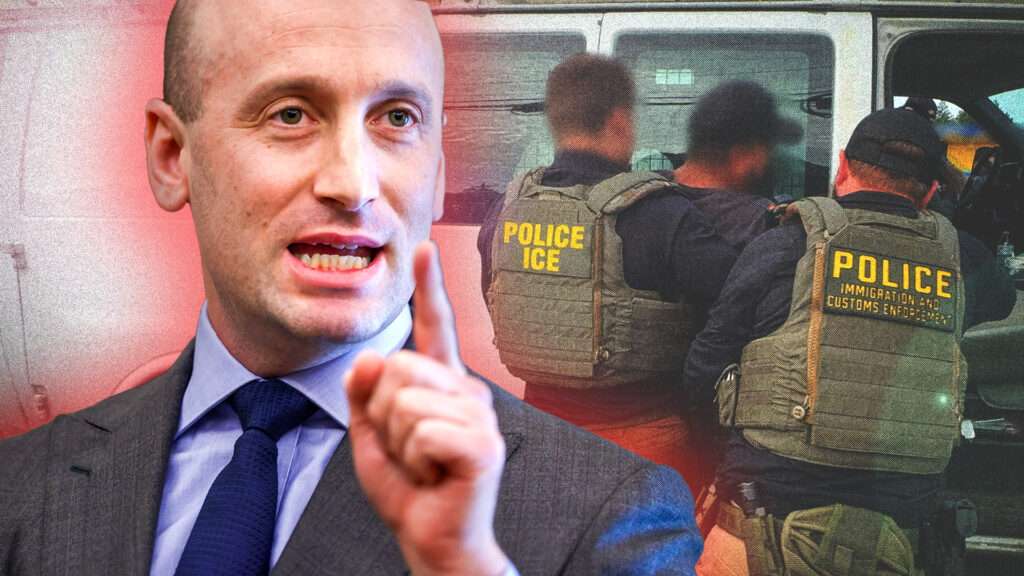
Stephen Miller, long seen as the architect of the administration’s hardline immigration agenda, was elevated to the role of White House chief of staff despite midterm setbacks and Trump’s admission that ICE enforcement may have been too severe.
Toward the end of September, Immigration and Customs Enforcement (ICE) agents descended on southwestern Kansas, a region where a sizable immigrant community underpins the area’s expansive cattle industry.
The operation disrupted daily life. Businesses shuttered, and workers missed shifts, according to a report from a local public radio station. The Kansas Livestock Association described the ICE actions as creating a “massive chilling effect on the legal, documented, skilled workers that put beef on the table,” and warned that the unwanted political interference could push prices upward for consumers. Local officials said they had not been given advance notice of the enforcement efforts.
And perhaps the clearest reaction came from Sen. Roger Marshall (R–Kan.), a Republican representing a state that President Trump had carried easily in 2024.
Rather than praising the ICE crackdown, Marshall issued a statement emphasizing the “mass disruptions to local communities and businesses” and urging the Department of Homeland Security to take immigration enforcement more “responsibly.”
Marshall was defeated in the November midterms as Kansas elected a Democratic senator, Adam Hamilton, for the first time since 1932. The ICE raids in southwest Kansas during the final stretch of the campaign are seen by many as having influenced that outcome.
Here are the county-by-county results from the Kansas Senate race.

The counties along Kansas’s eastern fringe typically carry that blue hue— even in 2024, when Trump carried the state by 16 points, Kamala Harris won the counties surrounding Kansas City and Wichita.
What stands out on the map are the blue patches in the southwestern corner. Hamilton captured Finney, Ford, and Seward counties. That outcome defies expectations, given Trump’s victory in Finney County by a 35-point margin in 2024, and even larger margins in the other two.
Yet that region is precisely where the September immigration crackdown took place. Dodge City, the hub of the state’s livestock and beef industries, is the county seat of Ford County, where voters shifted by 39 points toward Hamilton.
Statewide, Kansas voters swung about 22 points toward Democrats compared with 2024, according to The New York Times. In Seward County the swing was an extraordinary 52 points.
As election analyst Dave Wasserman observes, Trump received roughly 8,700 votes from that portion of the state in 2024. Marshall, the incumbent Republican senator, carried that region by about 900 votes less in that election. Hamilton’s lead exceeded 50,000 votes, so those counties were not decisive—but the shift is dramatic and, as Wasserman puts it, captures part of how Republicans lost the midterm.
“I’m very proud and honored that so many people there cast ballots for me,” Hamilton told The Topeka Capital-Journal. “What they knew was they’d been hurt by the current administration, and even Republicans from that area contacted the president and said, ‘this isn’t OK.’”
That appears to be the message voters sent, though it remains unclear whether the president is listening.
In a Sunday 60 Minutes interview, Trump seemed to acknowledge that his immigration enforcement policy had perhaps gone too far.
“I get very high marks for removing the bad ones,” Trump told interviewer Ross Douthat. “But I suffer because we also displaced people with good jobs.” He later conceded more plainly that his immigration policy “might be too tough.”
But that conclusion clashes with the sole major shift in his administration since the midterm drubbing. Last week, Trump announced that Stephen Miller—widely viewed as the mastermind behind the administration’s aggressive deportation policies—would be elevated to White House chief of staff.
The backlash against Trump’s immigration policies extends beyond Kansas, of course. In a CBS News exit poll from last week, 58 percent of voters said immigration enforcement had “gone too far.”
Nevertheless, what transpired in southwestern Kansas is especially revealing. After witnessing the impact of Trump’s ICE policies up close, even some of the country’s reddest counties shifted toward the Democrats.
