
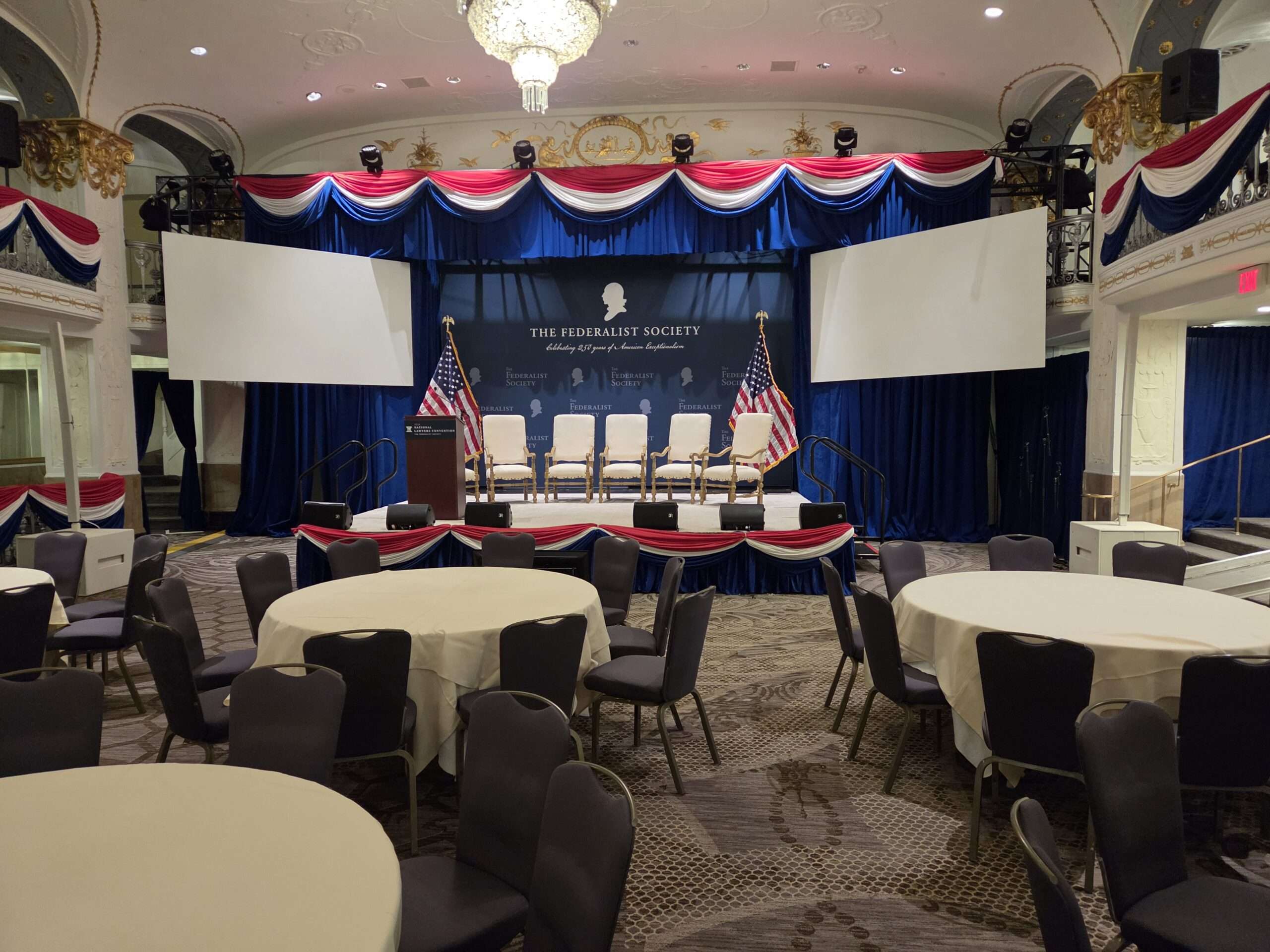
A Retrospective on FedSoc NLC Day One.
The opening day of the 2026 Federalist Society Convention is in the books, and there is plenty to share.
To begin with, it feels good to be back at the Mayflower—at least for those who managed to make it in. Years ago, FedSoc shifted the gathering from the Mayflower to the Hilton, a much larger venue. The organization had simply outgrown the traditional hotel. The downside, naturally, is that the Hilton is far from ideal as a lodging. There were assassination attempts on two Presidents at the “Hinkley Hilton.” There was no shared meeting space, and attendees had to navigate a labyrinth of corridors between sessions. Worse, the rooms were a decade overdue for renovations. We didn’t love it. Yet most of us managed to fit inside.
This year, registration for the national convention filled up almost instantly. I had planned to bring many of my students, but they never made it off the waiting list. Veteran members hung around the lobby hoping for an opening, with no luck. I heard that the Harvard FedSoc chapter organized a gathering for those who could not get in—apparently known as the “shadow docket.” People directed their frustrations at me, as if it were my fault we returned to the modest Mayflower because of my criticisms of the Hilton. I become the scapegoat for everything.
FedSoc will have to decide what to do for next year, the 40th Anniversary of the National Lawyers Convention. We might explore the newly released East Wing Ballroom, provided Judge Leon doesn’t block it! The Gaylord Hotel in Maryland could accommodate everyone, but I still carry the memory of the gala dinner there in 2016. I’ve long advocated for holding the convention outside of Washington, D.C. It would send exactly the right signal. The era when people in D.C. offices could simply stroll by for a few panels is behind us. And with the registration sold out, only those willing to participate in the entire program will attend. Anyone wishing to speak on the program should be prepared to board a flight. I might have suggested Texas as the venue, but that would place us in potentially hostile territory. Perhaps Florida—the “free state”—is our last, best hope.

Secondly, the conference format feels unfamiliar this year. I had grown accustomed to the familiar tempo, and I’m momentarily unsettled. There are no breakout panels. Every session is a “showcase” panel in the Grand Ballroom. The remaining rooms function as overflow spaces with screens to view the programming. The schedule has shifted entirely. The Rosenkranz Debate occurred on Thursday afternoon rather than Saturday noon over lunch. The Bork and Olson Lectures are both scheduled for Friday. And the event wraps up on Saturday at 2:15, roughly three hours earlier than usual. Moreover, in place of lunchtime panels, the second-floor rooms host smaller, more intimate lunches. You could join a table with a judge and eight others to discuss a topic of interest. I sat at Chief Judge Elrod’s table to explore the Lord of the Rings. (Trigger warning for commenters: I have never read any of those books, I fell asleep during the first movie, and have not watched the others.) The conversation was enjoyable! Some judges treat their judicial sinecures like Gollum clings to the ring. So precious.
I can see both advantages and drawbacks to the new approach. On the upside, this format is far less overwhelming. I often left sessions feeling drained by the sheer volume of material. I also found myself convinced I was missing something whenever I committed to a single panel, which often led me to hop between offerings. On the downside, the arrangement limits the number of speaking slots, narrowing opportunities for attendees to choose panels that truly interest them. The practice groups presented a broad spectrum of topical discussions, but there are far fewer speaking slots overall—only a handful each day. That makes those slots prime chances for rising members. Still, for this America 250 celebration, I appreciated the theme centering each panel around a few words drawn from the Declaration. It’s a subject I’ve studied for years, and I still learned a great deal. I doubt we could have sustained the Declaration motif through a breakout format.
Third, there is a noticeably stronger emphasis on students—the lifeblood of FedSoc. I valued that every panel was introduced by a student rather than the chair of the practice group. At the Scalia dinner, the winners of the Feddie student chapter awards were asked to stand. I’m incredibly proud of the South Texas Chapter, and my students Ryan Lanier and Makayla Arthur, for receiving the Hamilton Award for “Most Improved Chapter.” Matthew Weinstein, who served as the UCLA chapter president during the Percival protest, was presented with a Courage Award. And each Soc lunchtime table was hosted by a student chapter leader.
We should never forget that FedSoc began as an initiative by a cadre of law students. The older generation (myself included) should continually offer these sorts of chances to the younger. Not long ago I met Will Scharf at the Mayflower, and today he serves as White House Counsel. I could say the same about many current judges and other officials I encountered when I was a student. Indeed, some of today’s judges hosted me as a Professor at their chapters! (In 2033, I’ll be 49.) Everything that rises must converge.
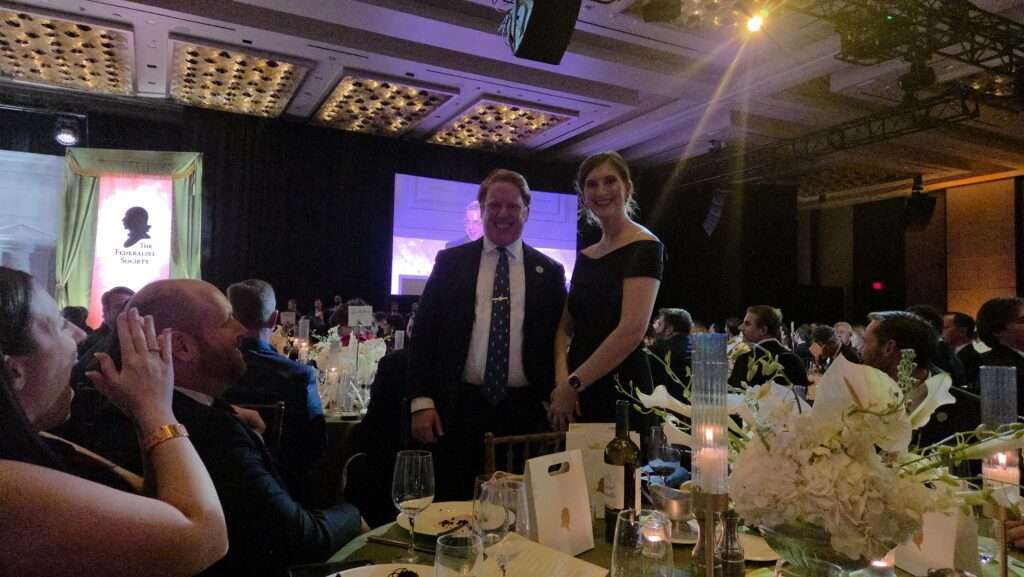
Sixth, I was somewhat anticipating a somber atmosphere at the Mayflower in light of last week’s election. I recall how the 2008 convention carried a mood akin to a funeral. There are ongoing efforts to address the losses of Attorneys General in Texas, Ohio, Iowa, and Kansas, with other states shouldering a heavier load. Lawyers in Austin can seek safe havens in Baton Rouge, Jackson, St. Louis, Nashville, Tallahassee, Montgomery, and other cities. I am presently researching intervention theories on both the plaintiff and defendant sides, admissions of error in criminal cases, and standing for state legislators and the state senate. The agenda has shifted.
Seventh, one feature I especially value about the National Convention is that practical matters happen right in the hallways. There is a strong push to do everything possible to advance the remaining judicial confirmations. These aren’t exactly the midnight judges of the departing Federalist Party, but the mindset is similar. There’s broad consensus that Judge Rudofsky was treated unfairly. I echo everything Rob Luther wrote in his Arkansas-op-ed. There is also a concerted effort to help Elliot Gaiser reach the finish line. It would be a waste if that seat went to James Talarico. A quip about cutting off your nose to spite your six-gendered face aside. And then there’s Todd Butler. Had the election turned out differently, things might have looked different, but he is on a path toward confirmation. I hope Butler proves me wrong—and he’ll have a swift opportunity to do so. The January en banc session includes a major 922(g) case and a challenge to Texas’s social media law. As for the new Eighth Circuit nominee, Cody Hiland, there is a lot of ground to cover to prove many people wrong.
More to come on Day #2.
