
Wary immigrants confronted by underqualified agents and insufficient due process are choosing to depart the country on their own terms.
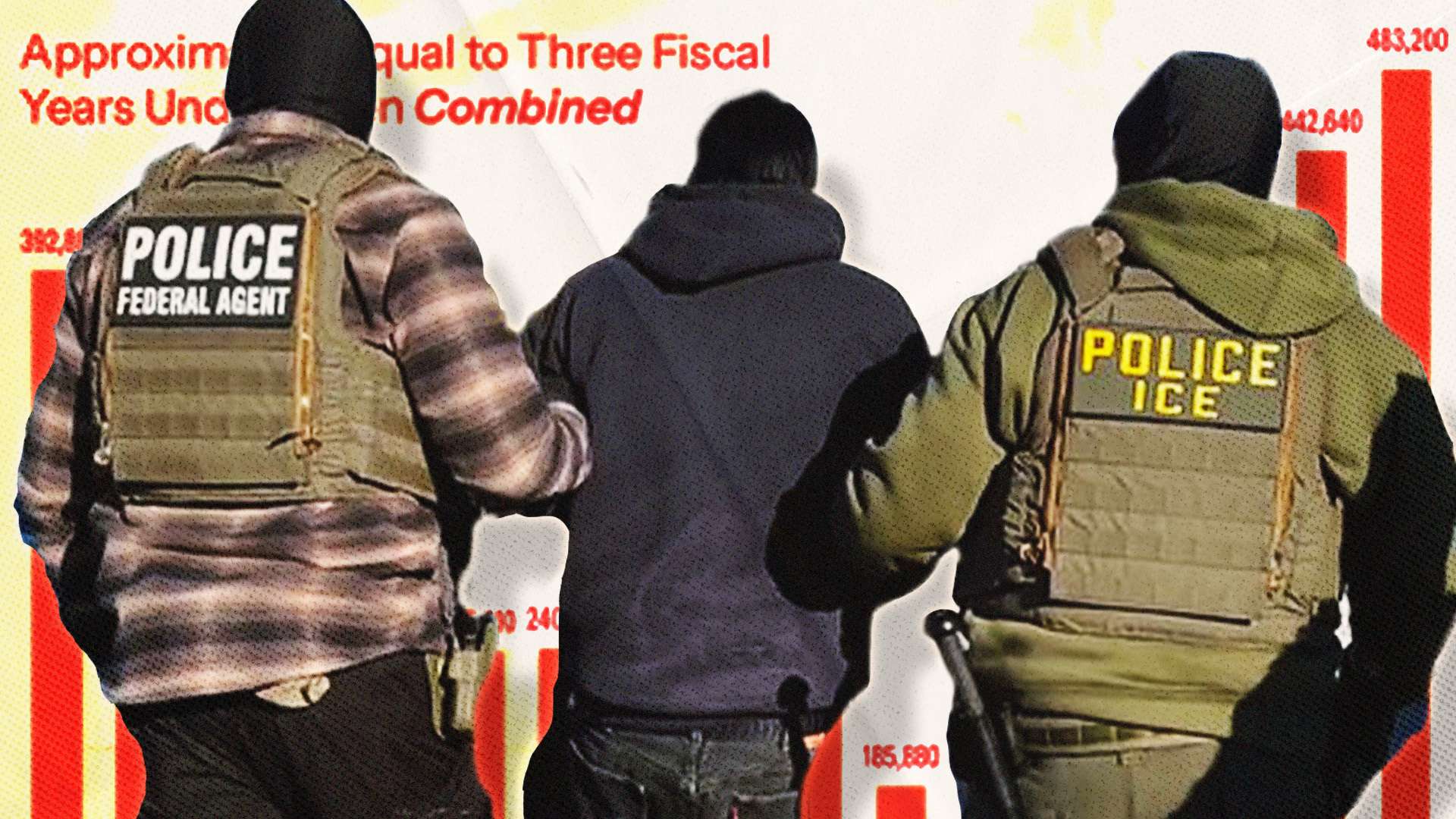
On Thursday, the Department of Homeland Security (DHS) announced that in FY 2026, Immigration and Customs Enforcement (ICE) “set a historic high for either deportations or arrests in a single fiscal year,” reporting “more than 491,000 arrests and more than 483,000 deportations.”
ICE asserted that its FY 2026 figures alone outstripped the deportation and arrest totals accumulated during the entire Biden administration. In fact, internal ICE data—obtained through the Freedom of Information Act by the Transactional Records Access Clearinghouse (TRAC), a nonpartisan data research outfit—show that FY 2026 recorded the highest deportation level since FY 2009, when, under President Barack Obama, ICE removed 489,251 people.
In a statement, DHS Secretary Markwayne Mullin credited President Donald Trump’s “leadership” for empowering the agency to “target and remove illegal aliens.” Yet the agency’s own data indicate that it conducted fewer removal operations during the Trump years than in earlier periods. ICE can maintain high deportation numbers even with fewer overall operations because more migrants are choosing to self-deport or are turned away at the border.
In July and August, voluntary departures and voluntary returns—removal processes that let illegal entrants leave the U.S. of their own accord without a removal order or “related immigration consequences”—comprised 37 percent of all deportations, compared with the first three months of the Trump administration, when they accounted for “less than 5 percent.” In FY 2026, immigration judges issued 11 times as many orders for voluntary departures as in FY 2024.
ICE’s deportation tallies—which include methods such as voluntary departures, withdrawals of applications for admission, and voluntary returns that permit reentry—are typically aggregated under deportations. The all-encompassing figure may play well with the president’s supporters, but it masks the climate of fear and illiberalism driving the Trump administration’s deportation numbers.
ICE set a goal to recruit 10,000 new officers and agents within a year. To achieve this, the agency has lowered hiring standards, sending prospective personnel to enforce Trump’s immigration agenda with minimal training, often before their background checks are finished. On Tuesday, The Washington Post reported that a review of a “small fraction” of the 12,000 recent DHS hires found “at least 19 officers who had faced past misconduct allegations or criminal charges, or had other red flags,” including at least six cases in which officers were “fired or decertified, or resigned under threat of dismissal.”
On Wednesday, The New York Times reported that David Brouillette—the rookie ICE officer who fatally shot a Colombian immigrant in Maine in July—carried a “record of deep-seated anti-immigrant hostility, especially against Colombians.” Despite the documented concerns about Brouillette, he was “fast-tracked through a preliminary vetting process” and “allowed to skip ICE’s full training course in Georgia.” The Times reported that “at the time of the shooting in Maine,” ICE had not yet reviewed Brouillette’s background report, so there was no indication of red flags that would have flagged him as undesirable as a law enforcement officer.
Being shot or beaten by unaccountable federal officers is one risk. Immigrants must also reckon with the possibility that they could be deported to a third country or secretly transferred out of state without notice to their loved ones or legal counsel.
Between state-sanctioned violence and a peaceful return on their own terms, it’s hardly surprising that many migrants would opt to leave the U.S. voluntarily rather than risk becoming another victim of the Trump administration’s policies.
Exit polls from NBC News and CNN indicated that Trump’s immigration enforcement tactics were unpopular with midterm voters. Yet the president appears prepared to press forward with his approach. After hinting at the possibility of an amnesty deal with the incoming Democratic-led Congress, Trump told reporters on Wednesday that there would be “no amnesty,” and that he hadn’t “told Stephen Miller,” the architect of his immigration program and the incoming White House chief of staff, to “make any changes to the administration’s efforts to deport millions.”
Beyond partisan rhetoric, Democrats have shown little sign they can act as a shield against the Trump administration’s immigration enforcement agenda. Trump could veto any bill endorsed by a Democratic-led Congress, and two years of a Republican majority have left ICE and the border agency with more than $152 billion in taxpayer funds that remain unspent between ICE and Customs and Border Protection.
Nevertheless, the incoming Congress could use its funding powers to rescind the money that backs ICE’s intimidation campaign.
