Interest-rate caps push high-risk borrowers toward costlier and riskier credit options.
Even amid sharp partisan divides, there are ideas so ill-conceived that they earn backing from both sides of the aisle. That describes the proposal to let the government set a ceiling on the interest rates charged by credit-card issuers. The policy may appear to aid indebted consumers, but in practice it would shut off legitimate credit for riskier borrowers and could push many toward lenders—some operating outside the law—who demand higher prices. In short, it’s a policy so unwise that it secures bipartisan support.
Bipartisan Economic Idiocy
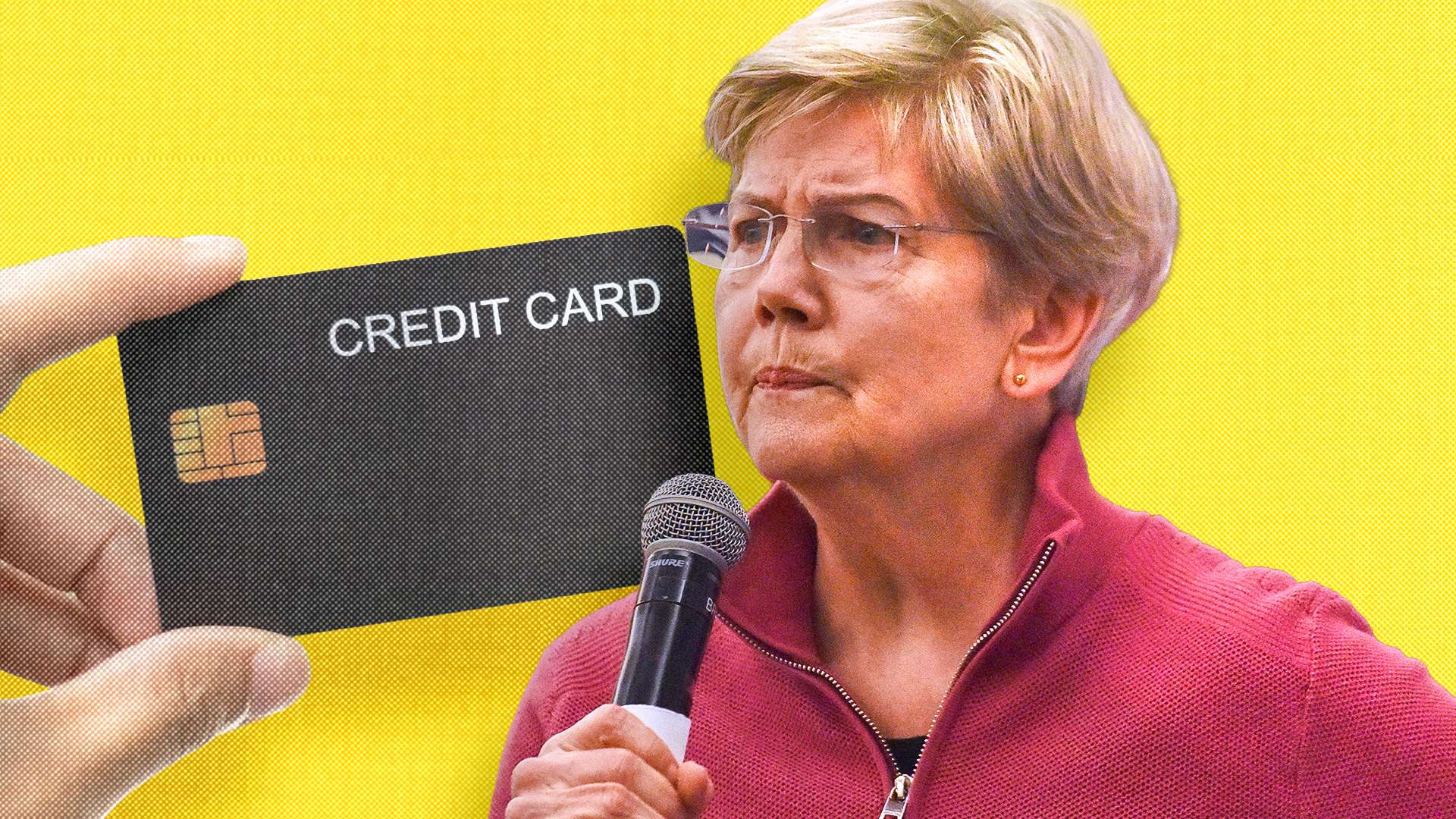
“President Trump himself said that he wants to reduce interest rates on credit cards to 10 percent,” Sen. Elizabeth Warren (D–Mass.) told CBS’s Margaret Brennan on Sunday. “I got the bill, I’m ready to go.”
Indeed, in January, President Donald Trump posted on Truth Social, “Please be informed that we will no longer let the American Public be ‘ripped off’ by Credit Card Companies that are charging Interest Rates of 20 to 30%, and even more….Effective January 20, 2026, I, as President of the United States, am calling for a one year cap on Credit Card Interest Rates of 10%.”
The two ostensibly adversarial politicians discussed possible cooperation on the issue earlier this year, though no concrete steps have materialized. Their flirtation over a shared fondness for populist economic rhetoric raises the question of whether this issue might temporarily bridge political divides.
And the notion of capping credit-card interest rates is truly misguided, unless the aim is to restrict access for higher-risk borrowers and push them toward pricier options like payday lenders and loan sharks. We do not have to guess about the consequences; there is substantial evidence that attempts to forcibly reduce borrowing costs can cut people off from legitimate credit.
In 2021, the Federal Reserve Board published a study by Gregory Elliehausen, Simona M. Hannon, and Thomas W. Miller Jr. that examined the effects of a 17 percent cap in Arkansas. They found that “consumer finance companies, traditionally a source of credit for nonprime consumers, do not have offices in Arkansas because, being subject to the usury ceiling, they cannot profitably lend to risky consumers.” Because of its impact on riskier borrowers, the cap was loosened for banks to “allow consumers to escape restrictive effects of the low Arkansas rate ceiling.” Even so, “results of our analysis suggest that nonprime consumers in Arkansas were rationed” in their access to credit.
Notably, the paper described the 17 percent cap as “very restrictive.” The current consideration of a 10 percent cap by politicians from both major parties would be even tighter and would likely further restrict access to credit.
‘An Interest Rate Cap Does Not Make Loans Less Expensive; It Makes Loans Less Available’
“A federal-government-imposed cap on credit card annual percentage rates (APRs) as severe as 10 percent would likely upend the credit card industry’s current business model,” warned Paul H. Kupiec, a senior fellow at the American Enterprise Institute, in a report exploring the very idea earlier this year. “Issuers would cancel most existing near-prime and subprime accounts. While some issuers might offer current cardholders new terms with higher fees and collateral requirements, many issuers would simply cancel accounts for consumers with weak credit scores.”
Or, as Miller, a finance professor at Mississippi State University, testified before the U.S. Senate Committee on Banking, Housing, and Urban Affairs in 2021, “an interest rate cap does not make loans less expensive; it makes loans less available.”
Some proponents of rate caps argue that this outcome isn’t necessarily bad. They contend that the poor borrow themselves into worse situations and that restricting access to credit would shield people from their own misjudgments.
But that isn’t how markets operate. If individuals need to borrow for essential reasons or personal desires, they will bypass obstacles of convenience and legality to obtain funds. If they do locate a lender—and they often do—they typically pay more for that access.
Credit carries a price, and those prices do not move freely without meaningful consequences merely because policymakers wish it. Either borrowers and lenders arrive at mutually acceptable terms, or consumers are steered toward alternatives that are riskier and more expensive.
Driving High-Risk Borrowers to Expensive and Sometimes Illegal Lenders
“Consider the tough, life-impacting choices consumers must face when they lack access to credit,” Miller added. “They might delay seeking medical care or dental treatment, for example; they might skip buying essential school supplies for their children; they could postpone maintenance on their home or vehicle, or even bounce a check to cover a utility bill. Some may turn to illegal loan sharks for the credit they need.”
There is substantial backing for these fears. In March of this year, Julian Morris, a senior scholar at the International Center for Law and Economics, noted that after Japan tightened rate caps under the 2006 Money Lending Business Act, consumer-finance balances fell sharply while illegal lending expanded. Some illicit lenders reportedly charged rates as high as 10% weekly—an APR of roughly 14,104%.
South Korea’s experience mirrored this pattern, Morris continued. “After steadily reducing the statutory maximum rate to 20% by 2021, one study estimates that a single 2018 rate cut pushed about 659,000 borrowers into informal or illegal credit channels.”
That does not mean all higher-risk borrowers end up with loan sharks. Markets adapt, and there are already legitimate alternatives to credit cards, including installment loans, payday lenders, and buy now, pay later (BNPL) plans. BNPL tends to be the least expensive option for those who qualify, often funded by retailers, but its use is limited—best suited for small purchases. Other legal credit sources can cost as much as or more than credit cards.
Understandably, people are drawn to the notion of politicians waving legislative magic to lower prices, since interest rates are the price of borrowing money. But lenders aim to earn profits, and the prices they set reflect the risk associated with different borrowers and the likelihood of default. Forcing credit-card companies to reduce rates does not reduce the cost of riskier borrowers; it simply deprives them of credit.
Credit carries a price, and those prices do not budge without real consequences just because politicians wish them to. Either let borrowers and lenders agree on terms, or drive consumers toward alternatives that are riskier and more costly.