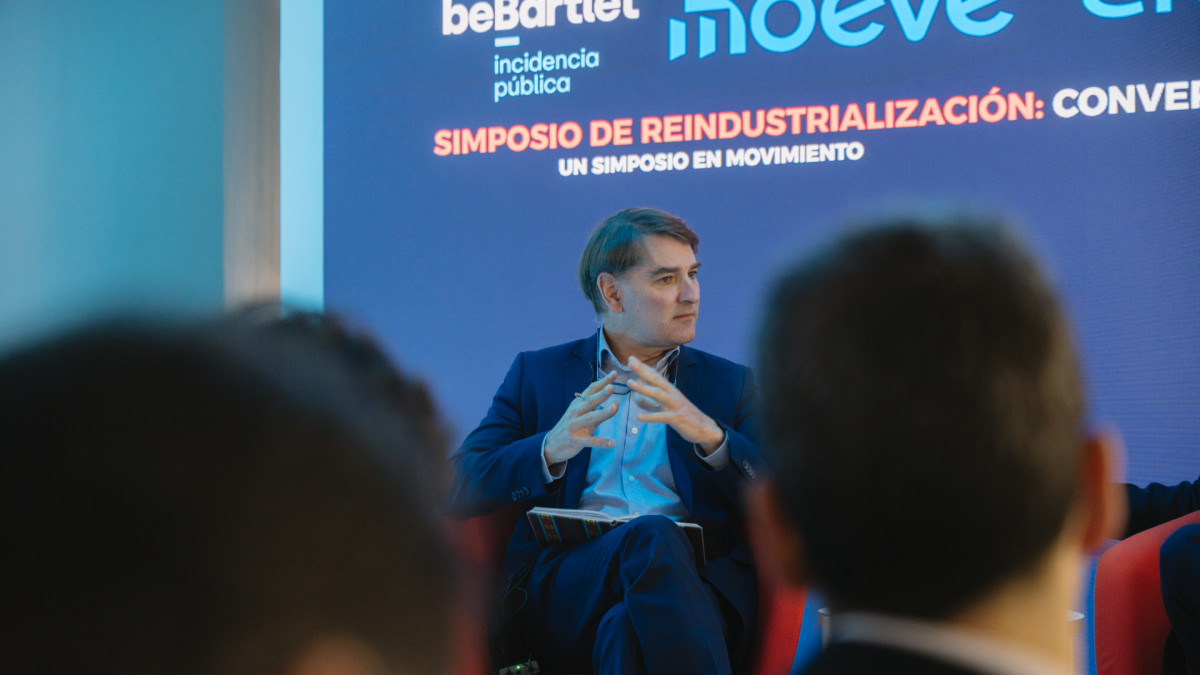
The idea that the best industrial policy is the one that does not exist has been surpassed by an international reality in which wars, disruptions in supply chains, and the use of tariffs as instruments of geopolitical pressure have placed productive capacity at the center of strategic priorities. This is the stance of Manuel de la Rocha at the Reindustrialization Symposium, where he explained that although reindustrialization has been a national bet of the Pedro Sánchez government from its inception, the transformation of the global scenario has required adapting its tools and moving toward a more active industrial policy.
With extensive international experience and linked to Sánchez’s project since its beginnings, De la Rocha framed this evolution around the need to strengthen economic security and strategic sovereignty, especially in the face of the risks posed by dependence on other countries for access to critical supplies. A concern that, from his perspective, must be accompanied by a policy capable of transforming the Spanish productive fabric, broadening industrial activity to new territories and taking advantage of the opportunities opened by the energy and technological transition to generate high-quality employment.
The five levers of the Government’s industrial strategy
As he reviewed the main actions undertaken by the Government, De la Rocha identified five major levers that have guided its industrial policy, beginning with the energy transition, to which he attributed a large part of the improvement in Spain’s competitive position. The deployment of renewables, whose share in electricity generation stood at about 60%, has helped reduce dependence on fossil fuels and improve energy price competitiveness relative to economies such as Germany or France, a benefit he considered particularly relevant for attracting new industrial investments.
“The deployment of renewables, whose share in electricity generation stood at around 60%, has contributed to reducing dependence on fossil fuels”
The public-private collaboration constitutes another pillar of this strategy, whose development has been closely linked to the leveraging of the Next Generation EU funds. De la Rocha highlighted in particular the twelve Strategic Projects for Recovery and Economic Transformation (PERTE), through which investments have been channeled toward activities deemed strategic, from semiconductors to the circular economy, with special attention to the electric vehicle.
In parallel, the Government has developed new public investment instruments, including the Spanish Society for Technological Transformation (SETT), the Co-Investment Fund (FOCO) and the Spain Grows Fund, designed to facilitate financing of strategic projects. In this framework he also placed the Government’s stakes in companies such as Telefónica and Indra, justified by the need to protect essential corporate assets for the country’s economic and technological autonomy.
The third lever, focused on innovation, has translated into an increased effort in research and development, which De la Rocha estimated at around €26 billion annually and whose ability to mobilize private resources he considered fundamental. This push has allowed launching new technology support programs, accompanied by regulatory reforms such as the Science Law, with which the Government aims to consolidate a more favorable environment for developing innovative capabilities.
Training and the retention of talent also occupied a prominent place in his remarks, especially due to the importance he attributed to reforming vocational training to meet industry needs. In this regard, he highlighted the creation of 400,000 new places, the expansion of dual vocational training and the establishment of centers of excellence, initiatives aimed at bringing the educational system closer to the realities of the productive fabric and improving job placement opportunities.
As the fifth lever, De la Rocha pointed to security and defense, an area where the Government has sought to turn its international commitments into an opportunity to strengthen the national industry. The increase in defense spending to 2% of GDP has been accompanied, he explained, by a techno-industrial plan designed jointly by the Defense and Industry sectors, which includes the promotion of leading companies capable of mobilizing entire value chains and generating skilled employment.
“The Government has sought to turn its international commitments into an opportunity to strengthen the national industry”
To these measures, he added transversal reforms that have accompanied the industrial strategy, including labor legislation, the Startups Law, and changes to the insolvency framework, aimed at facilitating business activity and improving investment conditions. As evidence of results, he highlighted Spain’s growing appeal to international investors, ranking as the second European Union country in greenfield projects, referring to new plant investments.
De la Rocha at the beBartlet headquarters in Madrid.
The European response to the loss of competitiveness
The diagnosis of the Spanish industry gave way to a reflection on the difficulties facing the European economy and the obstacles that continue to condition the implementation of the recommendations contained in the Draghi and Letta reports. De la Rocha acknowledged that many companies confront a particularly challenging situation, aggravated by the rise in energy costs derived from international conflicts and supply disruptions associated with the war in Iran and the closing of the Strait of Hormuz.
Although he considered that Spain enjoys a relatively more favorable position thanks to its energy structure, he argued for maintaining support measures to cushion the impact of costs on industrial activity, including extending toll exemptions and certain reductions in energy taxation.
Beyond the immediate difficulties, he identified the core European challenge as the loss of competitiveness against the United States and China, a correction that requires deepening the Union’s economic integration. In this sense, he defended strengthening the internal market so that companies can take advantage of economies of scale, through greater regulatory harmonization and simpler administrative procedures, explicitly distinguishing this objective from a deregulation agenda.
“Beyond the immediate difficulties, the main European challenge lies in the loss of competitiveness relative to the United States and China, which correction requires deeper economic integration of the Union”
The integration of capital markets, in his view, is another essential reform, given that European financial fragmentation continues to hinder companies from finding sufficient financing within the Union and encourages some investments to move to other markets. De la Rocha urged moving toward a more liquid and accessible financial environment, where initiatives like Finance Europe and the development of common debt instruments help channel European savings toward productive projects.
The availability of European funding will also be decisive to sustain the technological and industrial bet, especially at a moment when negotiations over the next Multiannual Financial Framework face significant difficulties. In this context, he advocated the creation of the European Competitiveness Fund as an essential instrument to mobilize investments and reduce the technology gap with major international economies.
Trade policy must also assume a more prominent role in protecting European productive capacities, particularly in sectors subject to intense external competition, such as steel and automotive. De la Rocha defended a more agile use of safeguard instruments and trade quotas, along with mechanisms such as the CBAM, whose application he considers necessary to prevent differences in climate requirements from translating into competitive disadvantages for European producers.
Regarding relations with China, he advocated for a strategy that allows correcting trade asymmetries and reducing dependence on single suppliers, while preserving space for negotiation and economic cooperation. This approach aligns with the European proposal for the Industrial Accelerator Act, identified as an opportunity to articulate a common industrial policy in which the criteria Made in Europe and the investment conditions contribute to strengthening European production, keeping the sustainability objectives of the Green Deal as part of the competitiveness strategy.
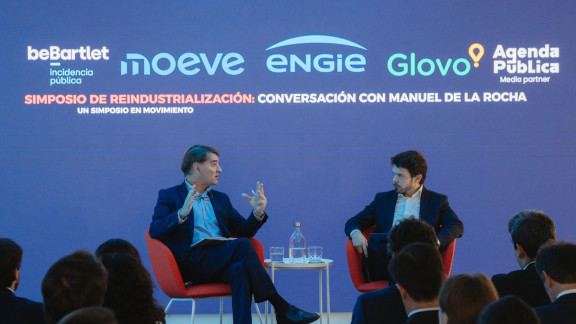
Manuel De la Rocha and Nacho Corredor during the on-the-move session of the Symposium.
November 29 and the future of Spain’s reindustrialization
Ahead of the November 29 election, the Secretary of State argued that the continuity of industrial policy is one of the central questions at stake, since the decisions taken in the coming years will condition Spain’s ability to seize the opportunities offered by the European transformation of the economy.
From his viewpoint, the Government’s strategy, based on promoting a clean and competitive industry that strengthens economic sovereignty, stands in contrast with other approaches that give greater prominence to deregulation or to reducing labor costs, and that maintain a closer link to fossil fuels. This difference situates itself within a broader debate about the future of the European economic model, whose preservation depends, in his view, on the capacity to protect the productive fabric in an increasingly fragmented international landscape.
“The Government’s strategy contrasts with other approaches that place greater emphasis on deregulation”
De la Rocha expressed confidence that Spain starts from a favorable position to play a significant role in this new phase of reindustrialization, thanks to the availability of renewable energy and to its technological and human capacities, which, together with the development of advanced infrastructures, have strengthened its appeal as an investment destination.
“I believe Spain has essential assets that not all countries possess,” he said, convinced that exploiting these advantages requires maintaining a sustained industrial commitment over time that allows the country to take a leading role in transforming the European economy.
In partnership with: