
Republicans decry the system as needlessly tangled and reminiscent of voter fraud. Yet for the third time in six years, Alaskans disagreed.
With more than 95 percent of ballots counted, the former Democratic representative Mary Peltola appeared poised to secure Alaska’s U.S. Senate seat, defeating the sitting Republican senator, Dan Sullivan.
Nevertheless, the broader verdict reflected a stronger endorsement for maintaining Alaska’s ranked-choice voting framework.
According to the Alaska Division of Elections, once all precincts had reported as of November 14, supporters of preserving the system outpaced its opponents by more than seven percentage points.
This marks the third occasion in six years that Alaskans were asked to weigh in on ranked-choice voting. Each time, the voters opted to keep it, and this latest result stands out as the clearest affirmation.
The outcomes imply that Alaska favors ranked-choice voting, and candidates contesting in the 49th state should operate within its rules rather than pushing for a repeal.
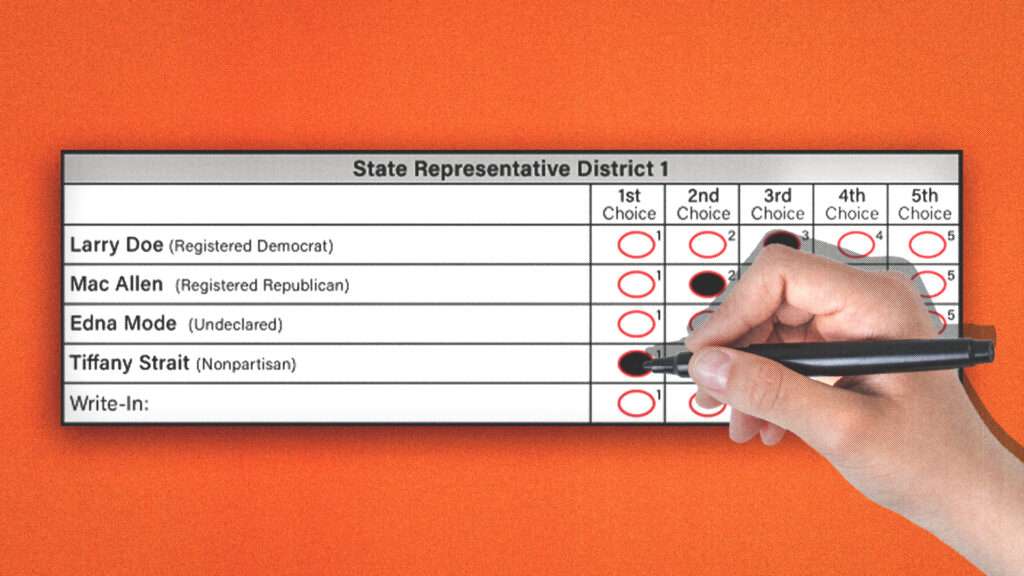
In November 2020, Alaska narrowly approved Ballot Measure 2, introducing two major shifts for future elections. First, it replaced partisan primaries with a single, nonpartisan primary in which all candidates run, with the top four advancing to the general election. Then, in the general election, voters would rank those four candidates in order of preference; if no candidate achieved an outright majority, the lowest vote-getter would be eliminated, and their ballots would be redistributed to the voters’ second choices. This process would continue until one candidate surpassed 50 percent.
Immediately, controversy arose: the right-leaning Alaska Independence Party sued, arguing that ending traditional primaries deprived parties of selecting their own nominees.
The Alaska Supreme Court upheld the law. “The nonpartisan open primary does not burden a party’s ability to choose its standard bearer,” wrote Justice Dario Borghesan, and furthermore, “political parties do not have a right to a State-run nominating process.”
The new law’s first test came in 2022: Republican Rep. Don Young died in March of that year, opening Alaska’s sole U.S. House seat for the first time since 1973. Dozens of candidates pursued the vacancy, including Peltola and former Governor Sarah Palin.
But rather than embracing the new framework, Republicans voiced complaints. “It’s bizarre, it’s convoluted, it’s confusing, and it results in voter suppression,” Palin told CPAC Texas that year. “It results in a lack of voter enthusiasm because it’s so weird.”
Palin wasn’t alone in her disdain. “Ranked-choice voting is a scheme to rig our elections,” Sen. Tom Cotton (R–Ark.) wrote in 2020, arguing its primary aim was to push Republicans into electing Democrats.
After Peltola won the special election, Palin argued that the outcome stemmed from voter confusion, describing ranked-choice voting as an “experiment” that was “crazy, convoluted,” and “confusing,” and she hoped Alaskans would “learn from this voting system mistake and correct it in the next election.”
In fact, after losing a second race to Peltola, Palin was the first to sign a petition seeking to repeal ranked-choice voting.
“We stand for the Alaskans who felt misled, for those who found the [ranked choice] ballot confusing, and for everyone who believes in the sanctity of the straightforward voting process,” said Phil Izon, head of Alaskans for Honest Elections, the coalition behind the repeal effort.
In 2024, Alaskans defeated the repeal, but by the narrowest of margins—50.1 percent to 49.9 percent, even tighter than the vote to adopt it initially.
Boosted by what they perceived as weakened support for the system, opponents pressed forward once more, this time with far more prominent backers.
President Donald Trump described ranked-choice voting as “corrupt” and argued that it “shouldn’t be allowed in our Country and will, hopefully, be repealed in the November Vote!”
“It is time to bring back a system that puts the voter first. One person, one vote. The candidate with the most votes wins. That’s how our democracy was designed to work,” wrote Alaska Gov. Mike Dunleavy. “I believe when given the chance, we will return to a system that is fair, understandable, and grounded in trust.”
The Alaska Republican Party adopted a resolution in support of the initiative.
Elon Musk, having contributed around $446 million in the cycle, added $1.5 million to a group backing repeal.
Yet despite heightened support for repeal, the measure was defeated by a wide margin, suggesting that ranked-choice voting is here to stay in Alaska.
If anything, Republicans would be wise to embrace it: despite Cotton’s assertion that its purpose is to disenfranchise Republicans, Lisa Murkowski secured reelection to the U.S. Senate in the same year Palin lost her House bid. And in 2024, Peltola lost her seat to Republican Nick Begich III, who placed third in 2022. With the race ultimately decided by ranked-choice, Begich looks likely to prevail again this year as well.
“Alaska’s election system has won three times in a row. The message from voters is clear: it’s here to stay,” said Meredith Sumpter, president and CEO of FairVote, which backs ranked-choice voting, in an emailed statement. “That’s because ranked-choice voting and open primaries are delivering for Alaska. Voters get more choice, elections are more competitive, and candidates need majority support to win elections.”
