
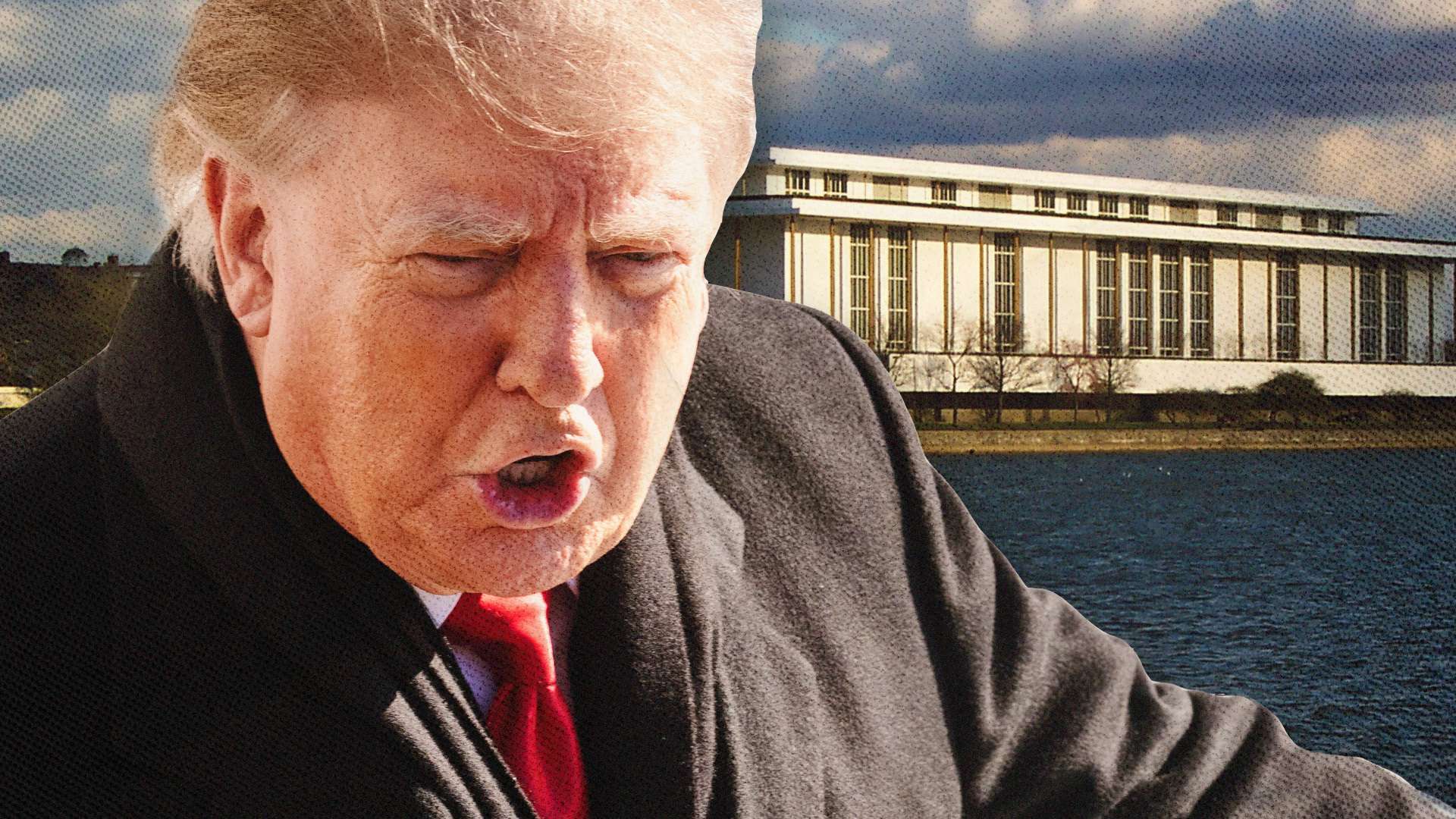
Despite broad public disapproval of his fixation on monumental projects, the president persists in urging Americans to acknowledge his “talent” for producing monuments to his own vanity.
On the eve of the Republicans’ rout in this month’s midterm elections, President Donald Trump spent nearly an hour addressing reporters, standing before the Lincoln Memorial Reflecting Pool. The remarks encapsulated Trump’s politically tone-deaf obsession with self-promoting construction schemes, a preoccupation that endures even as polls show Americans broadly disapprove of such displays.
Although his November 2 appearance was his last public chance to lay out why voters should back his party, he opened with a twenty-minute treatise on his efforts to restore the reflecting pool, dwelling at length on algae, piping, leaks, and lining. He quipped that “we’re giving serious thought to changing the name to the Trump Reflecting Pool,” nodding to his earlier bid to rename the John F. Kennedy Center for the Performing Arts.
Later, after firing a few broadsides at Democrats, Trump circled back to the reflecting pool topic. He also pointed to his “brand-new helipad,” the White House ballroom, and his plans to renovate the East Potomac Golf Links, establish a National Garden of American Heroes in West Potomac Park, and construct a “triumphal arch military complex” stretching from the Lincoln Memorial to Arlington National Cemetery.
According to polling by the Associated Press, midterm voters’ top concerns were “the economy” and “the state of democracy.” They also frequently cited the cost of living and government corruption. Yet in the moments just before Election Day, Trump appeared more focused on praising himself for beautifying the capital by erecting monuments to his ego—projects that have not earned him the gratitude he believes he deserves.
Last July, a Washington Post/Ipsos poll asked respondents how they felt about three of those projects: the ballroom, the reflecting pool, and the triumphal arch. Fewer than a third described themselves as “enthusiastic” (12 percent) or “satisfied” (19 percent), while nearly two-thirds were “dissatisfied” (27 percent) or “upset” (38 percent). About a quarter thought Trump was trying to “make Washington more beautiful,” while 51 percent said he had “a different goal” and the rest were unsure.
A Reuters/Ipsos survey conducted in mid-September found that 67 percent of Americans believed “the creation and renovation of national monuments in the Washington, D.C. area” should be either “a low priority” or “not a priority” for the president. In an Associated Press/NORC poll later that month, 68 percent said Trump had “gone too far” in “remodeling the White House, Kennedy Center, and other landmarks in Washington, D.C.”
A More in Common survey conducted around the same time yielded similar results: a large majority of respondents (71 percent) believed Trump “spends too much time on D.C. projects like the Reflecting Pool and the White House.” And in another Washington Post/Ipsos poll last month, 59 percent of respondents said Trump was devoting “too much” attention to “building projects in D.C.”
Nonsense, Trump told a Washington Post reporter on Monday. “It takes me 10 minutes a day, very little time,” he said. “Losers like you come out and they say, ‘Why are you focused on the White House?’ Because the White House is a symbol of our country.”
Trump also argued that his projects do not involve much money, even though the ballroom alone is expected to cost roughly $600 million, half of which would be funded by taxpayers. “This is peanuts,” Trump insisted. “And I pay for it. This doesn’t cost money… This is called talent, talent. You don’t have talent.”
In a statement to the Post, the Interior Department likewise stressed Trump’s talents as a builder. “Not only is President Donald J. Trump using his expert builder experience to make the White House beautiful now,” it said. “He’s improving and restoring the grounds to greatness for future presidents to enjoy. President Trump should be thanked for making our nation’s capital better than how he found it.”
Trump’s insatiable appetite for gratitude is most evident in his ongoing push to stamp his name on the Kennedy Center. U.S. District Judge Christopher Cooper nixed his first attempt, ruling on May 29 that Congress had named the performing arts venue and only Congress could rename it. That decision forced the Kennedy Center’s Board of Trustees, which is packed with Trump cronies and chaired by the president himself, to remove “THE DONALD J. TRUMP AND” from the lettering above the building’s entrance—a defeat so humiliating that the work was hidden from public view with tarps draped over the scaffolding.
The trustees tried again in August, approving a resolution to “recognize and honor President Trump’s current and future existential and unprecedented contributions to the survival of the Center.” They planned to designate the center’s site as the “President Donald J. Trump Plaza” and to add “renovated and restored by President Donald J. Trump” beneath “THE JOHN F. KENNEDY MEMORIAL CENTER FOR THE PERFORMING ARTS” on the building’s portico.
In September, Cooper said those changes would also violate federal law—in particular, a provision that says “no additional memorials or plaques in the nature of memorials shall be designated or installed in the public areas of the John F. Kennedy Center for the Performing Arts.” The statute contains a few exceptions, none of which covers the alterations the trustees had in mind.
Trump is now asking the U.S. Court of Appeals for the D.C. Circuit to overturn Cooper’s injunctions. Beyond arguing that exalting Trump on the Kennedy Center’s façade does not count as a “memorial,” the government’s lawyers contend that raising the money needed for renovations will be impossible unless he receives the acknowledgment he demands.
“This is a task which President Trump, given his unrivaled expertise and experience in real estate and construction, and prominence as President, is uniquely qualified to accomplish,” the appeal brief states. “Without appropriate recognition, the Kennedy Center will be back where it was at the beginning—a financially insolvent facility and a decrepit, dilapidated, crumbling building, that is bleeding hundreds of millions of dollars in losses and that continues to race toward physical and financial ruin. The stakes are existential.”
In other words, this dispute isn’t about the president’s ego. As with his other building projects, Trump claims to be pursuing the public interest, and he resents any resistance to granting him the recognition he believes is essential to the work, to the point that he has repeatedly threatened to demolish the Kennedy Center if he doesn’t get his way.
Most Americans view Trump’s tenure dimly, and they see his fixation on edifices as a frivolous diversion at best from his presidential duties. Yet Trump seems intent on continuing to press his vanity projects until he obtains the approvals he craves, which, in his view, would guarantee the work’s success—and suggests he may never stop.
