
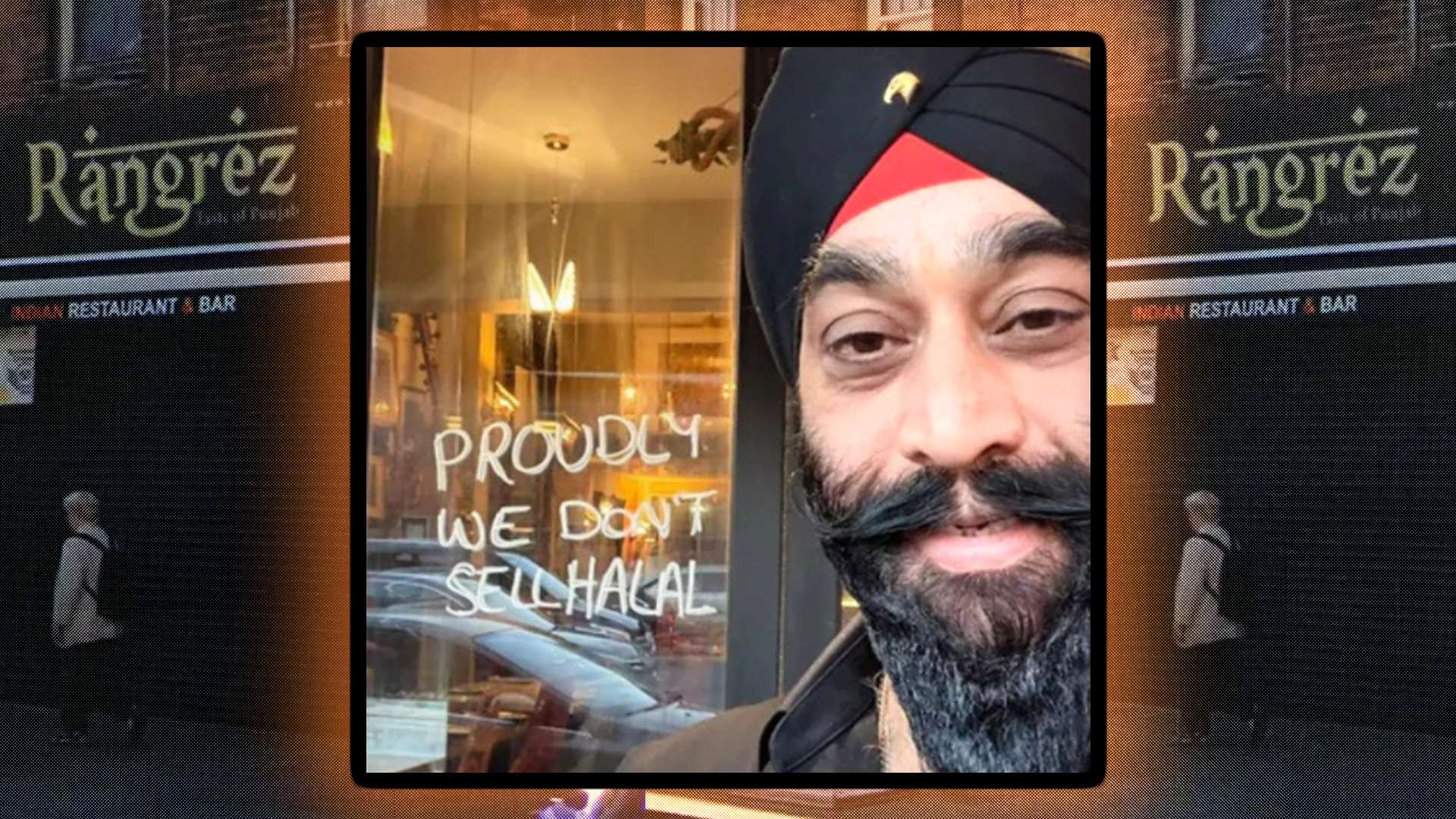
Harman Singh Kapoor asserts that his family has endured years of threats and vandalism for declining to serve halal meat, yet police have arrested him for a fourth time.
A UK-based restaurant owner was detained at his home following a social media post, after years of harassment over his decision not to offer halal meat.
“I am being arrested because I posted something online last night, something funny, and within 12 hours police came to arrest me,” said Harman Singh Kapoor, who runs Singh’s Dining by Rangrez in Hammersmith, London, in a video posted to X on Friday. In another video, Kapoor is seen being escorted into a police car. Although the offending post has since been removed, other commenters allege it contained graphic content involving a goat.
In an email to Reason, London’s Metropolitan Police confirmed that “A 54-year-old man was arrested on Friday, 13 November on suspicion of possession and distribution of an extreme image. He has since been released on bail.” Police declined to provide details about the nature of the image or the circumstances surrounding the arrest.
“They searched my whole house,” Khushi Harman Kapoor, his wife, tells Reason. According to Mrs. Kapoor, four officers combed through “everything,” including mobile phones, and were planning to seize her children’s laptops. “Then my daughter said, ‘Listen, we have exams. If you take our laptops, how can we study?'”
This was not the couple’s first run-in with law enforcement. According to his wife, Kapoor has been arrested on four separate occasions, often after clashes with protesters outside his restaurant. She alleges that on one occasion Kapoor was arrested for carrying a kirpan, a ceremonial dagger worn by Sikhs as a symbol of faith, even though carrying a kirpan for religious reasons is permitted under British law.
For years, the family says they have faced threats, harassment, and vandalism because they refuse to serve halal meat at their establishment. “I’m Sikh, and we are not supposed to eat or sell halal food,” Kapoor tells Reason. “From day one, we’ve made it clear we are not selling halal because it goes against my beliefs.”
While Kapoor’s stance on halal has stirred controversy, he has also drawn criticism for provocative social media posts about Muslims. In one video, he is shown spraying a bottle labeled “Singh’s Sausage Spray,” with the phrase “100% inbred repellent” written on it. In another post, he is pictured with slices of bacon on his hands, accompanied by the caption “Bacon fists. Protecting yourself in London is never easy.”
Over the past few years, Kapoor says protesters have repeatedly gathered outside his restaurant, harassing patrons and threatening his family. He says four of his cars have been vandalized, his restaurants have been attacked, and his family has received death threats. In one video posted to social media, young men are seen throwing chairs at the restaurant. In another video, hundreds of protesters are shown outside, with one speaker shouting “Allahu Akbar,” “shame on you,” and calling for the restaurant to be shut down.
Despite repeatedly contacting the police, the family contends that officers have failed to provide adequate protection from vandals. In a recent incident, Mrs. Kapoor says she spent 25 minutes on the phone explaining to police that a man was harassing the family outside their restaurant. Officers initially promised to arrive within 15 minutes, but instead called back two hours later to arrange taking her statement three days later. Yet when it came to arresting her husband over his social media posts, the police arrived promptly.
“And now I am scared to call the police,” Mrs. Kapoor tells Reason, explaining that she fears officers will arrest her husband rather than those who threaten the family. The Kapoors’ experience is just one example of how speech restrictions are perceived to be tightening in Britain—more than 62,000 people have been arrested for “speech offences” in the past five years, according to the Free Speech Union.
Despite the violent protests, not everyone condemns the family. Kapoor recalls a Muslim customer who placed an order worth about £150 (roughly $198) consisting entirely of vegetarian dishes, seen as a show of support. “He told me, ‘I am here to back you. What you’re experiencing is completely wrong,'” Kapoor recalls. The customer explained that although the restaurant does not serve halal meat, he could still enjoy the vegetarian offerings. “I’m satisfied with my religion, and I am not targeting another faith. Yes, I respect Muslims—their religion, their beliefs. As a Sikh, I remain devoted to my own faith.”
The family says all they want is the freedom to run their business in line with their religious beliefs and to provide for their loved ones without intimidation or interference. “Even if I lose my restaurant, I don’t care. I will stand by what I believe. You cannot bully me… You cannot tell me what to do,” Kapoor declares. “Freedom is not free… If I stay silent and yield to others’ demands, that is slavery. I refuse to be enslaved.”
People should be free to criticize Kapoor’s provocative social media posts, just as they are free to choose not to patronize his restaurant. But physical vandalism and threats should not be tolerated. Unfortunately, some observers feel that British authorities are more focused on policing online remarks than on safeguarding a family and their property.
