
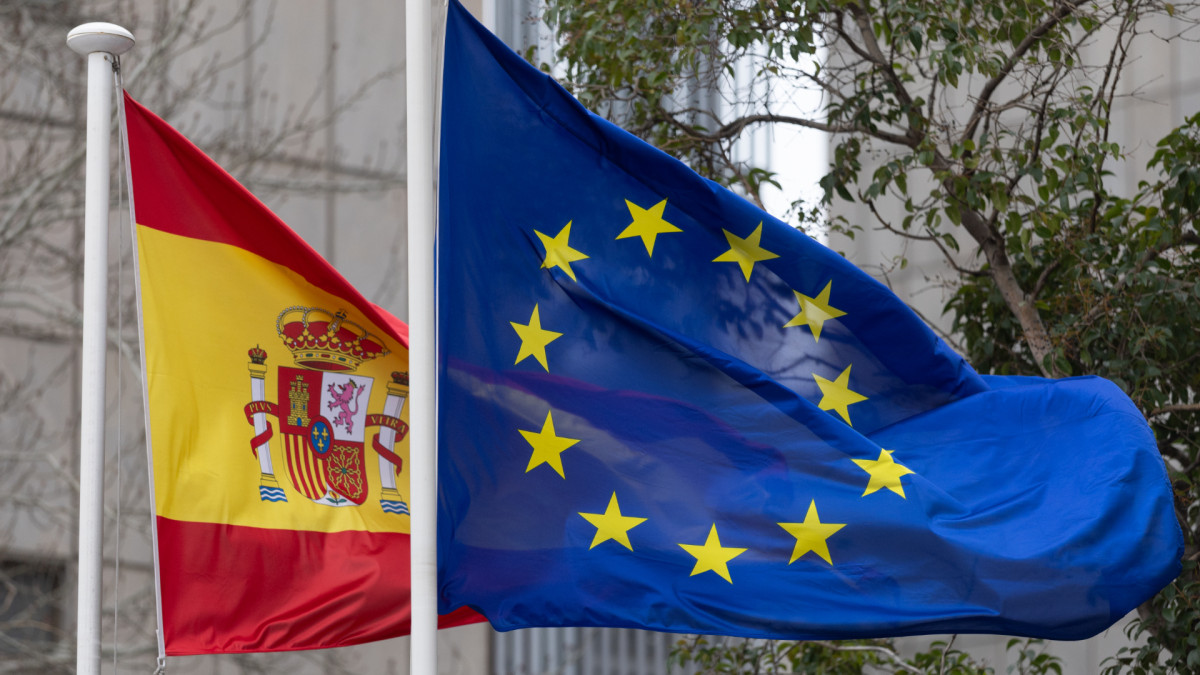
Clearly, as the November 29 election approaches, not all options are the same. The choices are very different. Look at their programs. These, however, do not meet the challenges we face as a country, for they do not engage with our circumstances to take them into account or attempt to change them. There is a lack of worldview. Spain is the country and its circumstances, to paraphrase the philosopher, without forgetting the rest of the quote: and if this one does not save it, Spain is not saved. They seem to ignore, or not want to engage with, that the world is changing, that we are living through, as Xi Jinping puts it, “great changes never seen in a century”.
The diversity of approaches not only about foreign policy —this goes much further— but about our external circumstances, and especially about Europe, is very present, for example, on the horizon of the upcoming French presidential elections. Not here, despite the fact that progress and retreats can come from both inside and outside. The global order and the European order matter; they affect us directly. The solutions to our problems (and the problems themselves) are not solely internal, but also external, although we have less capacity to influence them, especially if addressed in a scattered manner.
“The solutions to our problems (and the problems themselves) are not only internal, but also external, although we have less capacity to influence”
Do the programs matter? The “blue wave” of the Democrats against Trumpism in the United States has occurred without a leader and without a program. Programs can be swept aside by coalitions — the necessity of agreements —, by crises (pandemic, Ukraine, Iran, etc.). Or by the exercise of power, with or without audits or other tricks. Tony Blair has explained that for him programs are made to win elections, but once won, it is about governing, which is another thing. An excess of cynicism, no doubt. Which explains, however, the ease with which they are not fulfilled or are turned around once in power.
And yet, although few read them, they count, and give a sense of direction. In Spain they orient inward more than outward. Here we limit ourselves to the PSOE (The Power of the People, 114 pages), PP (National Reconstruction, 61 pages), Vox (Common Sense, 61 pages) and Frente Amplio (A program like a house, 151 pages). It isn’t that ultradetailed programs are needed, but visions. The Manifesto with which the British Labour Party won against Churchill in the 1945 elections, the one containing the development of the postwar welfare state, had only twelve pages. Its title: Let’s face the future: a declaration of Labour policy for the nation.
We are not emerging from a direct war, but these elections will take place in a worrying context, present in many societies around us, and in others beyond: many people, especially among the young —in Spain, with one of the oldest ages of emancipation (which has to do not only with housing)—, who foresee a troubled present and a not-so-bright future; the fear of the uncertainty in which we are entrenched and of a new kind of violence, exerted or threatened, hybrid or not; the implosion of systems; in addition to the drums of war and ongoing wars, with daily repercussions. Wars (Ukraine, Iran, Gaza) entail many things. They also reduce the purchasing power of Spaniards.
“We are not coming out of a direct war, but these elections will take place in a worrying context, present in many of our surrounding societies, and in others beyond”
To the members of a government that intends to repeat themselves they are judged more by their track record, by what has been done, than by what they propose. That said, what these programs say can be as significant as what they do not say. Although Sánchez — who has written a pacifist brief in Foreign Affairs — and Spain have a respectable and respected record abroad, how little is said in these programs about how to exit or defend against the Iran war or the Ukraine war! Or about how to resolve the Palestinian question, and the complexity of the Middle East in light of new circumstances. That external circumstance is left to the end in these programs, as in PSOE or PP, and on others it is skimmed over.
For Spain, much of our problems can only have a (partial) solution within the framework of the European Union (including relations with Morocco). However, when Europe is going badly, Spain does not fare well. Is Europe still an “external reformer,” a “plus of democracy” — at least of the rule of law — for Spain, when the EU is in crisis? Industrial competition — again, with a strong component of the military industry — and geopolitical tension between France and Germany, the distance between the frugal and the tax-dodging doves reemerge, along with eurosceptic visions from the neo-reactionary forces rising in this Old Continent. Part of the EU is sacrificing its soul and its values in decisions such as the shameful one by some countries (not Spain) to create in Rwanda the first migrant deportation center outside the Union. Although Spain may have no choice but to continue depending on the empire and the emperor, Europe can no longer trust the United States. Moreover, the divisions among Europeans regarding the exit from the Ukraine war (What European architecture do we defend?) are evident, without offering solutions. It is not simply something “out there.” The revelations about the connection of Núcleo Nacional militants with the Ukrainian neo-Nazis of the Azov 12th Brigade are worrying in every sense, and should give pause about what and whom is being supported.
“For Spain, good part of our problems can only be solved (partially) within the framework of the European Union (including relations with Morocco)”
The PSOE is more explicit about Europe. The Vox program does not even mention the EU, little popular among its voters, although it quietly ensures that extracommunity entrants are not placed in the “national priority.” Certainly, from Brussels and the capitals there is close attention to what Spanish European policy will come out of these elections. You won’t guess it by studying the programs, and the debates are not very revealing. More by trajectories and elective affinities.
The three major factors of the great transformation we are living through are the rise of China, globalization, and the ongoing technological revolutions, the three closely interconnected. Spain has opened up to China in ways other countries have not followed. It is not only that streets and roads across two or three years have filled with Chinese brands across Europe, but that it is our competition as well for maintaining a welfare state, inevitably to be reformed in response to the changes that have occurred. China and much of Asia maintain a real 9-to-9 workday, six days a week. And with a meager public health system, as well as pensions. More Confucian than communist, China poses an ideological challenge that wasn’t so clear just two decades ago. But one thing is to adapt the welfare state in Spain, and in Europe, to the new realities, and another, very different thing, to shrink it from within, and reduce everything public, when, however, state capitalism grows in liberal democracies.
The ongoing technological revolutions are —as they always have been— a central transformative factor. Regarding the currently most important, artificial intelligence (AI), these programs adopt an almost exclusively industrial focus — and on the defense industry, necessary, absolutely necessary, not to fall behind, but not sufficient. Little attention to the social impact, which, although uncertain, is already noticeable with a hollowing out of the middle classes for several years now. “An AI and digitization at the service of the economy and people,” says the PSOE, or the training voucher from the PP will not suffice. And who will train the trainers? The AI? These programs are not suited to helping young people choosing a career, whether university or vocational training (more clearly). The simple question of “What should I study?” has no clear answer. Not to mention the social and mental impacts of screens and networks, or the environmental impacts of data centers under construction and planned, on which the Government has indeed taken a stance. Despite the fascination, astonishment and fear that AI provokes, the issue is absent from the electoral debate in Spain.
“Despite the fascination, astonishment and fear that AI provokes, the issue is absent from the electoral debate in Spain”
And little or nothing about globalization and its changes, about the new protectionisms, which are also claimed for Spain, nor about managing the multipolar world. The term “multilateralism” does not appear in the PP program nor in Vox’s. It does appear in PSOE’s. Just one data point that speaks for itself about the importance of all this: the current EU has 452 million inhabitants; Africa, 1,550 million, and migratory pressure is what it is. Eurostat projections point to 2050 (the day after tomorrow) at 445 million for the EU, aging, and 2,500 million for a young Africa.
In this campaign there are contrasting visions of the internal, explicit or implicit. But these absences about the external or technological circumstances, are they due to not knowing, lacking criteria, or not wanting to say it? In the first case, worrying. In the second, a theft from the debate to which citizens would be entitled to know what to rely on. “Less looking at Brazil and more looking at how we fill the fridge with basic foods,” Feijóo has said, not exactly in English. The fridge is also filled from outside.
Will all of this be discussed in the debates?
