
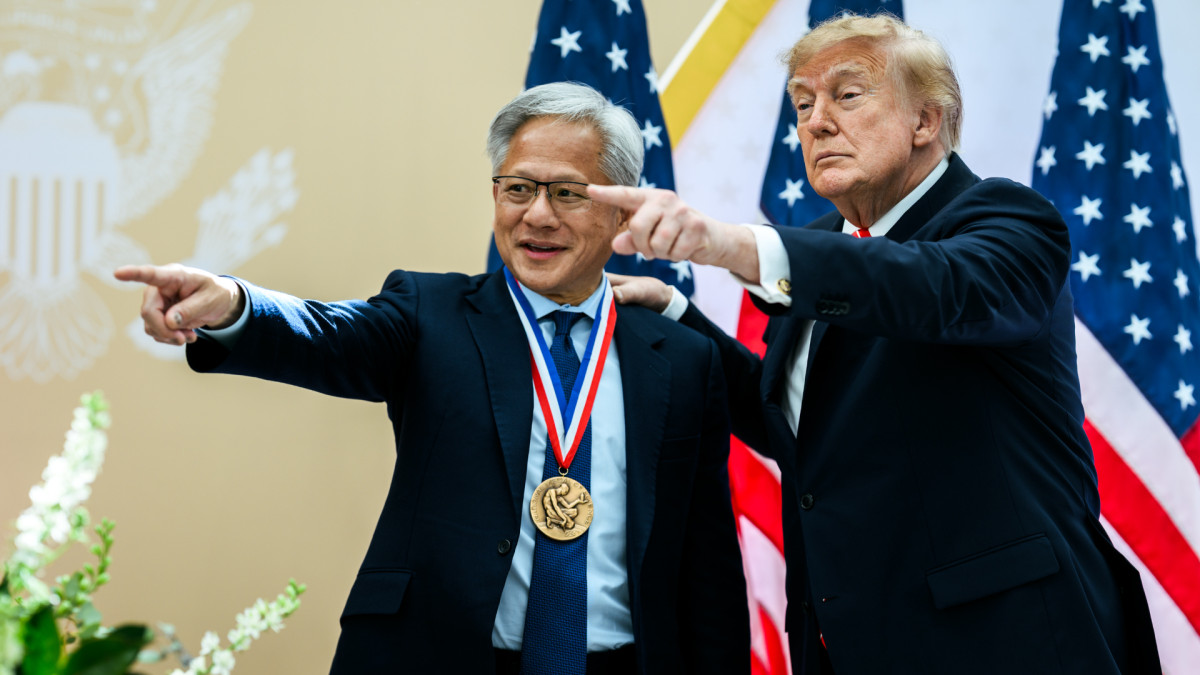
After 33 years at the helm of the company he co-founded, Jensen Huang resigned on November 12 from his roles as president, chief executive officer and board member of Nvidia. The charismatic business leader’s downfall originated with the publication a few days earlier of information about his ties to a Megaspeed director, a company that had long been at the center of U.S. intelligence suspicions. The firm was pointed to as one of the players in the smuggling of Nvidia products into China, products that carried an export ban to the Asian giant. The cascade of news and revelations surrounding Huang—some with more credibility than others—and a stock slide that worsened Nvidia’s decline by more than 30% from its peak precipitated the result. We do not know for certain, and we may never know, the truth of what happened behind the scenes in that vertigo-filled week. What we do know is that we are witnessing an earthquake with its epicenter in Nvidia, whose ripple effects reach the entire AI ecosystem. It could not be otherwise given the scale of such an event in a systemically important company within this technological arena.
The reshaping of the tech industry
The first reaction is internal. A new balance of power emerges at Nvidia. The company has introduced a figure it never had: a chairman of the board, Harvey Jones, separated from the executive. The chief financial officer, Colette Kress, takes the helm on an interim basis while a replacement is sought. Whoever is chosen to replace Huang, the division of duties between the two roles will redefine who truly commands the most valuable company in the sector. Only an unlikely—though many would welcome it—return of Huang to his position could restore things to how they were before November 12. But Nvidia’s board has ruled out that return for now.
“Sí sabemos que estamos ante un seísmo con epicentro en Nvidia cuyas ondas alcanzan a todo el ecosistema de la inteligencia artificial”
Beyond appointing a new chief executive, the urgent task is to define a credible governance structure for Nvidia to reassure its investors. The challenge is structural. Huang ruled with extreme micro-management: around sixty executives reported directly to him, and he never laid out a known succession plan. That architecture is not inherited; it must be rebuilt urgently, with mid-level layers and controls that do not exist today. And there is an uncomfortable question: did Nvidia control its sales channels? That one of its largest customers is suspected of diverting chips to China points to a supervisory weakness that the new team will have to close quickly, with internal accountability, if any, that must go beyond Huang. The first step has been to establish a watchdog committee for national security policies and export controls.
El terremoto en Nvidia reordena también la jerarquía de la industria tecnológica, no solo la de los chips. With Nvidia weakened, the big techs return to center stage, a position lost due to the soaring value of the green company. The biggest beneficiaries are the hyper-scalers (Amazon, Microsoft, Google), because Huang had cultivated their rivals: the neoclouds. Nvidia took stakes in CoreWeave, Nebius or IREN, allocated them compute capacity and backed about $36 billion in off-balance-sheet guarantees for them. Their shares fell sharply on the day of the resignation. Without his patron, the competitive risk posed by the neoclouds to the hyper-scalers is reduced, and a new Nvidia leadership could revisit those aggressive financial bets Huang pursued, about which the interim CEO-elect reportedly harbored reservations.
Where the changes will be greatest is in the semiconductor sector. Part of Nvidia’s success lay in its masterful management of its supply chain, keeping it safe from the tensions that afflicted its rivals. That capability rested largely on Huang’s personal ties, born in Taiwan, who boasted of sealing deals with island-based companies with just a handshake. The island’s industrial hub loses a champion and the island loses a hero. Its suppliers are already wondering whether the successor will maintain the long-term contracts and the upfront investment that were its hallmark. The Taipéi index fell by more than a thousand points during the crisis.
“Sus proveedores ya se preguntan si el sucesor mantendrá los contratos a largo plazo y la inversión anticipada que eran su sello”
The gap Nvidia may leave in the supply chain would give air to the competition. Taiwanese analysts foresee Huang’s exit accelerating the diversification of orders toward AMD, Broadcom and Google’s and Amazon’s own chips, although Nvidia’s dominance of the data-center chips market—holding a ~76% share—does not appear to be at risk. The question remains: whether Huang, at 63 with his technical prestige intact among many engineers, will eventually land at a competitor. Elon Musk has hurried to offer him a position.
Agitation in the United States political class
The CEO’s voice commanded attention from President Trump. Now we know that in the New York magnate’s cabinet not all viewed that influence with favor. Marco Rubio, then-Secretary of State, had already warned Trump of Huang’s dangerous connections in a classified memo that, according to The Washington Post, hardened the CIA’s conclusions; its leak sparked the scandal. Scott Bessent, then-Secretary of the Treasury, has voiced his disagreements with the management of Howard Lutnick, the Secretary of Commerce, in the Megaspeed case. And the president’s conflicts of interest, who authorized chip sales to China in exchange for a share of the revenues, have emerged. It would not be surprising if the Nvidia case prompted the exit of a high-ranking official in the Trump Administration.
The ideas of Nvidia’s chief executive also carried weight with the rest of the political elite. Huang was one of the most influential voices in shaping the framework for the development of large language AI models. He was a major lobbyist against specific AI regulation: he warned that state-by-state regulation would paralyze the industry and pressed against restrictions such as the GAIN AI Act. At the same time, he was a firm advocate of open models over closed models; he even pushed from Nvidia for his own family of models. Without his voice, those calling for stricter safeguards gain ground in Washington, and the open-model camp loses its most outspoken advocate with greater access to the Oval Office.
“Sin su voz, quienes reclaman salvaguardas más estrictas ganan espacio en Washington y el campo de los modelos abiertos pierde a su valedor con más acceso al Despacho Oval”
The last reply, and perhaps the longest-lasting, is geopolitical. Huang’s downfall also benefits hawks in the tech relationship with China. The former Nvidia head was the main advocate of keeping the Asian giant connected to U.S. technology and managed to secure Trump’s approval for the sale of the H20 and H200 chips. His fall strengthens lawmakers from both parties who were already demanding tighter controls, and experts at the Council on Foreign Relations urge closing loopholes such as the remote leasing of computing power by Chinese firms. For now, the Department of Commerce has already published new export rules, with tighter restrictions on remote access to AI accelerators and greater scrutiny of sales to Southeast Asia. All of this ahead of the Trump-Xi Jinping summit in Shenzhen.
The now-resigned Nvidia CEO was the AI superstar. The fall of Huang is not merely the replacement of a top executive. It shifts power within Nvidia, returns the spotlight to the big techs, unsettles Taiwan, opens a gap in the Trump administration and strengthens those who advocate more regulation and more restrictions on China. Yet prudence is warranted: this is a story still in development. FBI and Congress investigations remain open, Huang’s appearance before Congress on December 1, the selection of the new CEO, and the strength of the espionage evidence—which the CIA had not deemed conclusive—are all in play. Each new finding can raise or lower the magnitude of this earthquake on the Richter scale. For now, we know where the epicenter is; the aftershocks have barely begun.
