
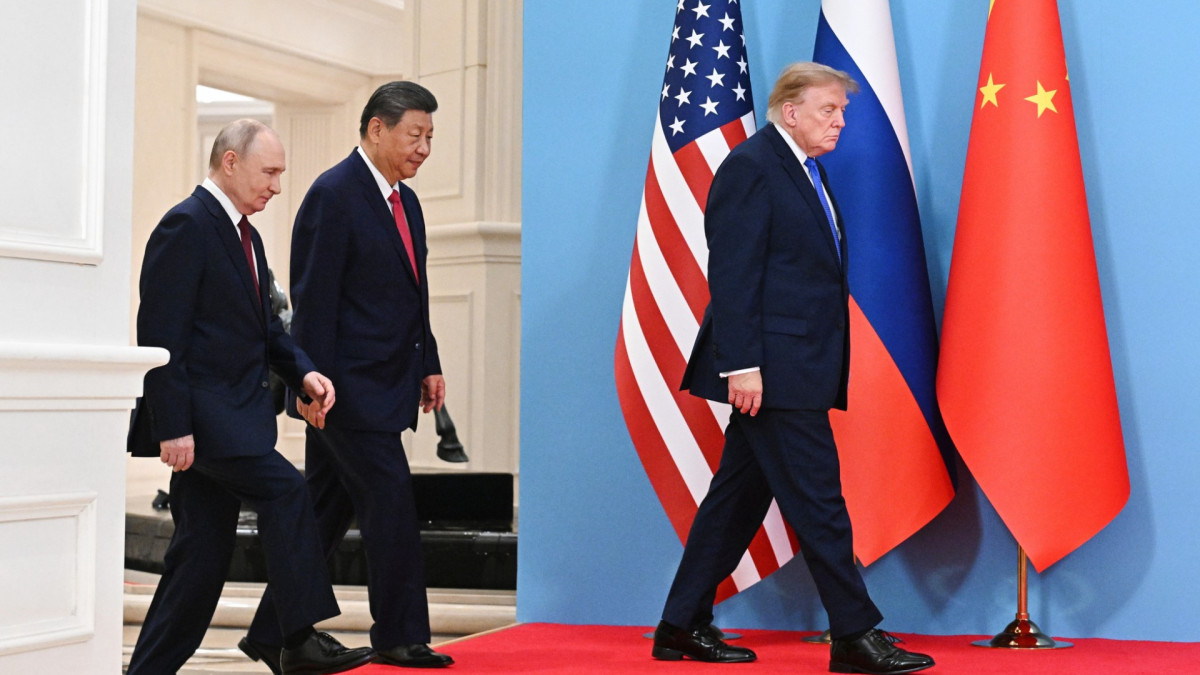
Photographs like the one showing Donald Trump, Vladimir Putin, and Xi Jinping gathered in Shenzhen crystallize a turning point in an era. Not so much for the agreements reached, but for what the joint presence of the three leaders represents. For the first time since the end of the Cold War, the United States stages its willingness to negotiate with its main rivals the rules of an international order that it can no longer lead alone. The American president, who arrived at the White House promising to restore American greatness, ends up starring the photograph that best symbolizes the exhaustion of his hegemony. Perhaps that is the main takeaway from Shenzhen. This has been not only a diplomatic summit, but the portrayal of a shift in the distribution of global power.
“Por primera vez desde el final de la Guerra Fría, Estados Unidos escenifica su disposición a negociar con sus principales rivales las reglas de un orden internacional que ya no puede dirigir en solitario”
Of course, the end of American hegemony does not mean that the United States has ceased to be a superpower. The country still retains an extraordinary military superiority, a central position in the international financial system, a formidable technological capacity, and an unparalleled network of alliances. Nevertheless, hegemony and power are not interchangeable concepts. The former implies more than having material resources. It entails the ability to set the rules of the game, define the international agenda, and secure for other actors to accept, voluntarily or out of necessity, a certain leadership. And this is precisely what this summit has laid bare.
During the three decades after the dissolution of the Soviet Union, Washington could act under the conviction that no power seriously challenged its primacy. The so-called unipolar moment allowed military interventions, the expansion of alliances, and economic decisions that were made without the need to negotiate on equal terms with other power centers. That hegemon y was never absolute nor free of resistance, but it established a relatively clear international hierarchy. Shenzhen represents the acknowledgment that that period has ended.
Of course, this transformation has not occurred suddenly. The economic and technological rise of China, the failure of American interventions in Afghanistan and Iraq, the 2008 financial crisis, and the growing challenge from the Global South have gradually eroded the material and political foundations of American leadership. Today, the United States under Donald Trump not only manages the relative decline of the United States but contributes to accelerating it by weakening multilateral institutions, questioning its traditional alliances and replacing strategic predictability with a deeply transactional foreign policy.
“El Estados Unidos de Donald Trump no solo administra el declive relativo de Estados Unidos, sino que contribuye a acelerarlo”
In Shenzhen, Trump seeks to demonstrate that he remains the world’s top negotiator, capable of bringing his adversaries to the table and resolving, through personal deals, conflicts that international institutions have failed to resolve. Yet, the very need for such negotiations reveals the limits of his power. Washington can no longer simultaneously contain China in the Indo-Pacific, condition Russia unilaterally in Europe, and guarantee the stability of the Middle East. The war with Iran and the difficulties in imposing his objectives across different theaters have highlighted the costs of an overextended strategy. The rhetoric of force thus coexists with a reality far less favorable to American interests.
In certain Chinese nationalist circles, the meeting is interpreted as the definitive recognition of the end of unipolarity. It is a biased reading, overrating American weaknesses and downplaying the difficulties of Moscow–Beijing relations, but it does identify a real transformation. China no longer merely seeks to fit into an order designed by the West, but intends to participate in defining its principles and, progressively, to modify the power relations that sustain it.
The Shenzhen final declaration is revealing precisely because of its priorities. The reaffirmation of the role of great powers in reforming the United Nations, the centrality of energy supplies, the dialogue on nuclear security and, especially, the questioning of certain mechanisms of international justice point toward a hierarchical conception of global governance. We are not witnessing the formal creation of an international directorate, but yes the will to recognize the great powers a privileged position to set the rules. The defense of sovereignty and non-interference can thus become a tool to limit the capacity of international law to hold those in power to account.
“La defensa de la soberanía y la no injerencia puede convertirse en un instrumento para limitar la capacidad del derecho internacional de exigir responsabilidades a quienes ejercen el poder”
Now, however, it would be a mistake to interpret Shenzhen as the birth of an alliance of equals. The three leaders pursue different objectives: for one, Trump seeks to regain diplomatic initiative and project a leadership image; Putin aims to consolidate his international rehabilitation and obtain recognition of Russia as an indispensable power for European security, despite the wear and tear caused by the war in Ukraine; and Xi Jinping, on his side, is unfolding a strategy with longer horizons. China aims to establish itself as the center of gravity of an international system in which the United States can no longer unilaterally impose its terms. Against Trump’s ego and Putin’s tactics, Beijing seems to rely on a more patient and structural strategy.
And what about Europe? Its absence from the photograph is another of the summit’s key clues. The continent that for centuries stood at the heart of global politics now appears displaced from the conversations that could shape its own future. The Ukraine war has shown how much its security remains dependent on Washington. Thus, while the United States negotiates with Russia and China, Europe remains trapped between strategic dependence on its American ally and its inability to build a common position, as demonstrated by the delegitimization of the figure of the high representative for the next negotiating round over the Ukraine war. Europe risks becoming part of Shenzhen’s menu, though it retains enough economic, commercial, and regulatory resources to avoid that if it can translate them into political power.
But the problem transcends Europe. The end of American hegemony does not guarantee the emergence of a more democratic, balanced, or just international order. Multipolarity can broaden the margins of autonomy for many states, but it can also lead to a system of spheres of influence where great powers negotiate about the sovereignty and security of third parties. In this sense, replacing one hegemon with a directorate of powers does not necessarily constitute progress for global governance.
“La multipolaridad […] puede desembocar en un sistema donde las grandes potencias negocien sobre la soberanía y la seguridad de terceros”
Thus, Shenzhen should also serve as a warning to middle powers and Global South countries. The alternative cannot be merely choosing between Washington, Moscow, and Beijing. It is necessary to build alliances capable of defending a more representative multilateralism, reforming international institutions, and preserving the principles that prevent force from ever replacing law.
What has been seen in Shenzhen, for now, is the symbol of the intention to move toward a new order by revealing the seams of the one that still governs today. Trump’s resistance to the deepening decline of American hegemony and the pax americana that accompanied it may, paradoxically, be accelerating this process. In light of this situation, a question arises that needs some form of reaction to prevent the end of a hegemon from giving way to a new form of shared non-liberal domination.
