
There is a paradox running through the current debate on migration within the European Union: the more space migration occupies in political discussion, the less room there seems to be to debate the policies needed to manage it and confront the problems attributed to it. Immigration has become a central issue in partisan confrontation, but that centrality does not translate into a realistic and measured discussion about policies of entry, residence, employment, integration, inclusion, or coexistence. On the contrary, the debate is obsessed with border control and returns, as if managing migration consisted essentially of preventing people from arriving or forcing them to leave.
“The more space immigration occupies in political discussion, the less space there seems to be to debate the policies necessary to manage it and confront the problems that are attributed to it”
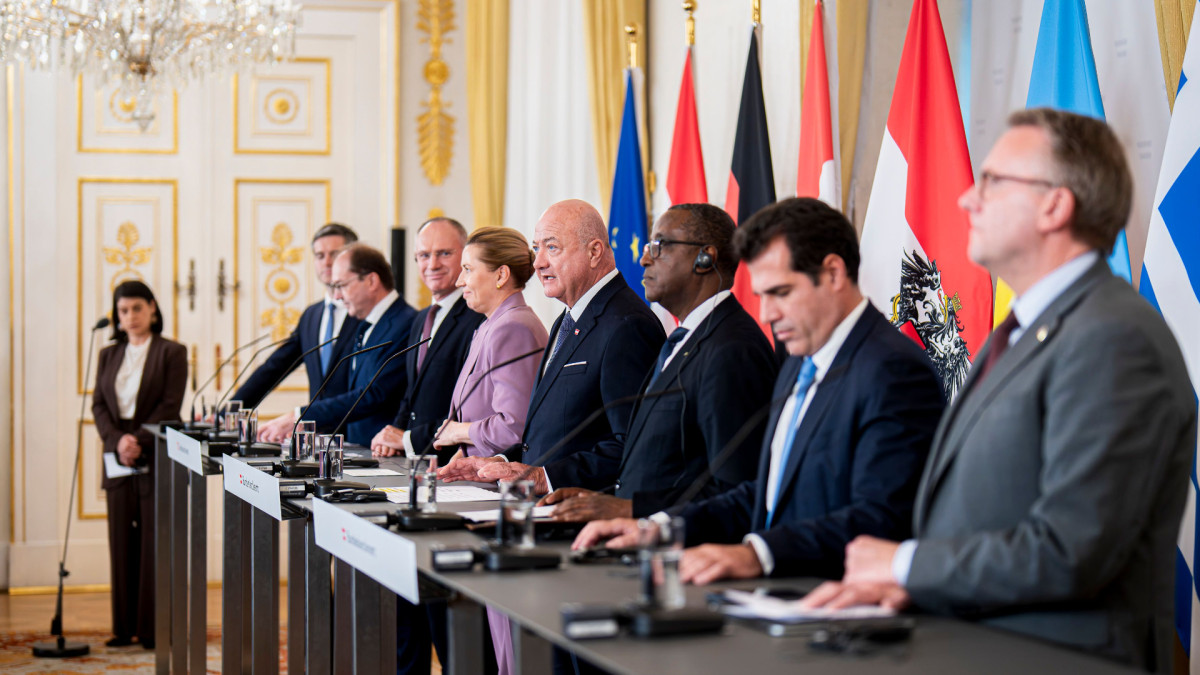
The announcement on 16 November by Germany, Austria, Denmark, Greece, and the Netherlands that they would negotiate with Rwanda the creation of a return centre is a clear example of this paradox. The five EU member states intend to transfer to that country individuals who are irregularly staying on their territories and who have an executable return decision. The initiative is presented as a historic “paradigm shift” to regain control of borders, reduce incentives for irregular migration, and combat human trafficking networks. For the European Commission, this initiative is an “innovative solution” that fits with the new Return Regulation adopted last October under the cries of “send them back” and that would meet all existing human rights protections.
The proposal, unveiled in Vienna, outlines the agreement they want to reach and would allow a first small-scale pilot experience of returns during 2027. The mechanism would target individuals with executable return decisions, and authorities claim that the facilities would be open, with possibilities for residence, work, and integration in Rwanda. But many issues, and not minor ones, remain to be clarified. For instance, the selection procedures, the conditions of stay, the financing, the oversight mechanisms, and the legal responsibilities of each government still need to be determined. It also remains to be decided what would happen if a person cannot return to their country of origin and does not want to settle permanently in Rwanda. And perhaps most importantly: it is not clear how this “return centre” in Rwanda complies with Article 14 of the Return Regulation, which states that such measures can only be carried out in third countries that respect international rules and principles, including the non-refoulement principle. The systematic human rights violations documented in Rwanda for years, together with the UK Supreme Court ruling of 2023, which found serious deficiencies in its asylum system and a real risk of refoulement, call for a clear explanation of how the rights of the people relocated to that country will be effectively guaranteed, rather than simply asserted as being protected.
Beyond the pending—but not minor—details of the proposal’s content, there are three major worrying questions that accompany this “innovative” initiative.
First, the initiative implies outsourcing the management of returns to a third country, transferring individuals who have no obligation to maintain any ties with that country and delegating to its authorities the responsibility to attend to them. This delegation also carries the risk of a “Guantanamization” of migration policy: to move people away from EU territory and, in practice, to make it harder for them to access judicial review and rights protection mechanisms. Yet geographical distance does not absolve states of their obligations. This is underscored by the jurisprudence of the Court of Justice of the European Union, which requires respect for the principle of non-refoulement and the right to effective judicial protection in return procedures, and by the Council of Europe’s Commissioner for Human Rights, who has warned of the specific risks posed by these centres.
Second, this outsourcing option also implies acknowledging the failure of a return policy that has aimed to be the central axis of the EU’s migration management. According to Eurostat, in 2025 there were 491,950 removal orders issued, while 135,460 people were returned to third countries, around 28% of the orders issued that year. It should be remembered that enforcing a return decision does not depend solely on the will of the Member States, but, above all, on the cooperation of the countries of origin to readmit those individuals. This dependence gives third countries substantial bargaining power and allows them to transform migration cooperation into a tool of political or diplomatic pressure. Return centres do not solve this dependence; they may add a new intermediary without guaranteeing readmission by origin countries.
“Return centres do not resolve this dependence, but they can add a new intermediary without guaranteeing readmission by origin countries”
Third, and as is often the case with such proposals, costs are not discussed. The British agreement with Rwanda contemplated payments of 370 million pounds, in addition to further amounts per person relocated, while the Italy–Albania arrangement to outsource return centres predicted a cost of around 650 million euros over five years, far higher than accommodating the person in an Italian centre according to a 2025 study. Thus, the proposal risks adding new problems without solving existing ones. And it is precisely here that one recalls that a public policy should not be evaluated solely on its capacity to generate striking announcements, but also on its results, its costs, and its respect for the rule of law.
“A public policy should not be evaluated solely by its capacity to produce striking announcements, but also by its results, its costs, and its respect for the rule of law”
So why have countries with very different migration realities and governments of various political leanings chosen to push a proposal of this kind? The convergence of divergent interests suggests that the answer is not so much based on technical criteria as on the way immigration has been politically constructed as a problem, and even as a threat, over the last decades.
On the one hand, public debate on immigration has focused on irregularity and border control (maritime). Although the figures show that the majority of the foreign population resident in the European Union is in regular status and that irregularity is more about residence than entry, the obsession with borders has diverted debates and resources. This gives rise to what Douglas Massey called the “paradox of illegality”: the hardening of borders can end up perpetuating irregularity, while administrative obstacles and the lack of pathways to regularisation that would help reduce it are neglected.
On the other hand, the push for returns and expulsions ignores, as noted earlier, the dependence on third countries, whose cooperation is essential to carry them out. Furthermore, this political priority has recently been accompanied by a significant shift in language: it has become normal to talk about “deportations” to refer to returns of irregular foreign nationals. This is not a neutral choice. In the EU legal framework, the reference concepts are return and, in certain procedures, expulsion. “Deportation,” a term with specific historical connotations in Europe, has become popularized by Trumpism and Europe’s radical right, progressively occupying public space and displacing legal precision in favor of a punitive rhetoric and show of force.
Words do not by themselves change the rules, but they contribute to defining what is considered normal and acceptable. The progressive adoption of this vocabulary, together with the priority given to control and returns, shows how deeply the discourse frameworks of the radical right have penetrated the agendas of parties across different political families and into mainstream media.
That this immigration view as a threat has become dominant is what we understand as a securitization process. Building immigration as a threat to security, social cohesion, the welfare state, or national identity allows for the justification of exceptional measures that would have seemed unthinkable a few years ago.
“The discursive frameworks of the radical right have penetrated the agendas of parties across different political families”
And it is precisely here that securitization ceases to be merely a discursive process. When immigration is repeatedly presented as a threat, measures that previously would have required extraordinary justification begin to be considered real possibilities. Outsourcing returns, this Guantanamization of European migration policy, is clearly a reshaping of the Overton window: it not only changes what is said about immigration, but also what is considered politically acceptable to do in its name. Perhaps this is one of the most significant transformations of the EU migration debate: not only the ability of radical right to bring its proposals into the public agenda, but the gradual adoption of part of its discursive frameworks and priorities by parties traditionally positioned as defenders of liberal democracy.
It seems necessary to remind ourselves that this is not about denying that irregular immigration poses management challenges, nor about questioning the legitimacy of States to enforce return decisions. It is about asking what problems these measures actually aim to solve and demanding that they be evaluated for effectiveness, proportionality, and respect for rights. Because, while substantial political and economic resources are being devoted to new outsourcing mechanisms, central migration-management issues still receive far less attention: inequalities, labor exploitation, weaknesses in public services, or inclusion in our societies.
Thus, the paradox of principle reappears. The centrality of immigration in public debate does not guarantee better migration policy. It may, in fact, do precisely the opposite: the more it is used as a battlefield, the less space there is to discuss how residence permits work, labor inspections, regular entry routes, reception, or integration. Public attention focuses on the most visible control measures, while everyday management problems remain unanswered.
“Public attention concentrates on the most visible control measures, while everyday management problems remain unanswered”
And perhaps here lies the deepest contradiction of all that is happening. The EU and its member states justify these initiatives in the name of security, stability, and protecting our societies. Yet in doing so, they risk weakening some of the principles that define them as liberal democracies. The rule of law, equality before the law, the prohibition of discrimination, effective judicial protection, or respect for international commitments are not peripheral elements of our political model; they are its foundations. When we begin to consider that those guarantees can be relaxed because they affect “other” people, we are introducing a logic that goes far beyond migration policy.
Indeed, that makes migration policy a litmus test for the democratic quality of the EU and its member states. If, in the name of “migratory control,” we accept that fundamental rights, equality before the law, or respect for the rule of law become negotiable, perhaps the problem is not how far we can push certain people, but how far we are willing to go in weakening our own democracies.
