
The long road to “everything that can be in the hands of the private sector will be.”
The December 2026 issue of Reason looks at the milestones of Argentine President Javier Milei and what remains to be done.

Following his victory in the presidential race, Javier Milei asserted that “everything that can be placed in private hands will be.” Such a stance would mark a radical transformation for a country where, by 2025, the government oversaw around 60 state-controlled enterprises. These entities do not operate as ordinary private firms; they function under special rules that create monopolies, and the state absorbs their losses.
The Milei administration has tested several routes to reduce state ownership. These include outright privatization, partial privatization through equity sales, converting state companies into corporations as a preliminary privatization step, outsourcing public services to private operators, and closing down operations deemed nonviable. Yet the destination remains constant: a freer society in which individuals can exercise their rights and bear responsibility for their choices. In Milei’s words, “The smaller the state, the greater the liberty.”
The Reforms That Survived the Legislature
The privatization drive began under the Ley Bases, a broad package of liberalizing measures designed to “unleash the productive forces of Argentines,” in Milei’s phrasing. The legislation provoked immediate controversy, and Congress stripped roughly two-thirds of its original provisions before passing it in June 2024.
Consequently, a plan to privatize more than forty state-run enterprises was trimmed to six entities of moderate importance. The law laid out guiding principles for the privatization process, emphasizing openness, competition, and public accountability.
The first privatization completed by Milei’s government involved Industrias Metalúrgicas Pescarmona, a metallurgical company. This sale was relatively uncontroversial, and it wasn’t even listed in the law, because transferring the state’s shares did not require congressional authorization. It was finalized in February 2025, when the national government and the province of Mendoza transferred 85 percent of the shares to the American consortium ARC Energy. The sale price stood at $27 million, and the purchaser inherited a significant outstanding debt.
With the Ley Bases in effect, the administration proceeded to disengage from the companies enumerated in the law, either wholly or partially. The Ferrocarril Belgrano Cargas, a railway company, remained under state control of the tracks, while private operators would run trains and logistics and be required to grant access to other operators. The Corredores Viales, a cluster of road corridors, were slated for privatization or concession arrangements. Energía Argentina, an energy concern, saw the government divesting assets and moving toward partial or complete privatization, among other initiatives.
From Banking to Broadcasting
Milei has not ceased pushing for further privatizations beyond the six companies listed in the Ley Bases.
Consider the Banco de la Nación Argentina, the national banking institution. Like Argentina’s other state-owned firms, it has been criticized for inefficiencies and questionable staffing practices. (For instance, in 2023 it employed a numerologist to provide “coaching” sessions for staff—though no criminal wrongdoing was found by the courts.) In January 2024, Milei announced plans to privatize the bank. However, the move would first require converting the bank into a corporation—an adjustment the financial institution itself described as necessary to open its capital to private investors. Courts blocked Milei’s decree transforming the bank into a corporation, arguing that only Congress could authorize such a change.
Argentina’s rail network has long suffered from subpar performance. Consequently, Milei’s government aims to privatize all state railways, not merely the Belgrano line. This might not entail selling the infrastructure itself, but could involve separating assets and activities, selling rolling stock, or granting private concessions to operate lines, tracks, workshops, and related services. Milei’s deregulation minister, Federico Sturzenegger, remarked two years prior that “by allowing competition on the tracks, we liberate ourselves from the state as well as from a monopoly contractor.”
The president has also signaled his intention to convert the government’s television and radio operations—which he once described as a “propaganda mechanism” for prior Peronist regimes—into corporations and to sell, concede, or transfer their activities to the private sector.
Government Oil
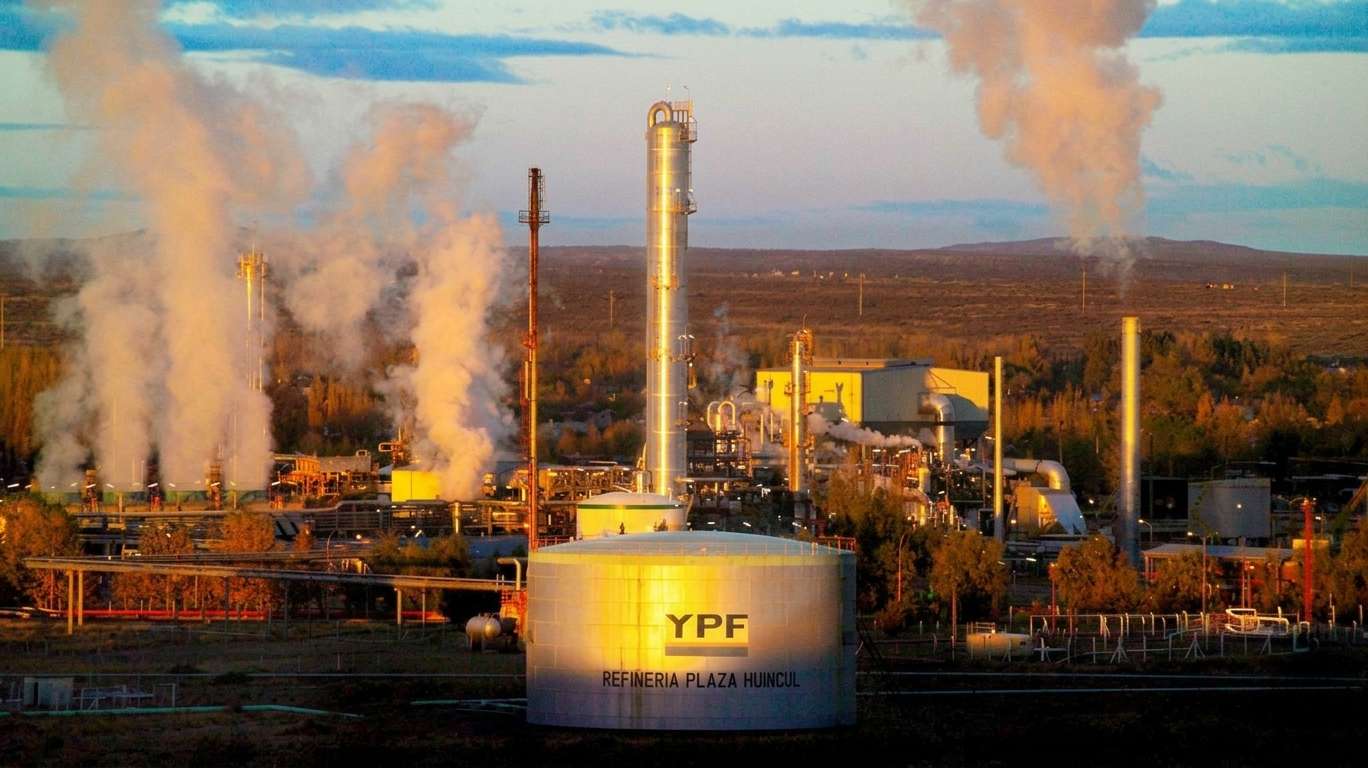
Argentina’s oil company, Yacimientos Petrolíferos Fiscales (YPF), carries a distinctive history. It began as a state monopoly in 1922. Over the following seven decades, the only private involvement came through certain concessions that worked with YPF to cover production gaps. The company often operated at a loss.
YPF was privatized in the 1990s, which led to operating surpluses, exportable volumes, and profits for its shareholders. However, President Cristina Fernández de Kirchner renationalized the firm in 2012 in the name of restoring “hydrocarbon sovereignty” for Argentina. Yet once back in state hands, YPF returned to operating deficits and struggled to meet the country’s energy needs.
The nationalization occurred through expropriating 51 percent of the company’s shares from the Spanish firm Repsol. An additional 25 percent was already owned by the Petersen Group, controlled by the Eskenazi family, a close ally of the Kirchner administration. They had acquired those shares in 2008 and 2011 with loans from banks and financing from Repsol, to be repaid from YPF’s own dividends—a setup that drew allegations of fraud.
The company’s bylaws required any shift in the majority shareholder to trigger a buyout offer to the other shareholders. The government, however, did not comply with this clause, prompting the Petersen Group to file suit in U.S. courts seeking damages. That litigation fueled further questions about fraud.
In 2023, a federal judge ordered Argentina to pay $16.1 billion, but in March 2026, the U.S. Court of Appeals for the Second Circuit reversed the ruling, ruling that Argentine law did not permit the damages claim. That has shielded Argentina from a hefty bill for the moment. The case remains unresolved, with the plaintiffs submitting a petition on September 30 asking the U.S. Supreme Court to hear their appeal.
The oil company stands out as the most consequential operation that has not been listed for privatization under the Ley Bases. During his campaign, Milei argued that the government would not be able to divest YPF until the company’s finances are strengthened and its value is higher. “In the energy transition we are considering, ENARSA [another state-owned energy firm] and YPF have a role. While their structures are streamlined, they exist to create value, so they can be sold in a way that benefits Argentines,” Milei later added.
Under Milei, YPF has indeed undergone reorganizations and notable investments. It has returned to profitability, and YPF shares listed on the New York Stock Exchange have shown persistent gains. But a sale is unlikely in the near term. By federal law, any transfer of the expropriated shares that would reduce the state’s stake in YPF below 51 percent requires a two-thirds vote in both chambers of Congress—a majority Milei does not command.
Echoing Kirchner’s rationale for renationalization, the opposition contends that privatizing YPF raises issues of sovereignty. Axel Kicillof, the Buenos Aires province governor and a presidential hopeful, has argued that “today more than ever we must defend our strategic resources and the role of the state. Privatizing is not a guarantee of efficiency but a retreat from responsibilities.”
A Near Miss on Airlines
And then there is Aerolíneas Argentinas, the Argentine airline. Privatized in the 1990s but never fully severed from state control, it was expropriated by Kirchner’s administration in 2008. By then, the state was already shouldering many of the company’s operating costs.
Under the presidency of Alberto Fernández, the airline endured substantial losses. During his campaign, Milei suggested transferring the state’s shares to the workers, providing them with a transitional period of state support for operations, and eliminating contributions from the national treasury. “Aerolíneas has highly qualified staff and profitable business units,” he later stated. “Let the employees manage it. With greater competition, the workers themselves will discipline those who engage in politics instead of work.”
In December 2023, Milei issued an executive order to pave the way for handing Aerolíneas Argentinas to its employees. Yet the handover never occurred. After 13 strikes in nine months, the government declared air transport an essential service. A new decree labeled the company “subject to privatization” and referred the decision to Congress.
Congress has yet to take action, so privatization cannot proceed for now. Nevertheless, as with YPF, the government has continued restructuring and normalizing the airline, which has ceased posting deficits.
Perhaps one day it will go further. While the legislature has blocked many of Milei’s privatization plans, a second term in 2027 with his party gaining more seats could enable additional privatizations.
During his inaugural address in 2023, quoting economist Alberto Benegas Lynch Jr., the president described classical liberalism as “the unwavering respect for each person’s life project, grounded in nonaggression and the defense of life, liberty, and property, whose fundamental institutions are private property, free markets, unfettered competition, the division of labor, and social cooperation.” His efforts to roll back state ownership flow directly from these principles. It remains possible that one day Argentina’s oil production will again be in private hands, true competition will reach the railways, and Aerolíneas’ aircraft will belong to those who fly them. As much as Milei has accomplished, there remains a long journey ahead.
