
The consequences are serious, but the merits are strong.
In 2020, amid the pandemic’s early days, the House of Representatives put in place a rule permitting members who were away to cast votes by proxy. Even though there were plenty of warnings about constitutional flaws in such a mechanism, the House pressed onward. In fact, the proxy rule remained in use through the end of 2022. One example of legislation enacted under this approach was the Consolidation Appropriations Act of 2023. By that point, the initial justification for social distancing had faded. The newly seated House convened in January 2023, and I noticed an absence of masks. Members of Congress walked about with their families.
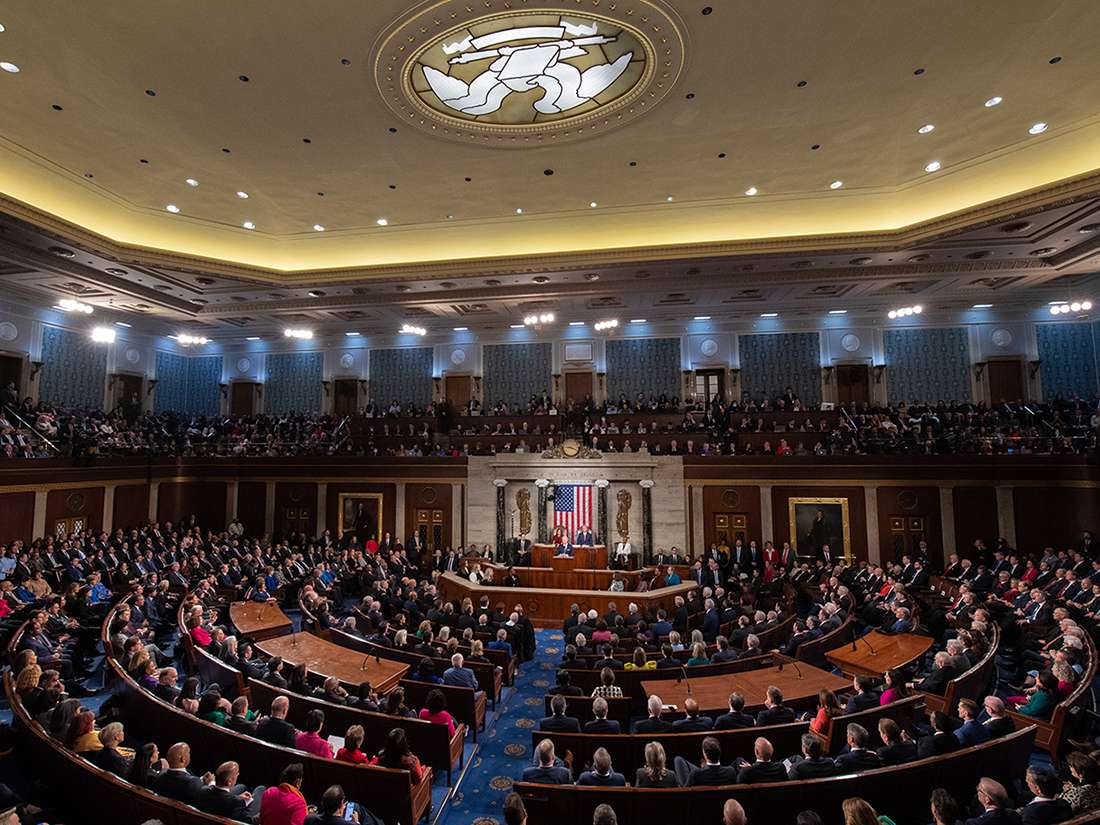
During the 2023 State of the Union Address in March 2023, every seat was filled. Look at this moment captured in the photograph. I don’t see many members with masks on.

There isn’t any justification to bypass the quorum rule at that juncture.
The pandemic is only a few years behind us, yet it is crucial to recall how many flagrant infringements of the Constitution occurred in rapid succession. As Justice Gorsuch wrote in Roman Catholic Diocese v. Brooklyn v. Cuomo, “Even if the Constitution has taken a holiday during this pandemic, it cannot become a sabbatical.” The proxy rule stood as one such sabbatical.
In 2023, Texas challenged the constitutionality of one provision within the appropriations bill—the Pregnant Workers Fairness Act. In 2024, Judge Hendrix of the Northern District of Texas authored a thorough opinion spanning more than a hundred pages. He laid out in depth why the enrolled bill doctrine does not foreclose review and why the proxy rule breaches the quorum clause. At the time, I found Judge Hendrix’s reasoning to be persuasive. The House had attempted to cut corners and was caught. A panel of the Fifth Circuit reversed, but the en banc Fifth Circuit has since affirmed Judge Hendrix’s ruling.
The immediate reaction to this ruling—“this can’t be right!”—is understandable. Yet I would urge readers to detach from the predictably dangerous instinct to weigh the outcome solely by its consequences. If every measure passed during the COVID era is now subject to constitutional challenges, the implications could be severe. Still, give some weight to the merit of the argument rather than the consequences. If the House chose to sidestep a constitutional requirement, the members who made that choice ought to face the consequences themselves.
The en banc Fifth Circuit split, a familiar pattern, by 9–8. Fortunate for the court, there were no senior judges on the three-judge panel. Judge Wilson authored the majority opinion, while Judge Graves penned the dissent. Judge Haynes maintains her unusual habit of not joining any opinion, compressing her position into a single footnote.
* Judge Haynes states that she believes it is inappropriate to discard the Federal House of Representatives in this arena, and thus she dissents. She also commends Judge Graves’s dissent.
Judge Haynes may think she is being clever, but I doubt many share that view. Indeed, in several recent cases, Judge Haynes simply writes that she affirms for the reasons articulated by the district court—as if nothing her colleagues authored ever mattered. I suspect this reflects a lack of respect for colleagues who devote substantial effort to crafting opinions, and she does not even bother explaining where she disagrees. She is capable of producing reasoned opinions, but she seemingly shrugs at the en banc stage.
Judges Wilson and Graves concur that Texas has standing. They likewise agree that the enrolled bill rule does not bar review. The disagreement is strictly about whether the proxy rule violates the Quorum Clause. After reading both the majority and dissenting opinions, I do not find the disparity to be close. The most compelling argument for the dissent concerns the so-called “Unanimous Consent” rule, and the majority effectively dispels that argument.
What happens next? It is a labyrinthine path.
I am fairly certain the new Attorney General will oppose this case and will attempt to undermine the suit, as well as the Fifth Circuit’s en banc precedent. In recent days, the Texas Attorney General has been dismissing and settling many cases, likely to prevent the new Administration from leveraging binding consent decrees. It is conceivable that Texas will seek some form of settlement with the United States. Alternatively, Texas could move to dismiss the case with prejudice before January 1, which would terminate the case but leave the Fifth Circuit’s precedent intact.
I would not rule out another state with a similar Article III injury stepping in. I am uncertain about timing, given that a final judgment is in place—though a judgment remains truly final only after a petition for certiorari has been resolved.
If this case remains alive beyond January, the United States will almost certainly file a petition for certiorari. The new Texas Attorney General is unlikely to oppose certiorari and may even request a swift reversal. It is possible the new attorney general could contend that, in the absence of adversity, there is no longer a live Article III dispute, and that the Fifth Circuit’s decision should be vacated under Munsingwear. I am not entirely sure how Munsingwear applies when the Attorney General switches sides, but we may soon discover. Then again, the Supreme Court often decides cases lacking adversity, so the case could proceed.
Indeed, there is a chance the Supreme Court itself will deem it prudent to resolve this issue. These challenges can surface in other contexts, and the longer the issue festers, the more troublesome it becomes. If that happens, the Court could appoint an amicus to defend the Fifth Circuit’s judgment.
So, what comes next? Once the merits are reached, the Court will have to engage in substantial analysis. Some commentators begin by speculating about how many statutes might be jeopardized. One such statute is the Electoral Count Reform Act of 2022. I will return to where I began: the Constitution’s meaning should not hinge on consequences. Either the House possessed a quorum, or it did not.
Do I have faith that a majority of the Supreme Court will adhere to that original meaning of the Constitution? No, I do not. Perhaps three votes at most—and that is not unusual for the Fifth Circuit. But do not pretend the Supreme Court is rendering its decision solely based on legal principle.
