
Bad credit? No credit.
Across the political spectrum, economic populists—from conservative to progressive—share a common view: if the signals sent by the credit card market rub you the wrong way, mandate a change in the system.
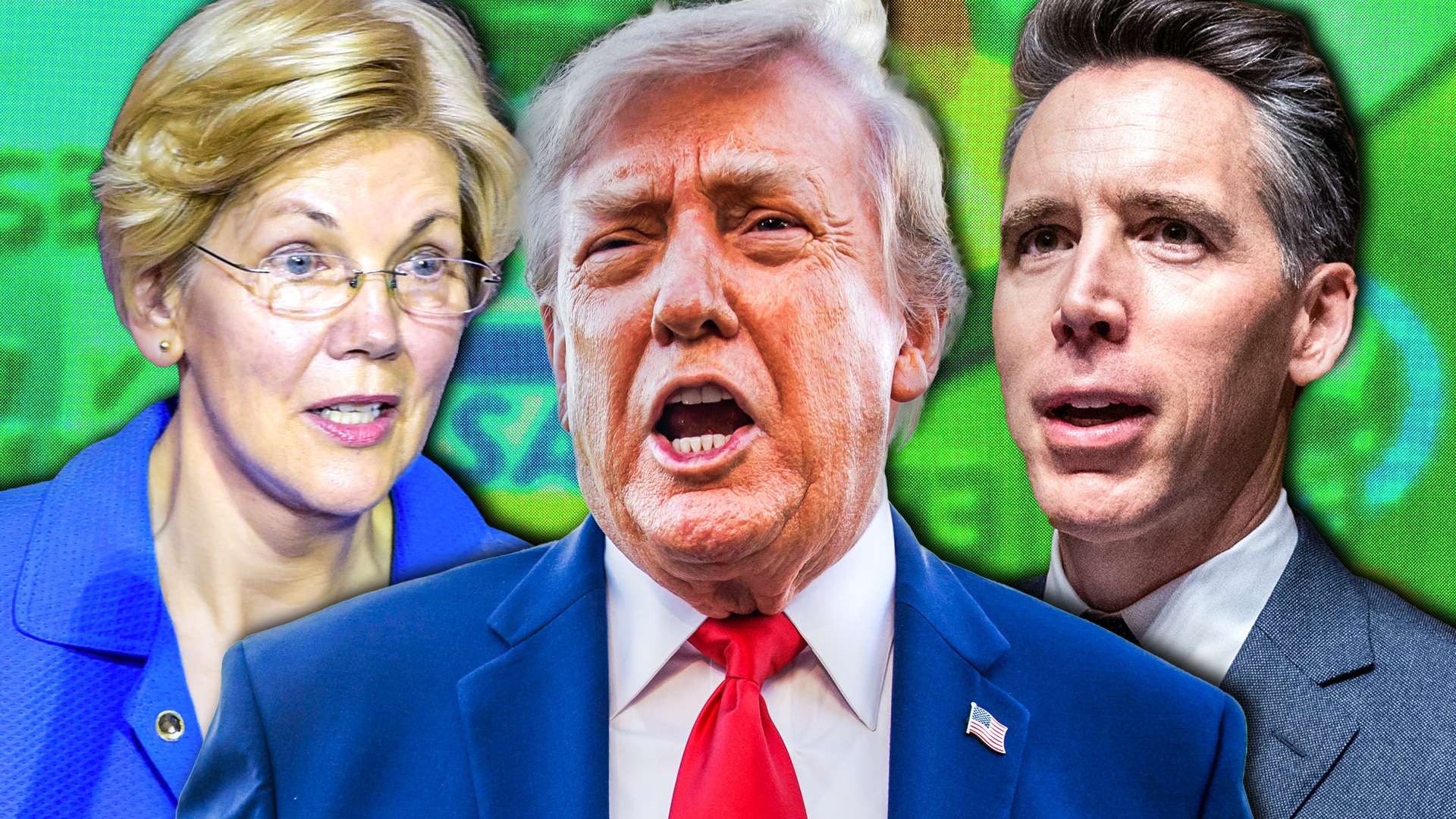
During a Fox News interview over the weekend, President Donald Trump indicated support for legislation that would cap credit card interest at 10 percent and said he would be willing to work with Democrats in the next Congress to enact such a cap.
Trump argued that the notion of free enterprise falters when a bill is drafted by someone in a Park Avenue office and proposes charging an excessively high fee.
This isn’t Trump’s first time backing rate caps, nor his first time framing the stance as exposing Americans to being “ripped off” by credit card lenders—who, after all, simply extend credit to those willing to purchase it.
But this time, his call for government involvement in credit markets is drawing attention from both parties.
Warren amplified Trump’s remarks on X, urging that credit card interest rates be capped to save money for Americans.
The president is right, wrote Sen. Josh Hawley (R–Mo.) on X. “Let’s pass my bill to cap credit card interest fees.” That measure is co-sponsored by Sen. Bernie Sanders (I–Vt.). Not to be outdone, Rep. Alexandria Ocasio-Cortez (D–N.Y.) has a similar proposal as well.
With so many prominent politicians pushing the idea at once, skepticism is prudent, and there is a real risk that such caps would hurt the very people they’re meant to help.
A 10 percent cap on credit card interest would likely disrupt the credit card industry’s current business model, as noted by Paul H. Kupiec, a senior fellow at the American Enterprise Institute, in a study published earlier this year.
If you genuinely believe lenders are taking advantage of Americans, dismantling the sector might seem acceptable or even necessary.
But the disruption could fall mainly on those already struggling. Kupiec notes that it would be hard to maintain access to traditional cards for customers with low-prime and subprime credit under a 10 percent cap.
In a narrow sense, a nonexistent monthly statement might appear cheaper than one carrying a 22 percent monthly rate. (The country’s median rate sits around that level, though actual rates vary by lender, card perks, and of course your credit score.)
Yet erasing credit cards altogether would entail significant tradeoffs in terms of financial flexibility.
That could push more Americans toward other, possibly illegal sources of credit. Illegal lending surged when South Korea experimented with rate caps a few years ago. Others will simply have to accept a lower standard of living that comes with reduced access to credit.
You might argue that this is a desirable outcome. Easy access to credit cards has enabled some to live beyond their means. Americans carry record levels of credit card debt. Something needs to be done.
But personal financial responsibility cannot be imposed at gunpoint. It is even less likely to emerge from a government policy marketed as a blow to Wall Street—or “Park Avenue,” as Trump phrased it. This is a problem that demands individual agency, not government policy. Want to stop paying 22 percent in interest charges every month? You could stop using the credit card, or you could learn how to use one responsibly. The government shouldn’t eliminate the second option.
When the federal government withdraws credit cards from the hands of Americans who are already struggling to make ends meet, I doubt many will view Trump, Warren, and Hawley as liberators.
