
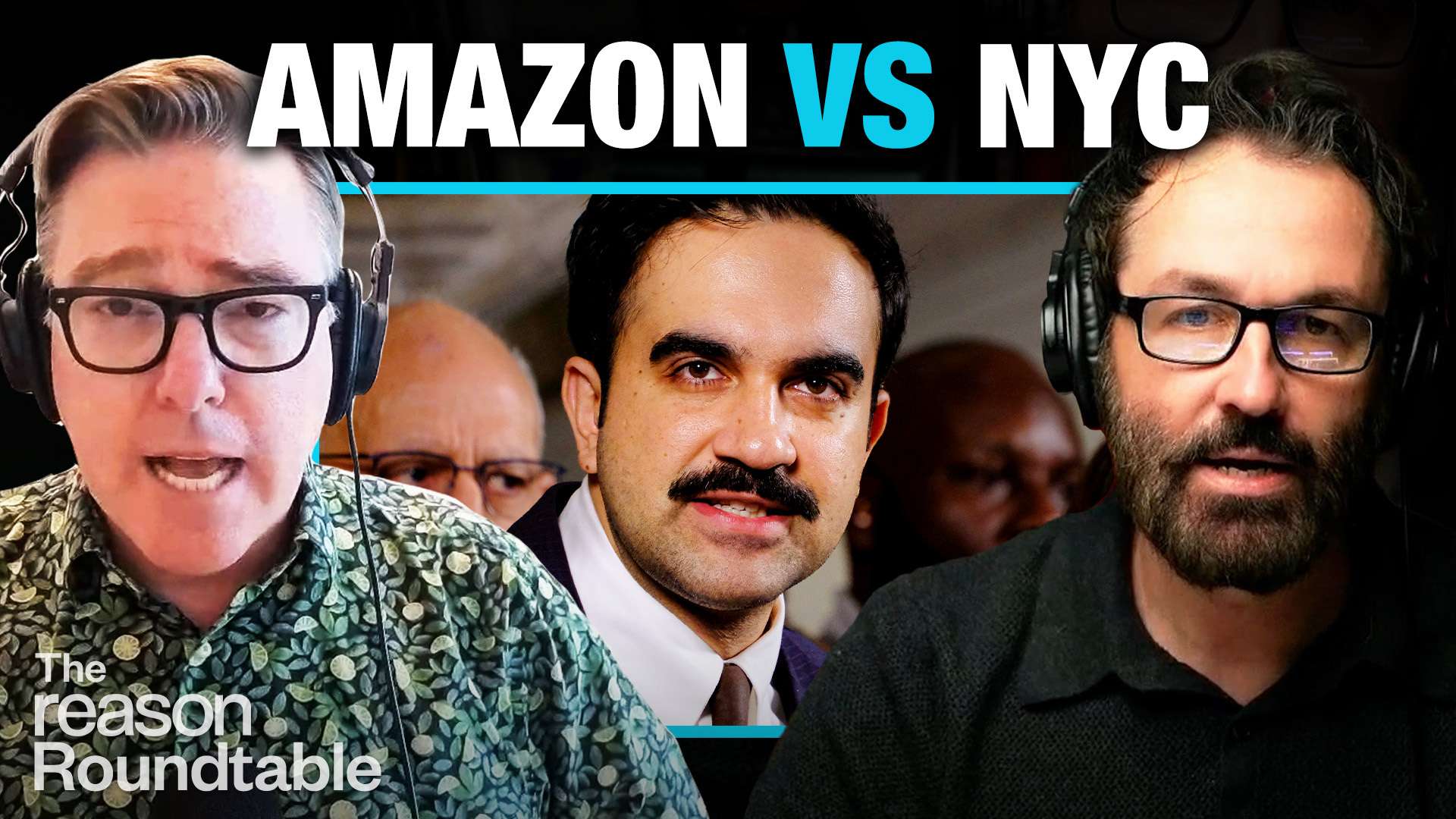
Additionally: Warren and Hawley’s cap on credit-card interest, El-Sayed’s TrumpCare pitch, and Huang’s return to Nvidia.
HD Video Download
This week, editors Peter Suderman, Katherine Mangu-Ward, Nick Gillespie, and Matt Welch examine New York City Mayor Zohran Mamdani’s clash with Amazon over proposed rules that would require delivery workers to be treated as full-time employees rather than independent contractors. As Amazon warns that prices could rise or service could degrade, the editors analyze how the measure might undercut Mamdani’s affordability pledges. They also assess the role of labor unions and the burdens of imposing new regulations on businesses.
The discussion then shifts to a bipartisan plan from Senators Elizabeth Warren (D–Mass.) and Josh Hawley (R–Mo.) to establish a 10 percent ceiling on credit-card interest. The editors consider how such a cap could limit access to credit, especially for lower-income Americans. Next, they review Sen.-elect Abdul El-Sayed’s (D–Mich.) strategy to persuade President Trump to back Medicare for All in a bid framed as TrumpCare. The panel further examines reports about Trump’s involvement in restoring Nvidia’s CEO Jensen Huang after allegations of Chinese espionage, and examines the corruption risks that arise when government intervention touches the technology sector. Finally, a listener asks whether Mamdani’s democratic socialism bears any meaningful resemblance to the authoritarian forms seen in countries like Venezuela and the Soviet Union.
Ask The Reason Roundtable questions LIVE on December 1 at 1 p.m. Eastern. Watch here: https://youtube.com/live/fx93MmI2S_U
0:00– Mamdani’s clash with Amazon
14:20– Credit-card interest caps
23:39– What the editors ordered from Amazon
27:48– El-Sayed’s TrumpCare proposal
32:58– Listener question on socialism
40:54– Huang’s reinstatement at Nvidia
50:08– Weekly cultural recommendations
Mentioned in the Podcast:
“First They Came for My Amazon,” by Liz Wolfe“This Mamdani-Backed Bill Would Kill Jobs, Boost Unions, and Make Deliveries More Expensive,” by C. Jarrett Dieterle and Adam Lehodey“Regulators Shouldn’t Punish Amazon for Making Delivery Better,” by Ethan Tran“Unionized Delivery Drivers Vs. Deliveries,” by Christian Britschgi
“The Flawed Economic Populism of Capping Credit Card Interest Rates,” by Eric Boehm“Capping Credit Card Interest: An Idea So Bad that Both Democrats and Republicans Support It,” by J.D. Tuccille“Price Controls Don’t Work. So Why Do So Many Democrats and Republicans Love Them?” by Veronique de Rugy “In Defense of Payday Lending,” by Nick Gillespie and Jim Epstein“Payday of Reckoning,” by Katherine Mangu-Ward
“The DSA’s Coming-Out Party,” by Matt Welch“Social Security Benefit Cuts Are Coming. Congress Has a Choice,” by Veronique de Rugy“Bernie Sanders Wants To Use Democrats’ Midterm Victory To Expand Medicare. Has He Looked at Europe?” by Reem Ibrahim“Failures of Canada’s Single-Payer Health Care Highlight the Flaws of ‘Medicare for All,’” by J.D. Tuccille
“Huang Is Back,” by Liz Wolfe“Inside the Administration’s Chip Divide,” by Liz Wolfe“Trump’s New Chip Export Rule Targets China but Exempts TikTok’s Parent Company,” by Tosin Akintola“The Most Corrupt Presidency in American History, by the Numbers,” by Matt Welch
“Substackers Battle Over Banning Nazis,” by Elizabeth Nolan Brown“Are Newsletters the Future of Free Speech?” by Matt Welch“Is the New Hunger Games Movie a Critique of Government or Capitalism?,” by Peter Suderman “The Myth of the Passive Indian,” by Amy H. Sturgis“Native Americans Taught Colonists How To Fight—and To Live Without Kings,” by Charles C. Mann
What are we consuming this week?
Peter Suderman
-
The Hunger Games: Sunrise on the Reaping
Katherine Mangu-Ward
-
A Discovery of Witches, by Deborah Harkness
Nick Gillespie
-
How To Save the Media, by Hamish McKenzie
Matt Welch
-
1491: New Revelations of the Americas Before Columbus, by Charles C. Mann
