
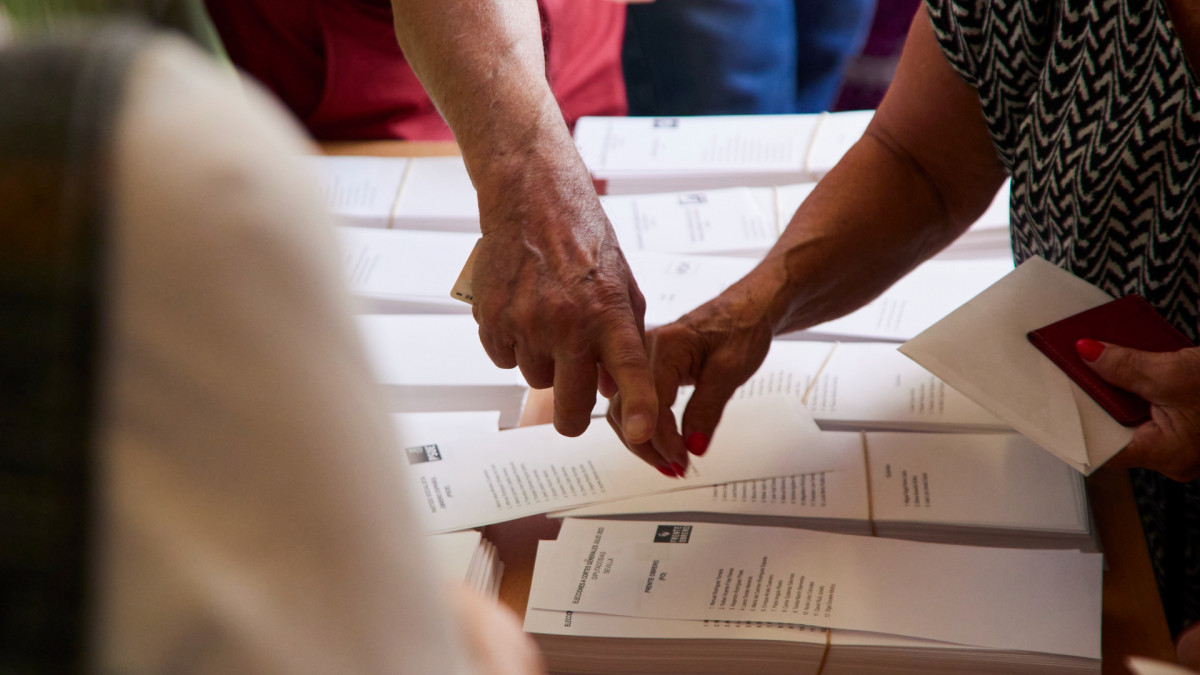
The final week of the campaign opens with the difficult task of convincing those who still do not know whether to vote, and if they vote, whom to vote for. If we look at the CIS post-election polls of the last four general elections, and if their average were repeated, 13% of voters who go to their polling station would decide this week how to fill a ballot that is currently blank.
If we start from a hypothetical distribution of the rest according to the survey average, the PSOE would need to surpass the PP by a little over eighteen points among those who decide this week in order to overtake the party at the head of the latest polls. It is a calculation conditioned on the assumed distribution of the vote.
“The PSOE would need to surpass the PP by a little over eighteen points among those who decide this week in order to overtake the party at the head of the latest polls”
The 13% is the average of four responses to equivalent questions: 10.2% in June 2016, 15.7% in April 2019, 10.4% in November of that year, and 15.9% in July 2023. If we add those who waited until the day of reflection or even the same Sunday, the average rises to 19.8%, and in 2023 it reached 26%. The November barometer places 13.8% of respondents as not yet knowing who they will vote for, although a declared voting intention in a survey can precede the elector’s final decision.
Estimating how many people we are talking about is tricky. We are dealing with human beings and, despite the efforts of the social sciences to refine their methods to approach those of the natural sciences, free will carries weight.
Turnout: a three-point swing
There are several ways in which we can try to extract that data, and all begin with knowing how many people will vote. Since 2008, neither postal voting nor the distance between the two leading parties shows a clear positive relationship with turnout. The audience of the most-watched debate, weighted by the census, offers a modest relationship (0.46): the face-to-face debate on the 19th gathered 10,152,000 viewers, and that figure would alone point to about a 72% turnout.
There are two references that allow us to better guide the estimate. The first is the type of call: since 2008 ordinary general elections have averaged a 74% turnout of residents and those repeated or held in summer a 70%, and Sunday elections are ordinary. The second are the prior polls: in the last six general elections, the turnout estimated by the institutes diverged from the actual by an average of 1.7 points, and the two that published it for November 29, Celeste-Tel and DATA10, placed it around 69% at the beginning of November.
“Since 2008 ordinary general elections have averaged a 74% turnout of residents and those repeated or held in summer, a 70%”
That figure falls short of the one argued here, and the reason lies in the history of the polls themselves. Since 2016 the institutes have estimated turnout close to 70% in all general elections, regardless of the call. They were right in the three that were repeated or held in summer and fell almost six points short in the single ordinary one, April 2019, which rose to 75.75%. Their fieldwork is also conducted before the campaign and the face-to-face event, so in this estimate polls carry less than a quarter weight, compared with almost three-quarters for the type of call.
A combination of these methods, weighting the indicators according to their results in previous convocations, would give us a turnout for these elections of 73% of the residents in Spain, which is the figure known on election night. The indicative range, between 71.5% and 74.5%, takes as reference the average retrospective error of the method, 1.4 points, although its worst case, April 2019, was three. With only seven elections, the range lacks the proven coverage of a statistical prediction interval.
The exercise: the ballots yet to be filled
That is, if the 13% of post-election polls were repeated, between 3.35 and 3.5 million voters who will vote would decide this week which party to vote for, not counting those who do so on the day of reflection or on Sunday. In an imaginative example, if we take the average of the polls and subtract that undecided mass, with a turnout of 73% we would hypothetically assign 7.1 million votes to the PP, 6.5 million to the PSOE, 4.2 million to Vox and 1.4 million to Frente Amplio. There would remain 3.4 million ballots to fill in the simulation.
“If the 13% of post-election polls were repeated, between 3.35 and 3.5 million voters who will vote would decide this week which party to vote for”
It is a speculative exercise, because it assumes that the vote of the rest of the electorate is distributed as the polls say, but it has the following aim. The PSOE sits in that average behind the PP by 2.7 points, which, applied to the remaining population, would amount to about 616,000 voters. The mass deciding this week is more than five times larger, so that, if the rest of the distribution remained fixed, the PSOE would overturn the result with a little over eighteen points of advantage over the PP in that group, for example, with a 41% versus 22%. The PP, for its part, could lose among those undecideds and keep first place as long as the margin did not exceed that threshold.
The closest precedent spans a broader period than the simulation. In 2023, according to the recall cross by post-election voting, the last week or afterwards decided 25.7% of PSOE voters and 19.8% of PP voters. The sample recalls more socialist votes than there were, and those proportions are not enough to forecast the distribution of late voting. The most plausible scenario is that the PP maintains first position, though the gap could narrow if late-vote distribution favored the PSOE without reaching the simulation’s threshold.
Who decides late and why
According to what we know from different CIS studies, these last-minute undecideds move for different reasons, and the first thing to rule out is that they form a homogeneous group. Age helps reveal those differences: in November 2019, the last week or the same day the 24.5% of those under 25 and the 5.7% of those over 64 decided. The doubt about the party must be added to the doubt about turnout, because 27.8% of those who voted in 2023 thought at some point during the campaign that they would not vote. The decision, moreover, can change, since 18.6% changed their mind about their vote at least once and more than half of them, 55.2%, did so in the last week.
“The doubt about the party must be added to the doubt about turnout, because 27.8% of those who voted in 2023 thought at some point during the campaign that they would not vote”
Asked about the reason for their vote in an open-ended question whose responses the CIS had not yet completely coded, only 0.8% cited the electoral campaign, and yet one in eight voters decides in the last week, if we take the average of the four post-election polls. The contradiction is apparent, because the campaign can intervene at the moment a doubt is resolved without the voter identifying it as the reason for their vote. Part of the parties’ effort this week has to do with mobilizing soft voters, especially since the pending decision may be whether to go to the polling station.
The latest poll and the ballot that remains
Monday was the last day on which the electoral law allowed the publication of polls, so decisions after fieldwork will be outside the measurement, even though the surveys had captured those voters’ prior preferences. On July 17, 2023, on the eve of the silence, the average of private polls placed the PP near 35%, the PSOE at 28%, and the sum of PP and Vox at 176 seats. Six days later, the ballot boxes left the PP at 33.05%, the PSOE at 31.7%, and the two right-wing parties at 170 deputies. A seven-point gap remained at a little over one, in an election in which one in four voters later said they had decided that week or at the polls themselves.
“Seven points of distance remained at a little over one, in an election in which one in four voters later said they had decided that week or at the polls themselves”
The 2023 data do not allow attributing all the difference between polls and results to those who decided late. What arithmetic does say is how much their vote can weigh: if they represent 13% of the electorate that goes to the polls, every ten points of advantage of one party over another in that group add a little more than one point to the final margin between them. There is also a ballot that polls scarcely address, the one that arrives blank at the ballot box, which the law counts as a blank vote and thus as a valid vote. From midnight Monday to Tuesday it is forbidden to publish or disseminate polls, and on Sunday at eight in the evening the booths will open the ballots one by one, including those submitted when there were no polls to count.
