
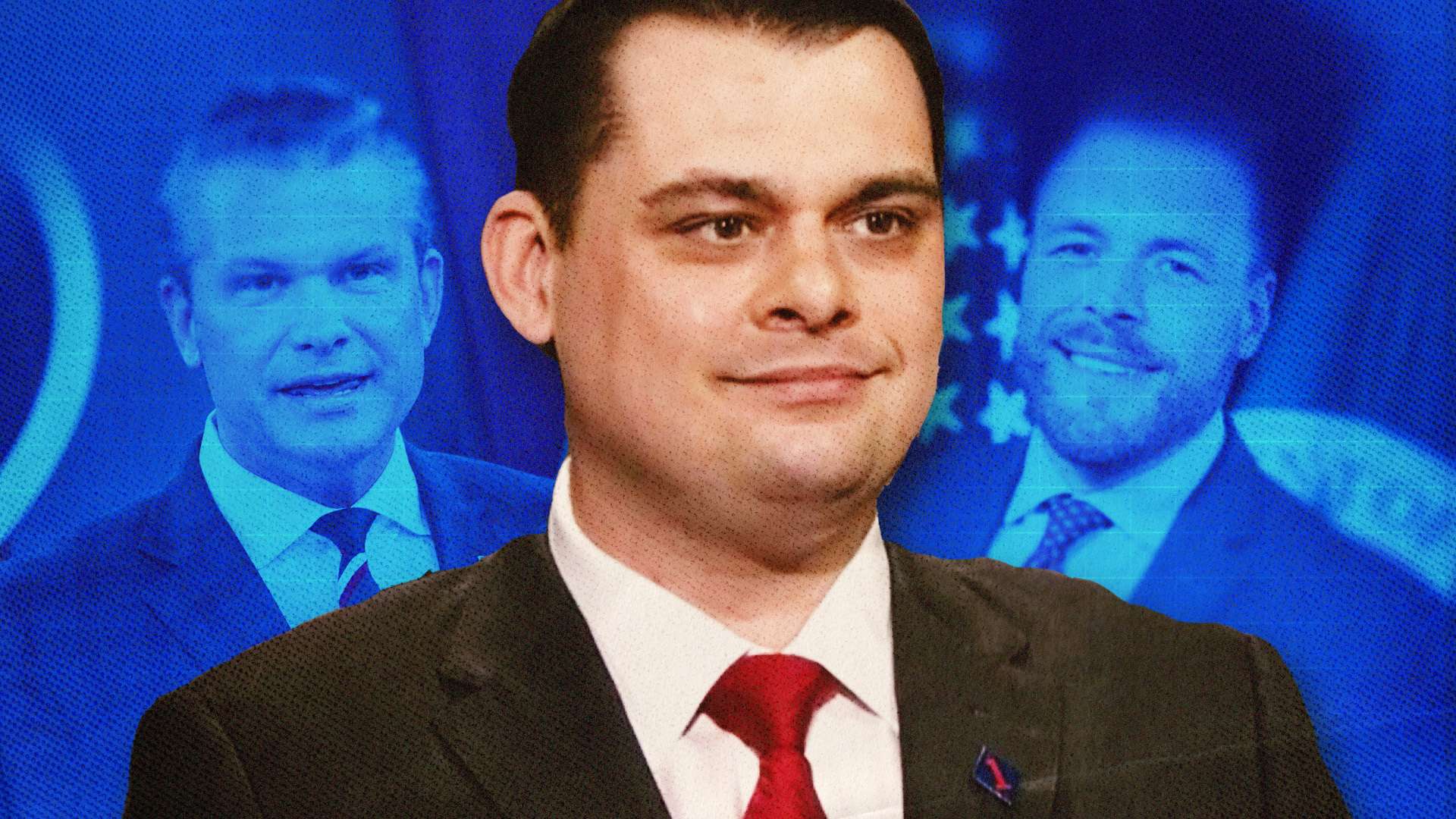
An adviser with libertarian leanings was expelled from his post at the Pentagon amid a clash between hawkish voices and dove-leaning factions.
Dan Caldwell became one of the casualties in the early power struggles within the Trump administration. Shortly after the inauguration, hawkish factions labeled Caldwell, a libertarian-leaning adviser to War Secretary Pete Hegseth, as a principal adversary. A few months later, Hegseth’s then–Chief of Staff, Joe Kasper, terminated Caldwell and two others over alleged leaks to the press. Caldwell consistently maintained his innocence.
Kasper has just cleared Caldwell’s name in a stunning interview with Politico, published on Monday. The interview largely scrutinized Hegseth’s leadership, which Kasper characterized as self-serving and inept. (The Pentagon told Politico that Kasper is a “disgruntled former staffer” who is “peddling made-up gossip.”) Kasper referenced the dismissals of Caldwell and the other two, making it clear that the inquiry found nothing substantive.
Reason contacted both Kasper and Caldwell. Kasper did not reply. Caldwell chose not to comment, given his ongoing government work.
“Since the OSI — the Office of Special Investigations — wrapped up its inquiry earlier this year, it has been clear that the allegations of leaking confidential material were baseless, and I’m glad one of the lead investigators has acknowledged they were fabrications,” says Darin Selnick, a former Pentagon official who was also charged with leaks, to Reason. “We were never questioned by the OSI, and going forward I would like the OSI report to be released and for the three of us to be formally exonerated by the Department of War.”
The exoneration of Caldwell and his colleagues echoes the initial partisan skirmishes that shaped the Trump administration’s approach to foreign policy. At the start of his second term, Trump assembled a spectrum ranging from aggressive hawks to dovish moderates. The ensuing months devolved into a cycle of bitter factional bickering, and despite earlier setbacks, the hawks prevailed. By the end of 2025, Trump had either launched or broadened several overseas conflicts, culminating in what the hawks had long desired: a regime‑change war against Iran.
In those debates Caldwell offered a libertarian-leaning perspective. Prior to joining Hegseth’s circle, the ex-Marine served with Defense Priorities, an outfit created by Rand Paul’s protégés and by associates of Charles Koch.
Hardline conservatives and other hawks quickly laid the blame for their reversals at Caldwell’s feet. After Hegseth brought in several dovish aides, David Wurmser—a former Bush administration strategist—told Jewish Insider that Caldwell was populating the Pentagon with his “Koch crowd,” described as either isolationist, anti-American, or both. Fox News also carried segments critical of the new appointees without naming Caldwell outright.
The underlying tensions spilled into the open due to a separate incident: NBC News obtained leaked plans from the Trump administration to invade Panama in March 2025. A few days later, then-National Security Adviser Mike Waltz accidentally added a journalist to a Signal thread meant for Yemen-war planning. Waltz and Kasper spiraled into a fevered hunt for leaks, which quickly escalated into a purge, according to New York Magazine.
In April 2025, Pentagon security escorted Caldwell, along with Darin Selnick and Colin Carroll, another associate, out of the building. Hegseth tried to weaponize the dismissals as a diversion from the Signal affair, telling reporters that “a few leakers get fired and suddenly a lot of hit pieces surface.” Not long after, Kasper resigned from the Pentagon. Hegseth, who kept him on as a part-time adviser, described Kasper as “a fine man, a great American” who “has done a wonderful job for us.”
When Caldwell was dismissed, he argued that he had been set up partly because he favored steering clear of conflicts in the Middle East. “I advocated positions that should not be controversial yet were,” he told conservative commentator Tucker Carlson.
While Caldwell cast Hegseth as a partner in resisting the hawkish consensus, Hegseth would soon emerge as the public symbol of Trump’s military campaigns. “Pete, I think you were the first to speak up and say let’s go ahead,” Trump told reporters in March 2026, alluding to the ongoing assault on Iran.
As for the leak probe, it produced little of consequence. Twelve months after it began, the administration rehired Caldwell to serve in the Office of the Director of National Intelligence, a strong signal that he was not deemed careless with classified material. Yet it was only this week that someone—Kasper—went on record to formally exonerate the ex-suspects.
Today, the prospects for the Pentagon hawks have cooled. The Iran conflict is widely blamed for Republican losses in the midterms, and Hegseth has drawn ire from both sides of the aisle. Rep. Thomas Massie (R–Ky.) led a failed impeachment bid against him over war-crimes allegations earlier this month, while Sen. Ted Cruz (R–Texas) warned that “he will either resign of his own accord or be dismissed by Trump.”
Just as some Democrats have come to regret their hawkish stances, a number of Republicans appear to be experiencing similar buyer’s remorse. “History will likely be far harsher on [Hegseth] than I could be,” Kasper told Politico.
