
That norm changed because there were women who spoke out loud, asserting that what was presented as natural law was an arbitrary construct that could be revised. The vote for women, access to higher education and the labor market, the right to manage one’s own patrimony, and equal pay: each advance was an act of collective rectification, by a society that admitted, even if it took generations to do so, that it had erred. From this we can draw a double lesson. Social norms can improve, but they can also be re-examined.
“Each advance was an act of collective rectification, a society that admitted, although it took generations to do so, that it had been mistaken”
In Spain, gender-based violence took longer to enter that list of changes. In December 2004, Organic Law 1/2004, on Measures for Comprehensive Protection Against Gender Violence, was achieved with a level of parliamentary and social consensus hard to imagine today. Several factors made it possible: sustained mobilization by feminism and women’s associations; television coverage of cases like that of Ana Orantes, which moved public opinion; support and impetus from international bodies such as the United Nations; and the will of a newly elected Socialist Government.
What has changed since then? The institutional consensus has weakened: the State Pact against Gender Violence of 2017, approved under a PP government, passed the Senate unanimously, though the conservative government’s commitment did not go far enough to guarantee an adequate budget for its implementation. Ultimately, its renewal in 2021 occurred without the backing of Vox, which rejects the very concept of gender violence and its framing as a structural phenomenon in our societies. But perhaps the more important erosion is in public opinion consensus. In a few years the frame has shifted from one centered on human rights and victim protection to another that presents equality progress as part of a “culture war” and argues that feminism is going too far.
This questioning has found a powerful loudspeaker in social media. Influencers, YouTubers, and digital communities amplify arguments aligned with the radical right and contribute to weakening the consensus that made possible, just two decades ago, the approval of the aforementioned Comprehensive Law Against Gender Violence. These contents reach especially young people, who are often still constructing their political and social reference frameworks. We do not know precisely how wide their influence is, but we do know that normalization typically precedes acceptance: what ceases to seem extreme begins to be perceived as a legitimate option within public debate.
“Normalization often precedes acceptance: what ceases to seem extreme begins to be perceived as a legitimate option within public debate”
A case in point is Jordi Wild. The famous YouTuber with almost eight million subscribers is the star of the campaign: he managed to seat three candidates in his Manresa bedroom for interviews: Colau, Feijóo, and Sánchez. Abascal was the first to publicly accept the challenge, but the interview ultimately did not take place. Jordi Wild is not exactly known for endorsing gender equality policies. In a study published in a scientific journal we analyzed the content disseminated across his platforms during three months of autumn 2022 and documented the presence of arguments critical of feminism and challenges to various equality policies. Nevertheless, in the interview with Colau (episode 391 of The Wild Project), Wild condemned femicides. But he also minimized the figure of forty-four women murdered by comparing it to the country’s population and to murder rates in other countries. A comment that sparked numerous online criticisms and for which he later apologized.
Despite Wild’s apologies, that misstep shows how easily we can fall into the error of viewing femicides as individual misfortunes: that weak woman who chose poorly her partner or failed to leave a toxic relationship. It is the line of reasoning that sustained the norms of the past, when violence within a relationship was considered a private matter. Understanding this violence as a social problem, rooted in power inequalities between men and women, allowed the transition from compassion to recognition of rights and, from there, to the development of public policies. However, these remain clearly insufficient and do not manage to shield women as they should. One clear sign is that most victims do not dare to report for fear of the consequences: rapid judicial procedures that demand almost impossible evidence, the possibility of a drastic drop in earnings, or even the fear of losing custody of their daughters and sons. The research on the factors that facilitate or hinder reporting remains very limited. We need more resources to better understand how violence victims face this painful and complex decision and what tools can help them take this step with greater protection.
“Understanding this violence as a social problem, rooted in the power inequalities between men and women, allowed the transition from compassion to recognition of rights and, from there, to the development of public policies”
With the exception of this scarcely discussed episode, the silence around gender equality and male violence in the 29N electoral campaign is striking. These topics have lost prominence, at least compared with the 2023 elections. They did not even feature prominently in the televised head-to-head between Feijóo and Sánchez, which focused more on issues such as corruption, the economy, immigration or housing. However, when a topic disappears from the debate, it does not disappear from the political agenda. What is not proclaimed at rallies is written into programmatic documents: Vox explicitly commits to repealing gender laws (p. 30, point 47 of its program), accusing them of having “criminalized men.”
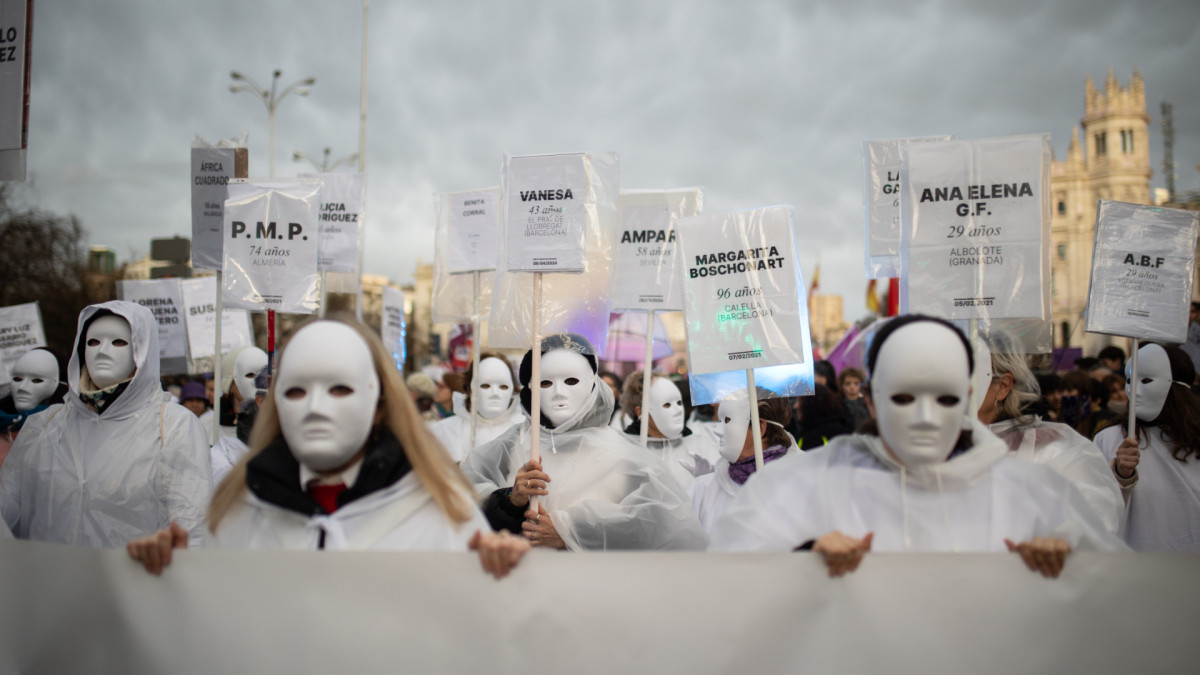
Yet numbers do not lie. Since official records began in 2003, 1,388 women have been murdered in Spain by their partners or ex-partners; 47 of them so far in 2026, leaving 38 orphaned children under 18. To this figure one would add women murdered by other men who do not even appear in the gender-violence statistics.
The most disquieting part is that murders are only the most extreme manifestation of a much broader and more persistent phenomenon. The threat of violence shapes the lives of millions of women, curtails their freedom, and erodes their well-being. Moreover, its consequences do not fall solely on the victims: they extend to their families, their surroundings, and society as a whole. It is not by chance that several studies have concluded that this form of violence, on a global scale, incurs a cumulative cost greater than that of wars and terrorism combined. A cost too high to ignore.
“The threat of violence shapes the lives of millions of women, curtails their freedom and erodes their well-being”
If today it seems inconceivable that a woman would need her husband’s permission to open a bank account, it is worth recalling that advances are never irreversible. What one generation wins, the next may question if it stops defending it and, above all, naming it. On the next 29N, the public will decide not only who will govern our country, but also which problems deserve attention, which will cease to occupy the center of public debate, and ultimately, what kind of society we want to preserve and which democratic consensus we want to protect.
