
The abundance on your Thanksgiving plate stands as an economic marvel produced by capitalist markets.
Wishing you a Happy Thanksgiving!
This year, the typical Thanksgiving feast crept up by six percent in price.
Some point to policymakers who fuel inflation by expanding the money supply.
Yet gratitude ought to go to the entrepreneurs and businesspeople who keep discovering ways to deliver meals at lower costs.
Retailers like Walmart offer a complete Thanksgiving dinner for ten people for $35. Aldi provides a similar option for $39.
A more meaningful comparison is the number of hours you must work to afford the meal.
Back in 1986, a worker performing nonmanual labor had to labor 3.22 hours to pay for a Thanksgiving feast. Today, it requires only about 1.79 hours.
Many aspects of life improve over time.
For that, I am grateful.
And I’m thankful that, in today’s United States, charitable aid and abundant food ensure that nobody needs to go hungry.
That certainly wasn’t the case throughout most of history. Hunger was the norm for ages, including here in America.
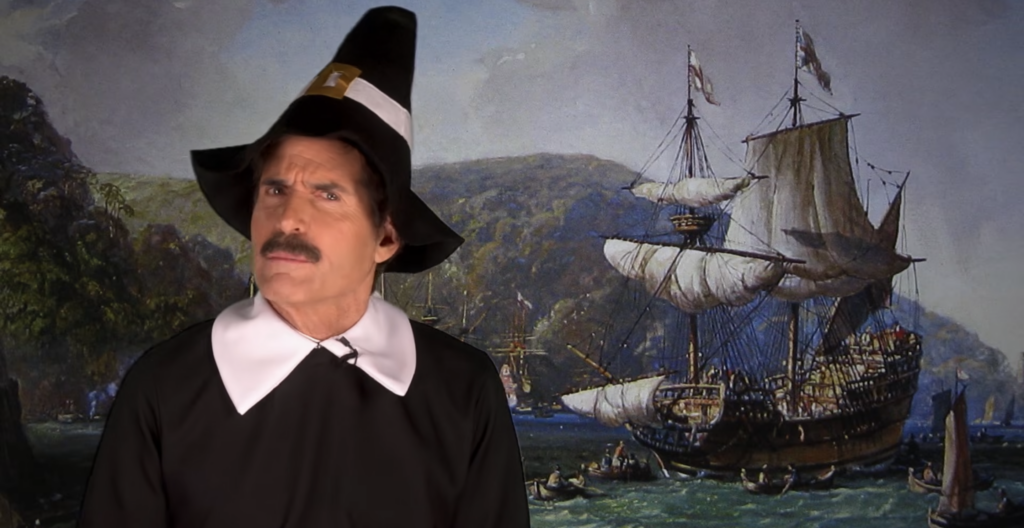
When the Pilgrims landed at Plymouth, they envisaged a peaceful new order where all goods were shared among everyone. Some called it socialism!
In their first year, they pooled the harvest and distributed it evenly, regardless of how much each person contributed.
The outcome was disastrous.
Only a minority of Pilgrims put in significant effort. Many relied on others to carry the load.
Governor William Bradford noted that some pilgrims feigned illness, claiming “weakness and inability,” and that “much was stolen.”
The communal arrangement, Bradford observed, “was found to breed much confusion and discontent and retard much employment.” Nearly half the colony perished that winter.
Had it not been for the aid of the Wampanoag people, more would have starved.
Economists refer to this as the “tragedy of the commons.”
Imagine ranchers sharing a common pasture. Each rancher seeks to maximize his own herd, adding more cattle. Before long, the extra stock devours all the grass, the pasture is exhausted, and everyone loses.
Yet a large portion of Americans still votes for the very system that nearly starved the Pilgrims.
Today, 43 percent view socialism positively—the highest level recorded by Gallup. Among young adults, 57 percent prefer socialism to capitalism.
Americans should remember that we have already experimented with socialism. The enduring abundance we celebrate at Thanksgiving owes its existence to the hard lesson that socialism fails. There is much to learn from that history.
Pooling “public” property may sound appealing, but only private ownership motivates people to work and to conserve what they produce.
In a bid to salvage the colony, Bradford abandoned the socialist experiment. “Every family,” he wrote, “was assigned a parcel of land” to cultivate their own crops.
Private property! Capitalism!
Remarkably, those who had once claimed “weakness and inability” recovered and thrived.
Bradford described the transformation: “It made all hands very industrious, so that much more corn was planted than would have been otherwise… The women now went willingly into the field, taking their little ones with them to help sow the corn.”
Of course they did. They could keep what they produced.
Shortages gave way to surpluses, and that surplus became the abundance we celebrate today.
Yet for many, it is now merely taken for granted.
Today, Americans spend less than ten percent of their disposable income on food. A century ago, families allocated nearly a quarter of their income to nourishment alone.
This bounty did not arise because wise people in Washington managed the food supply or fixed “fair” prices. Government agencies can barely handle routine tasks like the DMV line.
It stems from capitalism: millions of free people engaging in billions of voluntary exchanges. Farmers devise innovations to produce more on less land. Truckers, warehouse workers, and grocers coordinate to move food across the country with astonishing precision. Airlines compete to lower fares, letting families travel home for the holidays.
Entrepreneurs, driven by interest and opportunity, prosper by devising ways to make goods cheaper, faster, and better for everyone.
As you sit down to your meal tomorrow, take a moment to recognize what’s on your plate—the miracle of free markets at work.
COPYRIGHT 2026 BY JFS PRODUCTIONS INC.
