
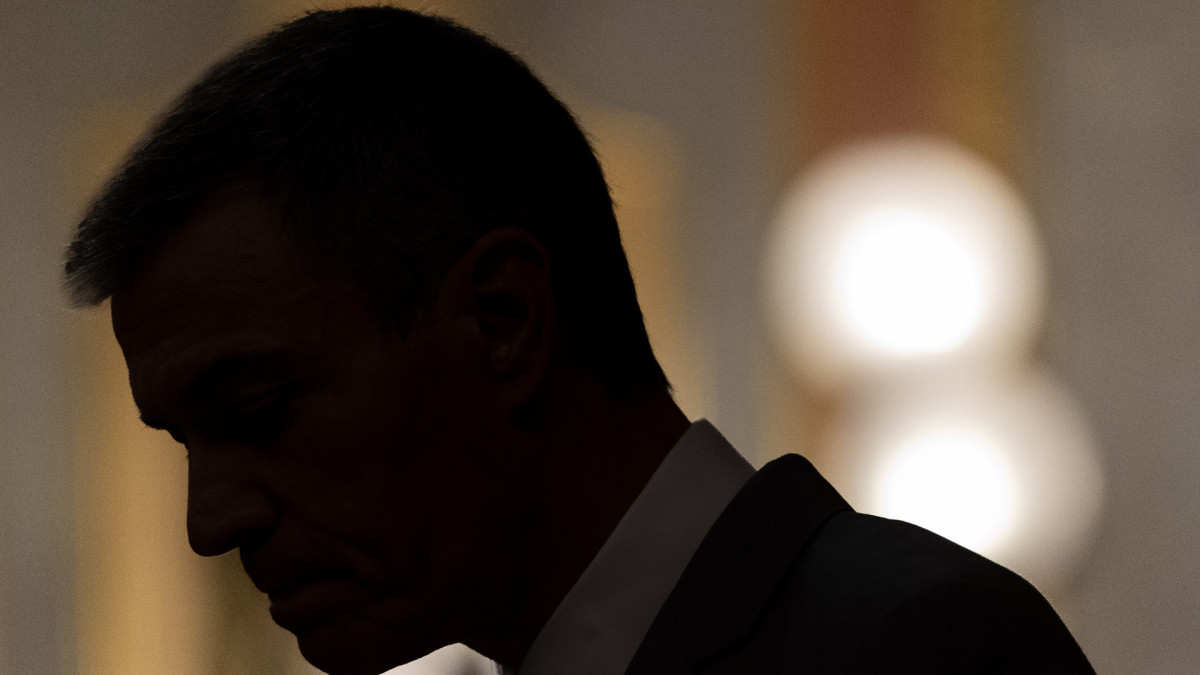
The legislature concluded following the dissolution of the General Courts on October 6 and the calling of elections for November 29, leaving a profoundly contradictory balance. The government of Pedro Sánchez can boast notable results in economic, labor and social matters. However, these advances coexist with a troubling deterioration of institutional quality, a questionable use of certain constitutional instruments, and a tendency to equate defending the general interest with preserving power. Recognizing the former does not excuse the latter.
In the economic realm, the results are positive. Spain has maintained growth higher than that of many major European economies. According to the National Institute of Statistics, GDP grew by 2.7% year-on-year in the third quarter of 2026, while employment reached 22,852,600 people. Although these results stem from a variety of factors, some external to government action, it would be unfair to overlook the contribution of certain public policies.
The 2021 labor reform, whose effects have consolidated during this legislature, has fostered greater contractual stability. The successive increases of the minimum interprofessional wage, set at 1,221 euros per month in 2026, along with the revaluation of pensions and social protection measures, have contributed to improving the living conditions of many citizens.
Naturally, these advances admit important nuances. Unemployment remains high (10.18%); productivity shows structural weaknesses; and access to housing has become one of the country’s main social problems, especially for young people. Economic growth does not always translate into a commensurate improvement in material living conditions.
“Economic growth does not always translate into a commensurate improvement in living conditions”
Also worthy of favorable consideration is the expansion of civil and social rights promoted by the governments led by Sánchez since 2018. The regulation of euthanasia in 2021, equality policies, instruments against sexual violence, child protection, the recognition of LGBTQI+ rights, advances in work-life reconciliation, and support for dependence, among other things, have contributed to broadening the horizon of freedoms and protection for many citizens.
Some of these measures, such as the labor reform, housing legislation or the laws on euthanasia, LGBTQI+ rights, and democratic memory, did not enjoy the backing of the PP and Vox. Nevertheless, it would be incorrect to present all parliamentary activity as a confrontation between blocs: the unanimous approval of the ELA law in 2024 shows that agreement was possible when there was political will.
Thus far, the positives.
The institutional deterioration and the constitutional limits of the Government
The shadows appear, above all, when we shift the focus from the results of government action to the manner in which power is exercised.
The first concern refers to the proper respect for institutions and their independence. In a constitutional democracy, institutions do not belong to the government in power, not even to the parliamentary majority that supports it. Therefore, attempts at partisan colonization of oversight bodies, pressures on the judiciary, or the delegitimization of those who exercise independent institutional functions deserve severe criticism.
“In a constitutional democracy, institutions do not belong to the government in power, not even to the parliamentary majority that supports it”
It is particularly troubling the tendency to present institutional controls as political obstacles and unfavorable judicial decisions as manifestations of a supposed opposition to the government. It is legitimate to disagree with a judicial ruling. What is incompatible with a demanding constitutional culture is to fuel from political power distrust of judges and courts merely because their decisions do not meet expectations.
A second shadow resides in the weakness of legislative activity. During this legislature only 34 laws were enacted, compared to 118 in the previous one. This scant output reflects the government’s difficulties in forging stable majorities, but also a worrying loss of the Parliament’s capacity to carry out its legislative function.
Added to this is the frequent resort to the decree-law, conceived by Article 86 of the Constitution for situations of extraordinary and urgent need. Its repeated use, especially when it responds more to the difficulties of negotiating a law than to genuine urgency, blurs the centrality of the Cortes and reduces opportunities for parliamentary deliberation and amendment. Not every use of the decree-law is abusive, but its normalization as an ordinary tool of governance is constitutionally questionable.
“Not every use of the decree-law is abusive, but its normalization as an ordinary instrument of governance is constitutionally questionable”
Even more worrying has been the absence of presenting general state budgets during the entire legislature. Article 134.3 of the Constitution expressly requires the Government to present them to Congress within the prescribed lead time. It is true that the following paragraph allows automatic extension of the previous budgets. But one thing is that the Constitution contemplates that possibility when new accounts are not approved, and quite another that the Executive can repeatedly dispense with the obligation to submit them to the Cortes. This amounts to a flagrant breach of a constitutional obligation.
Nor can we ignore the problems arising from certain concessions granted to independentist parties to secure the continuity of the parliamentary majority. The amnesty law constitutes its most controversial expression. Although the Constitutional Court upheld its constitutionality in essence in 2025, that does not erase political objections regarding the motives and circumstances of its negotiation. And this is independent of whether, in the end, the implementation of this law may have contributed to deflating the political tension in Catalonia.
What is at stake in the November 29 elections?
The reach of these controversies also projects onto the next legislature. The PP proposes to repeal the amnesty and euthanasia laws, restore the crime of sedition, substitute the democratic memory law with a concordance law, repeal the housing law and modify central aspects of the gender law, especially the registral self-determination of sex, among other things. Vox proposes an even broader revision, including the repeal of the labor reform, the gender laws and other social norms (such as those that protect the LGBTQI+ community), in addition to restrictive changes in immigration policy and access to public benefits. In this respect, the near-odio rhetoric that this party uses regarding immigrants is very worrying.
These proposals show that a large part of the rights and policies developed during Sánchez’s governments remain the subject of intense controversy. Their modification or repeal may be legitimate within the rules of democracy, but must also be subject to constitutional limits, especially to the principles of equality, legal certainty and protection of fundamental rights.
At bottom, the principal shadow of this legislature has been a growing confusion between governing and clinging to power. Parliamentarianism demands pacts, bargains and concessions. But it also requires limits, transparency, responsibility and respect for the rules of the game. When political survival becomes the dominant criterion, constitutional principles risk being treated as obstacles to be circumvented.
“When political survival becomes the dominant criterion, constitutional principles risk being treated as obstacles to be circumvented”
It would be unfair, however, to attribute all responsibility for the institutional deterioration to the Government. The opposition has also contributed to a dynamic of polarization, disqualification and deadlock that impoverishes public debate. Defending the rule of law must be a shared obligation, not an argument used selectively against the opponent.
The conclusion is inevitably ambivalent. Spain has advanced in important areas of economic well-being, labor protection and recognition of rights over these past years. These are achievements that deserve recognition, regardless of one’s ideological preferences. But these advances do not justify the weakening of institutions, the trivialization of constitutional obligations or the subordination of the rule of law to the needs of power.
Because a democracy is not measured solely by the rights it recognizes or the prosperity it generates, but also by the strength of its institutions and by the willingness of its rulers to accept limits. Governments come and go, and their policies can be corrected. The deterioration of constitutional culture, however, leaves wounds far harder to repair.
“A democracy is not measured solely by the rights it recognizes or by the prosperity it generates”
Given its enormous significance, all these lights and shadows, as well as the various proposals put forward by the different political parties, will have to be evaluated by citizens when casting their vote on the upcoming 29N. Think it through.
