
Without airline deregulation, perhaps I would have paid more to a state-operated monopoly for the same close brush with danger.
The December 2026 issue of Reason surveys the achievements of Argentina’s president Javier Milei and what remains on his agenda.

Even before we canceled our initial attempt to land in the southern mountain town, I sensed our journey was in trouble. Strong winds had our aircraft bouncing around like a shaken leaf. Throughout the cabin, passengers were sick into the aisles.
To my left, one travel companion muttered prayers at a pace that grew increasingly frantic. In the middle seat, I fumbled rosaries as my hands trembled. On my right, another companion kept a steadier demeanor. “The one time my domestic flight in Argentina actually leaves on time,” he remarked, shaking his head.
The objective of the trip was to admire Bariloche, a beloved lakeside resort tucked in the Patagonian Andes near the Chilean border. Argentina’s domestic airline market had recently been deregulated, making it feasible and affordable to fly there from Buenos Aires, where we had been staying since arriving in the country. If conditions allowed, we planned to ski as well.
Regrettably, the weather wouldn’t even permit a landing.
I’m not typically a jittery flyer. The rational part of my brain reminds me how safe air travel is in the United States, and that usually quiets the reptilian nerves that flit about during ordinary turbulence. But I wasn’t in the United States, and this wasn’t ordinary turbulence. Even more worrisome, the budget airline we chose operated under a framework enabled by the government’s liberalization of the industry. For most of my career, I had supported deregulation. Now I found myself praying that a low-cost, profit-seeking carrier would keep us and the other passengers safe in exceptionally challenging conditions.
With every bob and roll, I became convinced I might witness my own ironic demise.
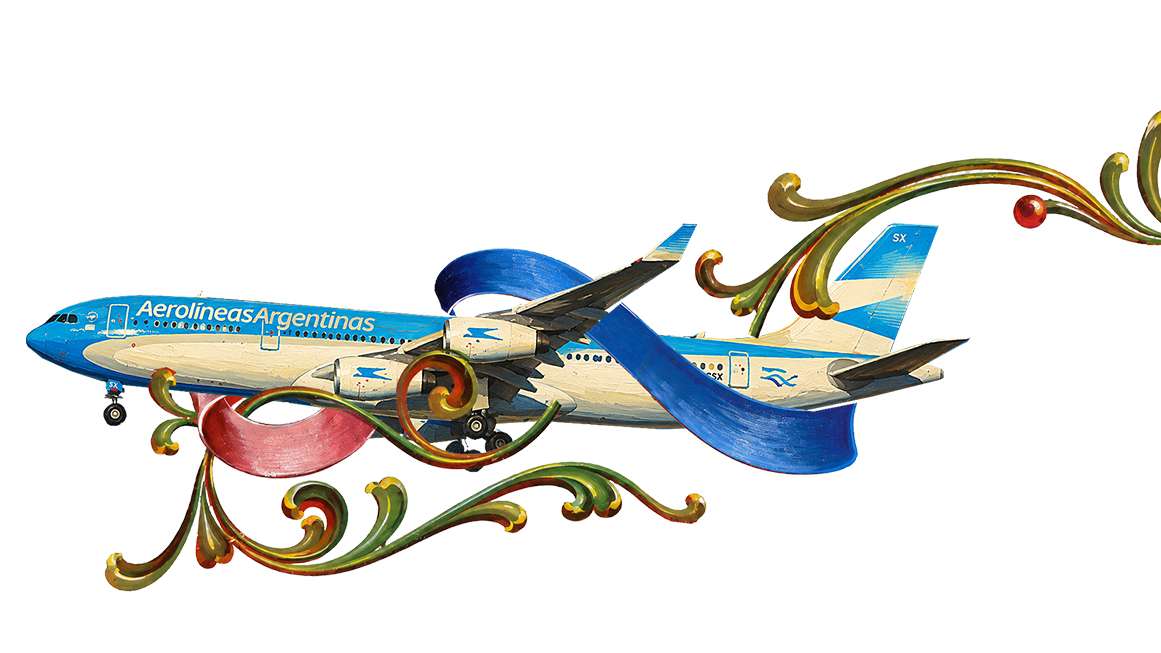
For decades, Argentina’s aviation sector was dominated by Aerolíneas Argentinas, the state-backed flag carrier. The airline was born under President Juan Perón in 1950 and spent many years as a large, protected monopoly under both civilian and military administrations. In 1990 the government attempted to improve its balance sheet by privatizing the airline. Yet it continued to post losses year after year, shielded by continued state protection from competitors.
Renationalization in 2008 did not improve Aerolíneas Argentinas’ finances. Instead, it worsened the government’s fiscal position, with subsidies to the re-nationalized airline reaching $8 billion by 2021. The carrier also became infamous for unreliability. While official on-time statistics remained high, many travelers to Argentina are familiar with the national carrier’s abrupt changes to departure times—and even alterations to which airport a flight would depart from.
From 2019 to 2022, 17 airlines ceased operations in the country as Aerolíneas Argentinas enjoyed preferential treatment and other carriers faced regulatory constraints and union conflicts. Prices climbed while service quality dwindled.
When Javier Milei won the presidency, privatizing the airline was flagged as a prime objective.
That move did not occur. Yet Milei’s deregulation of the nation’s aviation industry does appear to have benefited Aerolíneas Argentinas and the traveling public overall. The airline pruned unprofitable routes and reduced staff. By 2025, it achieved its first operating profit since the 2008 renationalization.
Milei’s “open skies” policy, which loosened price controls and permitted more foreign carriers to operate between Argentine cities, led to an uptick in flight activity. In 2025, a record 50.6 million passengers were carried to, from, and within Argentina.
My plane eventually touched down safely, but we had to stand in line for an hour to collect our luggage, which gave me time to ponder the policy implications of my unsettling experience. Without the lower fares and broader flight options enabled by deregulation, perhaps I would have stayed grounded and avoided the terrifying trip altogether. Or, in a more statist system, maybe I would have paid extra to a state monopoly to endure the same near-miss.
The rosary still clenched in my trembling hand suggested a third possibility. Perhaps there is no single policy takeaway: weather is weather, and prayers can be answered under different regulatory regimes.
We chose to fly with a competing airline on our way out of Bariloche. I figured it would be at least as safe as the carrier we had used to arrive. Divine protection is boundless. Unlike the Argentine government, He can safeguard more than one airline.
