
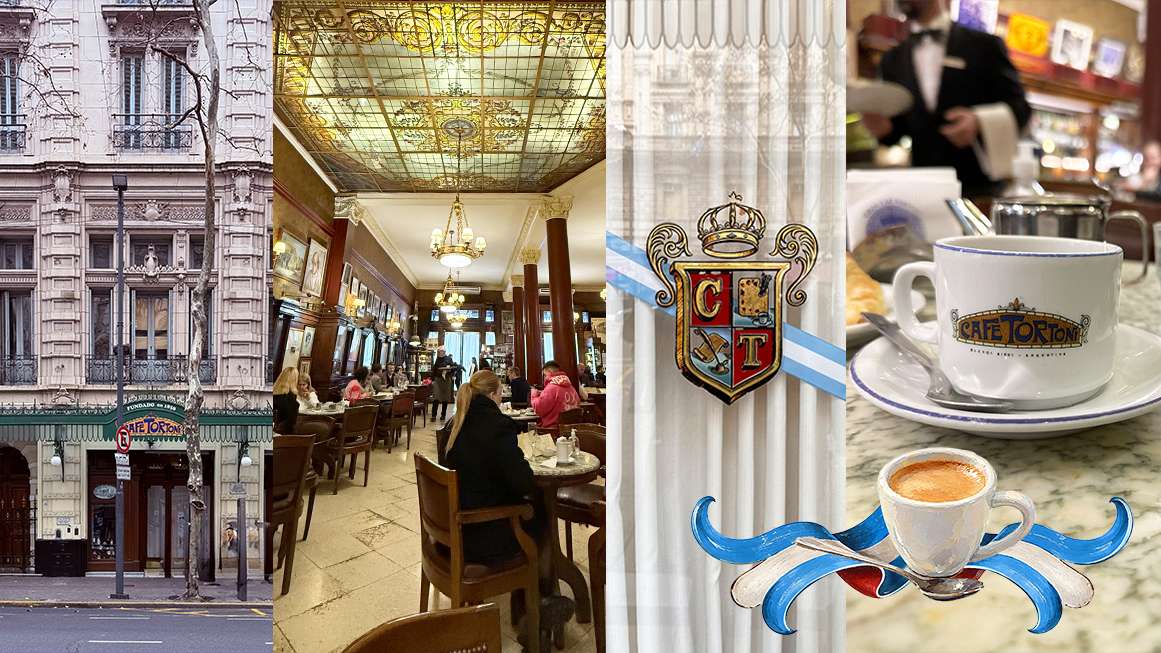
Café Tortoni has long functioned as a cultural crossroads in Buenos Aires for more than 160 years.
The December 2026 issue of Reason reviews the achievements of Argentina’s President Javier Milei and what still lies ahead.

Along Avenida de Mayo in Buenos Aires, a queue forms daily before a café distinguished by a green canopy, gilt letters on glass, and heavy wooden doors. Inside its main hall, three wax figures preside over a marble-topped oak table: Jorge Luis Borges, Alfonsina Storni, and Carlos Gardel. In a separate chamber, a weekly tango performance provides a glimpse into the city’s musical life. The Gran Café Tortoni has operated since 1858—older than the Argentine air force, Peronism, and the peso itself.
Historically, Tortoni functioned as a melting pot for art and ideas and played a part in shaping the city’s literary and artistic world. It welcomed many of the key figures of Argentina’s storied past, and proved resilient through upheavals, outlasting rulers who promised salvation yet left the country battered instead.
The café began with Jean Touan, a French immigrant who arrived amid one of Argentina’s successive waves of migrants. The country was still young—independence had been declared in 1816—and hungry for bold personalities. By the time the café moved from Calle Esmeralda to its present home in 1894, Buenos Aires had begun a remarkable transformation that earned it the nickname “the Paris of South America.” Tortoni’s stained-glass ceilings, along with its oak and leather seating and marble sidewalk tables, rendered the venue a miniature replica of the French capital. The Belle Époque in Buenos Aires mirrored the nation’s growing prosperity: by 1910, it stood among the world’s wealthiest nations.
Argentina’s fortunes were not limited to economic gains. Its cultural and intellectual life flourished, and Tortoni helped sustain it. In the 1920s, artists and thinkers gathered in cafés around the city to discuss art and ideas. One evening in 1926, a group of them (including the renowned painter Benito Quinquela Martín) moved their conversations to Café Tortoni—and kept returning. The group occupied some of the best tables but consumed very little. Wanting to support the intellectuals while also making room for paying customers, Pedro Curutchet, the café’s new owner, eventually approached the group and offered the basement for their gatherings. They accepted the offer and renovated the space themselves.
Within weeks, they founded La Peña del Tortoni, a private club of painters, writers, and musicians who discussed art and ideas and held concerts, poetry readings, and exhibitions. Curutchet told the group that “here one may converse, speak, and drink with moderation, and give the measure of one’s savoir faire. But only art and the spirit have the right to express themselves here without measure.”
In the span of 17 years, La Peña offered Porteños a place to express themselves freely over pastries and cortados. Some of the most renowned and influential cultural figures of the time, including Nobel laureate Luigi Pirandello, poet Alfonsina Storni, writer Federico García Lorca, and tango icon Carlos Gardel, gathered around Tortoni’s oak and marble tables.
By the 1940s, as the famous tertulias were dying down, Argentina had begun experiencing the political turbulence that has characterized much of its history since then. In 1943, the country suffered its second military coup. The final blow came not from the military government, however, but from the Buenos Aires municipal government: It sent La Peña a notice saying the basement failed to meet the municipality’s safety standards, ordering the project to end. Its leaders decided to acquiesce instead of fighting the bureaucrats.
La Peña’s demise wasn’t the end of Tortoni, and the café was a haven for art and free expression during Argentina’s authoritarian years. It remained a place to meet, debate, and enjoy art through successive military coups and various other governments, including the rise of Peronism. Among the personalities Tortoni hosted during the tumultuous years of 1943–1982 were the writer Jorge Luis Borges—who “exchanged verses” with fellow poet Carlos Mastronardi, according to author Laura Arias—and the renowned scientist René Favaloro, who gave a speech where La Peña used to gather.
Tragedies came and went, but Tortoni kept serving its customers. It stood firm through the 1871 yellow fever epidemic, which killed about 8 percent of Buenos Aires’ population. It endured six military coups—one of them among the bloodiest in Latin American history—and operated through periods of hyperinflation. Police shot people mere feet from its doors during the 2001 riots. Through it all, Tortoni answered only to its customers, remaining a place where people could meet over coffee and enjoy cultural offerings.
President Alberto Fernández’s draconian pandemic restrictions brought the place to the edge of demise. Argentina had the world’s longest continuous lockdown, lasting 234 days, among other oppressive measures. The government forced Tortoni to shut down after 162 years of continuous operation—again in the name of “safety”—and it was nearly forced to close its doors forever. As restrictions eased, Tortoni bounced back wounded but undefeated.
Nowadays, Tortoni is mostly a tourist attraction. It still serves coffee and hosts cultural activities, but it has adapted to the changing demands of its customers, who now are more likely to debate through their screens than in groups gathered at a café. Tortoni’s resilience mirrors that of Argentina itself: a society that has struggled through chaos and misrule but keeps managing to push forward. When the café almost closed in 2020, a waiter told an Argentine outlet: “May these 162 years last another 162.”
