
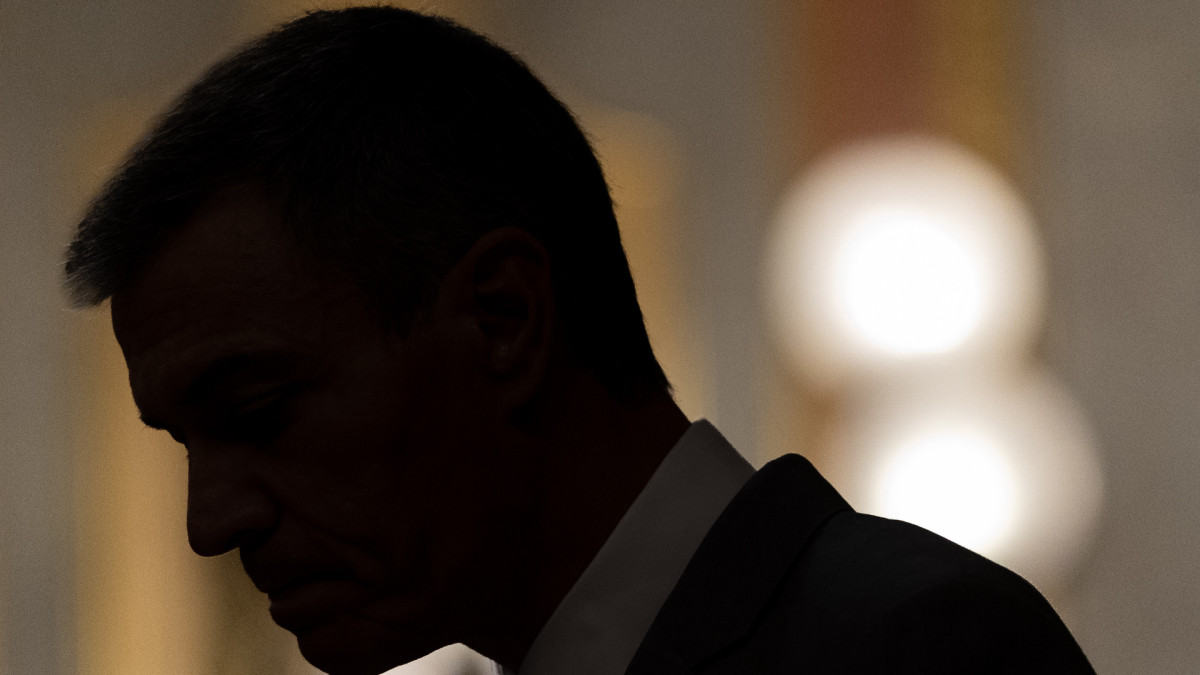
The session concluded following the dissolution of the Cortes Generales on October 6 and the call for elections for November 29 leaves a profoundly contradictory balance. The government of Pedro Sánchez can boast substantial results in economic, labor, and social matters. However, these advances coexist with a worrying deterioration of institutional quality, a controversial use of certain constitutional instruments, and a tendency to equate defending the general interest with preserving power. Recognizing the first does not obligate excusing the second.
In the economic realm, the results are positive. Spain has maintained growth higher than many of the major European economies. According to the National Institute of Statistics, GDP grew by 2.7% year-on-year in the third quarter of 2026, while employment reached 22,852,600 people. Although these results are the result of various factors, some unrelated to governmental action, it would be unfair to ignore the contribution of certain public policies.
The 2021 labor reform, whose effects have consolidated during this legislature, has fostered greater contractual stability. The successive increases of the minimum wage, set at 1,221 euros per month in 2026, the uprating of pensions, and social protection measures have contributed to improving the living conditions of numerous citizens.
Naturally, these advances come with important caveats. Unemployment remains high (10.18%); productivity shows structural weaknesses; and access to housing has become one of the country’s major social problems, especially for young people. Economic growth does not always translate into a commensurate improvement in living standards.
“Economic growth does not always translate into a commensurate improvement in living standards”
Also worthy of favorable assessment is the broadening of civil and social rights driven by the governments led by Sánchez since 2018. The euthanasia regulation in 2021, equality policies, instruments against sexual violence, child protection, the recognition of rights for LGBT people, advances in work-life reconciliation, and support for dependency, among other things, have contributed to widening the horizon of freedoms and protection for numerous citizens.
Some of these measures, such as the labor reform, housing legislation, or the laws on euthanasia, LGBT rights, and democratic memory, did not have the backing of the Partido Popular and Vox. Nevertheless, it would be incorrect to present all parliamentary activity as a confrontation between blocs: the unanimous approval of the ELA law in 2024 demonstrates that agreement was possible when there was political will.
Thus far, there are bright spots.
The institutional deterioration and the constitutional limits of the Government
Shadows appear, above all, when we shift the gaze from the results of governmental action to the way power is exercised. The first concern concerns the proper respect for institutions and their independence. In a constitutional democracy, institutions do not belong to the Government of the day, not even to the parliamentary majority that supports it. Therefore, attempts at party colonization of control bodies, pressures on the judiciary, or the delegitimization of those who exercise independent institutional functions deserve sharp criticism.
“In a constitutional democracy, the institutions do not belong to the Government of the day, not even to the parliamentary majority that supports it”
It is particularly troubling the tendency to portray institutional controls as political obstacles and unfavorable judicial decisions as manifestations of supposed opposition to the Government. It is legitimate to disagree with a judicial ruling. What is incompatible with a demanding constitutional culture is to feed from political power a distrust of judges and courts merely because their decisions do not satisfy expectations.
A second shadow resides in the weakness of legislative activity. During this legislature only 34 laws were passed, compared to 118 in the previous one. This scant production reflects the Government’s difficulties in building stable majorities, but also a worrying loss of Parliament’s capacity to develop its legislative function.
To this is added the frequent resort to decree-laws, conceived by Article 86 of the Constitution for situations of extraordinary and urgent need. Its repeated use, especially when it responds more to negotiating a law than to genuine urgency, blurs the centrality of the Cortes and reduces the possibilities for parliamentary deliberation and amendment. Not every recourse to decree-law is abusive, but its normalization as an ordinary government instrument is constitutionally questionable.
“Not every use of the decree-law is abusive, but its normalization as an ordinary instrument of government is constitutionally questionable”
Even more worrying has been the absence of presenting general state budgets throughout the entire legislature. Article 134.3 of the Constitution explicitly establishes the government’s duty to present them to the Congress within the foreseen timeframe. It is true that the following paragraph allows automatic renewal of the previous budgets. But one thing is that the Constitution contemplates that possibility when new accounts are not approved, and quite another that the Executive can repeatedly refrain from submitting them to the Cortes. This constitutes a flagrant breach of a constitutional obligation.
Nor can the problems stemming from certain concessions granted to nationalist parties to assure the continuity of the parliamentary majority be ignored. The amnesty law constitutes its most controversial expression. Although the Constitutional Court upheld its substantial constitutionality in 2025, that does not erase political objections related to the motives and circumstances of its negotiation. And this, irrespective of whether the application of this law ultimately helped deflate the political tension in Catalonia.
What is at stake in the 29N elections?
The reach of these controversies will also shape the coming legislature. The Partido Popular proposes to repeal the amnesty and euthanasia laws, restore the crime of sedition, replace the Law of Democratic Memory with another concord-type law, repeal the housing law, and modify central aspects of the trans law, especially the registral self-determination of sex, among other things. Vox proposes an even broader revision, including the repeal of the labor reform, the gender laws and other social norms (such as those that protect the LGBTQ+ community), as well as more restrictive changes in migration matters and access to public benefits. In this regard, the near-hate discourse practiced by this party toward immigrants is very worrying.
These proposals reveal that a large part of the rights and policies developed during Sánchez’s governments continue to be the subject of intense controversy. Their modification or repeal may be legitimate within democratic rules, but they must also be subject to constitutional limits, especially the principles of equality, legal certainty, and the protection of fundamental rights.
At heart, the main shadow of this legislature has been a progressive confusion between governing and staying in power. Parliamentarism demands coalitions, transactions, and renunciations. But it also requires limits, transparency, accountability, and respect for the rules of the game. When political survival becomes the dominant criterion, constitutional principles run the risk of being treated as obstacles to be circumvented.
“When political survival becomes the dominant criterion, constitutional principles run the risk of being treated as obstacles to be circumvented”
It would be unfair, however, to attribute all responsibility for the institutional deterioration to the Government. The opposition has also contributed to a dynamic of polarization, disqualification, and gridlock that impoverishes public debate. Defending the Rule of Law must be a shared obligation, not an argument selectively used against the adversary.
The conclusion is necessarily ambivalent. Spain has advanced in important areas of economic well-being, labor protection, and rights recognition over these past years. They are achievements that deserve recognition, regardless of individuals’ ideological preferences. But these advances do not justify weakening institutions, trivializing constitutional obligations, or subordinating the Rule of Law to the needs of power.
Because a democracy is not measured solely by the rights it recognizes or by the prosperity it generates, but also by the strength of its institutions and by the willingness of its leaders to accept limits. Governments come and go and their policies can be corrected. The deterioration of constitutional culture, however, leaves wounds far harder to repair.
“A democracy is not measured solely by the rights it recognizes or by the prosperity it generates”
Given its enormous significance, all these lights and shadows, as well as the different proposals that various political parties present, will have to be weighed by citizens when casting their vote on the upcoming 29N. It is worth thinking it through.
