
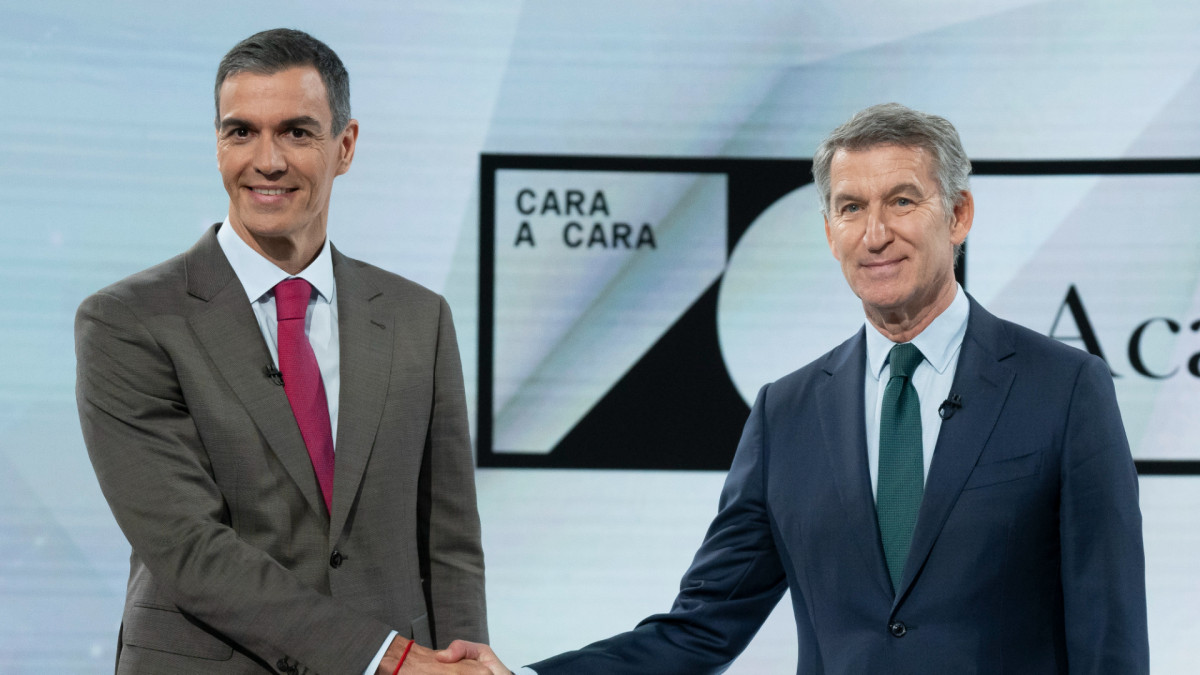
The face-to-face that Pedro Sánchez and Alberto Núñez Feijóo held yesterday gave the impression of two parallel discourses that only occasionally intersected. The most probable scenario is that it will not prove decisive, because one candidate went to hold ground and the other to depict his opponent in order to draw abstainers to vote, so its effect would be split among a small shift in votes, the activation of the opposition vote, and the consolidation of electoral bases.
Polls illustrate that division of roles. In the pre-electoral survey by the Centro de Investigaciones Sociológicas (CIS), based on 45,074 interviews conducted in October, the Popular Party retained 63.2% of those who say they voted for it in 2023 and saw Vox gaining to 20.1%, and the 40dB tracking published on the same day as the debate still places that outflow at 14%, so that Feijóo’s first priority remains to his right. The PSOE seems to have done much of the return trip in this month. In the CIS of October it retained 66.1% of its own voters, with 14.1% unsure what they would do, and in the tracking retains 75% and only doubts 4.3%, while among former Sumar voters indecision stands at 11.3%. They use different baselines and methods, and the comparison is only to give a sense of scale, but it shows that Sánchez had few of his own undecided voters left and that relative indecision was greater to his left, so that with his own base his aim was not to give reasons for that pool to reopen, and the abstention he hoped to pull out would also have to be sought on his left.
The debate also reveals the aspirant’s method. The Popular Party would have played to prevent current events from dragging the government’s major crises into oblivion, and did so by naming them one by one in the campaign’s only face-to-face.
Two parallel discourses
Feijóo opened with the line “Spain deserves a decent president” and, in a nearly read cadence, enumerated corruption cases and the administration’s crises, and presented each of the five blocks as the balance sheet of eight years in office. In economic matters he entered the tax debate, a framework natural to the Partido Popular and which distances him from identity issues that pull him toward Vox, and in public services he reproached the Prime Minister for his silence on train accidents, from which the bloc barely emerged. On the corruption issue, where it is difficult for a government to come out looking good, he closed with the question “Who paid for your primaries, Mr. Sánchez?” that went unanswered, and that silence, which says nothing about the substance of the accusation, appears to be the clearest cut of the night.
Sánchez answered in a positive and cautious tone. He asked forgiveness for cases that could affect his organization and government, and defended his continuity with what his campaign regards as its strongest argumentative weapons, advances in rights and economic prosperity. His terrain was the closing of the fourth block, when he steered the discussion toward rights and obtained from his opponent a camera-confirmation: “I will modify the euthanasia law, make no mistake.” The moral debate is a trigger area for the left, and Feijóo’s assertiveness in it only makes sense if his aim was to preserve votes and stop the shift toward Vox.
“The moral debate is a trigger area for the left, and Feijóo’s assertiveness in it only makes sense if his aim was to preserve votes and stop the shift toward Vox”
Such a strategy serves to hold one’s own ground, but it can also activate a voter who is currently abstaining. Sánchez’s approach serves to portray the opponent to that same voter, but it may leave unaddressed the memories that the other awakens. Both also need the pivotal vote, because the published polls do not give either a path to govern without external support.
Memory as a campaign terrain
Human memory is fragile and tends to cling to the immediate, and the electorate is also flooded with information, so each traumatic event eclipses the previous one. The Ceuta crisis at the end of July was only partially eclipsed by the uproar over the penthouse that the Madrid government bought alongside Isabel Díaz Ayuso’s residence and was greatly overshadowed by the death of Maricarmen Abascal, which street-level discourse turned into a symbol of housing, and by the Urda train accident. With each turnover, the block that the conversation favors also shifts, and a campaign can reach its final stretch with its strongest arguments outside the immediate memory of voters.
“The memory of the human is fragile and tends to cling to the immediate, and the electorate is also flooded with information”
A portion of this effect is known in political science as priming. Shanto Iyengar and Donald Kinder popularized the term in 1987 with experiments on news programs, where they found that by focusing on certain issues and neglecting others, television alters the yardstick by which the public measures governments and candidates. The psychology of memory helps explain why this works. Endel Tulving and Zena Pearlstone proposed in 1966 to separate what is available in memory from what is accessible, after showing that part of what subjects could not recall remained stored and resurfaced when given a cue. Their experiment used word lists, and while the direct application to a campaign is metaphorical, the two ideas help decode what Feijóo did on Thursday, which was to distribute cues so that people vote with his yardstick. Judicial cases at the opening, the trains in the third block, and Ceuta in the last, functioned as activators of the emotional memory of a voter who might have left those episodes behind. In campaign rooms they say it differently: emotion drives action and reason ensures that action is timely.
Ceuta, the scene and the document
The last block makes this clear. Feijóo spoke of an “invasion,” reproached the president that the intelligence services had warned, and that his visit to the city lasted one hundred minutes, and promised that “Ceuta will be my first folder in the Council of Ministers.” Sánchez responded with the official reply. He cited a communication from the National Intelligence Center to the judicial authority stating that there is no conclusive evidence that the Moroccan regime was behind the border assaults, and argued that a president must base decisions on “certain data, not assumptions.”
The response is understandable from realpolitik, because no head of government points to a neighboring state without evidence that can be sustained, but it tension between official statements and plausibility and is hard for the average voter to accept, more pragmatic and earthly. One candidate offered a scene and the other a document, and in those days the viewer keeps scenes rather than statistics. In that terrain the initial advantage belonged to the aspirant.
“One of the candidates offered a scene and the other, a document, and in those days the spectator keeps scenes before statistics”
The memories, however, do not have a single owner. Ceuta can return to the voter’s mind as an overflowing border, and then it reinforces the governance frame against institutional crises with which the right competes, or as a broken coexistence, and then it reinforces the forward-looking frame against retreat with which the left competes. The word chosen to wake it partly decides which of the two returns. “Invasion” solidifies for the voter that the Popular Party competes with Vox for, and in Ceuta, where part of the conservative electorate has family ties on the other side of the border, it can also activate a vote of rejection. Behind that memory there are dozens of deaths and their families, and anyone who uses it in campaigning incurs a debt of sobriety with them.
What a debate moves
The CIS post-election polls limit what to expect. In April 2019, it was said that 7.1% of those who watched debates had changed their voting intention, and in November of that year, 4.2%, and only a little more than half of them moved from one party to another. The clearest measure of the weight of an emotional impact is 2004, when 28.5% of respondents acknowledged that the March 11 attacks had influenced their decision. Of those, 53.8% said it reaffirmed the vote they were already planning to cast; 21.9% said it encouraged them to vote when they had not planned to; and 13.5% said it led them to switch parties.
“In the post-electoral CIS of November 2019, 4.2% claimed to have changed their voting intention after the debates”
Even an impact as large as the 11-M reinforced and mobilized far more than it converted, and that underpins the forecast of a limited effect to reinforcement and activation. The night’s reactions fit that, because the PSOE proclaimed its candidate the winner and PP sources spoke of a clearer victory than in 2023, two readings that are only compatible if each party was looking at a different audience. Besides, many voters will not have watched it and will receive it in pieces in the days to come.
Nine days
The most serious objection to this reading is that a memory activator works in both directions, because the confirmation about euthanasia will travel through the left’s circuit with the same ease that the silence about the primaries will travel through the right’s, and neither candidate chooses whose wound is awakened. Hence the question of who won the debate has little traction. Each played a different game and the result will be read in two different figures, that of the Conservative voter leaning toward Vox and that of the Socialist voter who still doubts, in polls to be published until Monday the 23rd, the last day on which electoral law permits dissemination.
At this point, the most probable scenario is that the first, at 14% of the last tracking, will fall only slightly, and that the second, at 4.3%, will not rise, a forecast made just hours before the face-off and without audience data that would need to be revised if either moved clearly. Then there will be five days without published polls, in which the debate will already be another rung in the chain and what remains active in the voter’s memory will only be known with the tally on 29N.
