
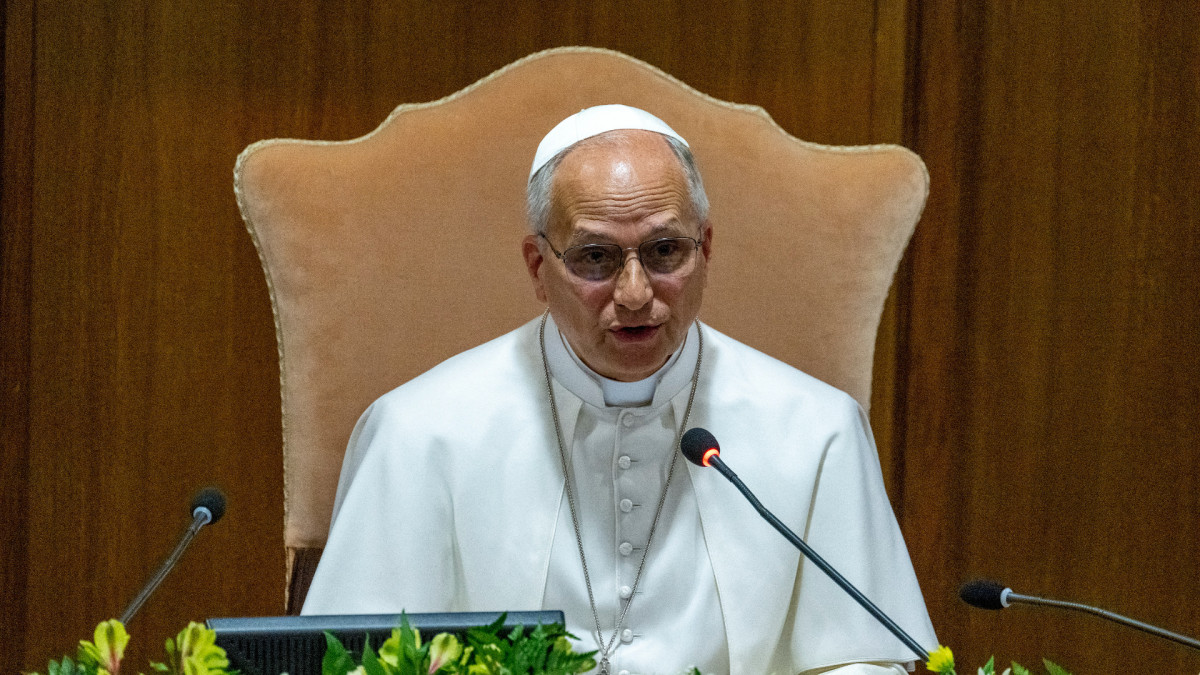
The first encyclical of Pope Leo XIV, presented yesterday at the Vatican, addresses one of today’s major challenges: the impacts of artificial intelligence (AI) across various orders. It is not a techno-phobic or Luddite message from a Pope trained in Mathematics, but a reflection before “a valuable aid that requires attention.” The long papal missive lays out a series of warnings about the danger of a diminishment of human dignity. The content matters and so does the moment. For example, within the ranks of Trump supporters and MAGA (Make America Great Again), a broad movement of resistance against some aspect of AI is emerging, moving from America First to Humans First.
Not by chance, Magnifica Humanitas is dated the same day (May 15) as the Rerum Novarum, which Leo XIII dictated 135 years ago (for a reason Robert Francis Prevost chose his name as pope) in response to the ravages of the Industrial Revolution. That encyclical laid the foundations of the so‑called social doctrine of the Church, which Leo XIV seeks to update in this text to adapt it to the res novae (things new) of our time. The AI, without a doubt, is.
“The encyclical advocates for «desarming» this technology and putting an end to «the normalization of war», as the one we are witnessing (a message to Trump and Putin)”
To convey its thoughts, which are to become the doctrine of the Catholic Church on AI, “on the guardianship of the human person in the time of artificial intelligence,” it has chosen a format dating back four centuries. It is noteworthy that for yesterday’s presentation at the Vatican it had invited Christopher Olah, cofounder of Anthropic, a company that is currently at the center of a storm, on the one hand for the dangers posed by its latest AI model, Mythos, and, on the other, for having filed a lawsuit against the Trump Administration after the February federal ban on its technology for refusing to permit its unrestricted military use. Precisely, the encyclical advocates for “desarming” this technology and ending the “normalization of war,” as we are living (a message to Trump and Putin), and for avoiding that this technology “dominates humanity”.
The text goes far beyond the opinions hitherto expressed by Leo XIV or by the Dicastery for the Doctrine of the Faith and the Dicastery for Culture and Education, whose text on AI, Antiqua et Nova, we analyzed in its day. It outlined many of the issues addressed in Magnifica Humanitas. But it is not the same that the Pope, whose influence extends beyond Catholics, supports some ideas or makes them his own. Not inclined to definitions, he calls to avoid the misunderstanding of equating this “intelligence” with human.
We are in a transition, and the reflections of this Pope can only be temporary. Leo XIV addresses the new inequalities that it provokes within societies and among societies (rich vs. poor); the “new enslavements” that “feed on economic chains and digital infrastructures”; the risk of “social control” with AI, which “can condition democratic processes”; the “culture of power” (“as happens with every great technological advance, AI tends to increase especially the power of those who already have economic resources, skills and access to data”); the new data colonialism, the “new rareearths of power,” which leads “to select who and what matters”; or the cited “normalization of war,” in which the use of AI has grown, alongside the “unlimited force,” in a crisis of multilateralism whose recovery is demanded.
All of this, of course, within a religious conception. With or without it, it touches on the key questions. His appeal to the “humanism,” even to the “Christian humanism,” is measured, though it always has as its aim the human person and his or her freedom, and expresses an open rejection of the premises of transhumanism and posthumanism. Another issue is the proposed solutions, which, he acknowledges, often clash with real possibilities. Including the question of the “transparency” of these models, which has few prospects of being achieved when increasingly one does not know what goes on inside them. For Leo XIV, in line with what many others demand, “it is essential that the responsibilities be clear at all stages: from those who design and program the systems to those who use them and those who decide to entrust them with concrete decisions”.
He denounces that in recent years, also as an effect of the diffusion of AI, cognitive sciences, nanotechnology, robotics and biotechnology, although they can be positive, have accelerated the technocratic paradigm and, therefore, a new spiritual, ethical and political framework is needed. “Let us avoid,” he asks, “the Babel syndrome”: the idolization of profit that sacrifices the weak, the homogenization that flattens differences, the claim of a single language — even digital — capable of translating everything, even the mystery of the person, into data and yields, This is “the risk of dehumanization,” which he defines as building the future excluding God and reducing the other to a means. There is no need to agree on this to align with many of his proposals in this encyclical.
“The concerns about the effects, especially social, but also geopolitical, of this AI have begun to penetrate also among the Trumpists”
That the architects of Silicon Valley, of the San Francisco Bay Area, and, in general, of AI compare themselves to God or are convinced that they are building God is something that does not escape the Catholic Church nor others. Nevertheless, the concerns about the effects, especially social, but also geopolitical, of this AI, which is in its early stages, have begun to permeate the Trumpist camp as well. In the open letter Humans First, Steve Bannon (one of the major inspirations of the U.S. president) and his co-signers issue an explicit call to Donald Trump’s leadership to embrace AI.
Some impact is already evident in the questions the president has about whether to require AIs to undergo pre-market control before being marketed, in the manner of medicines, or to keep them deregulated to ensure innovation and competitiveness in all fields. They call for controlling the masters of the air who dominate them (and who supported the deregulation resurgence under Trump): “The United States has not become the greatest nation in the world to allow unelected elites to conduct experiments with the population without guarantees or accountability”. Bannon (and probably Trump) has understood that positions against AI can shape policy, especially if others seize the Luddites’ banner.
This Pope, born in the United States, is having significant differences with Trump, and some things he says in this encyclical go against the messages coming from Washington, especially regarding the use of force and multilateralism. Both for content and credibility as well as timeliness—the moment—Leo XIV’s encyclical appears timely. Although a 58-page text may seem overly long for the reading habits of its powerful compatriot.
