
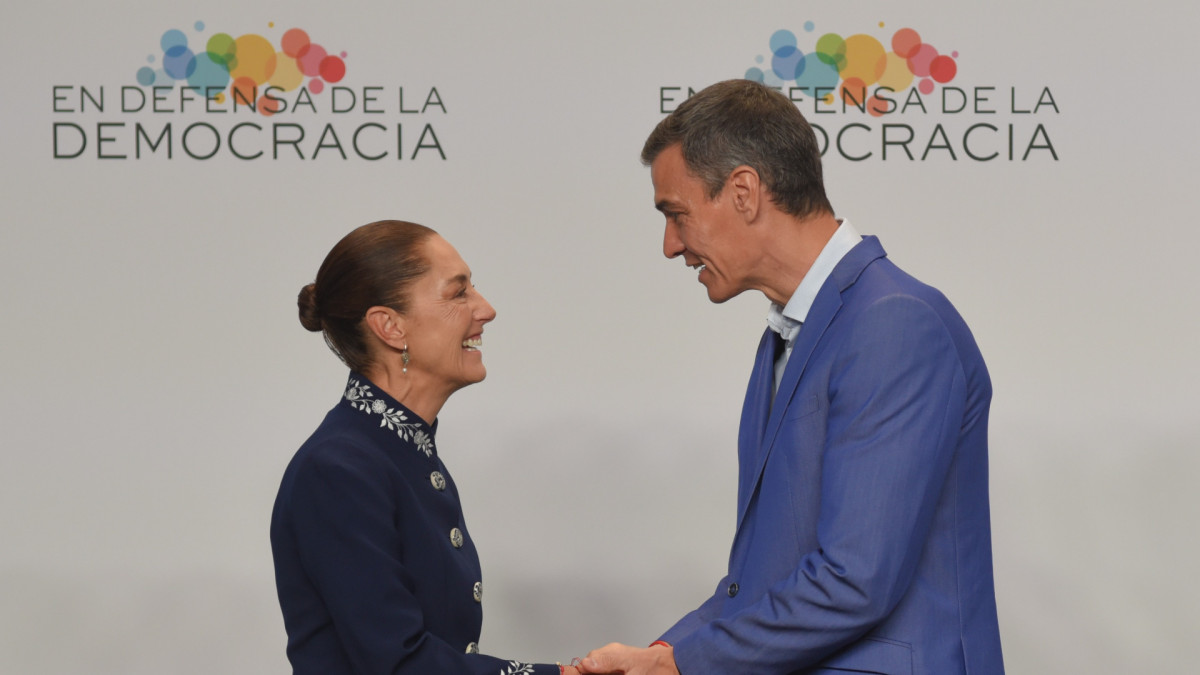
The objective was always clear: to assemble a counterweight to the global ultraconservative and ultraliberal wave —led and promoted by Donald Trump— that has battered the world for years like an out-of-control tsunami. This is how the IV Summit in Defense of Democracy was proposed and held in Barcelona, organized by Pedro Sánchez, and attended, despite all forecasts, by Claudia Sheinbaum.
The scene seemed rather modest: a progressive summit in the Catalan capital, good intentions translated into speeches, photos, hugs, protocol, media. Names? Luiz Inácio Lula da Silva, Gabriel Boric, Gustavo Petro, Yamandú Orsi, as well as ministers and other prominent figures in international politics. But behind the political liturgy something deeper was at stake: Mexico (the second-strongest economy in Latin America, behind only Brazil) was once again drawing closer to Spain, after eight years of rough gestures, exhausting tensions, of letters and words that turned into walls, not bridges. In short, the journey of the Mexican president to the address of the Spanish prime minister was more than a diplomatic signal; it was a decisive action that opens new paths in one of the most distinctive and significant relationships between Europe and the Americas.
“That Sheinbaum sat in Barcelona beside Pedro Sánchez is a gesture that is worth more than a hundred speeches”
As has always been said —Carlos Fuentes (Cervantes Prize in 1987) was a major proponent of this idea—, the history of Mexico cannot be understood without Spain, just as Spain cannot be understood without Mexico. And, beyond historical arguments, today, for Sheinbaum, Spain is the gateway to Europe. Moreover, in a world so polarized, in which geopolitics reshapes itself every day — especially after every outburst or improvised act by Donald Trump —. Therefore, that Sheinbaum sat in Barcelona beside Pedro Sánchez is a gesture that speaks louder than a hundred speeches: it is, in short, a demonstration of the joint will of two governments to rebuild diplomatic bridges, open a path for dialogue and establish that ideological differences cannot continue to embolden the foundations of a historic, political and economic bond as strong as the one that unites Mexico and Spain.
Because everything happened at a pivotal moment: the summit coincided with María Corina Machado’s visit to Madrid, where she met with Núñez Feijóo, Isabel Díaz Ayuso and José Luis Martínez-Almeida. In other words, on the one hand, in the Spanish capital, the leaders of the Popular Party embraced and bestowed honors upon the opposition leader to the Maduro regime in Venezuela, while Pedro Sánchez received Claudia Sheinbaum in Barcelona. No need to dwell on explanations for those two scenes, those two photographs, which say it all. Polarization, these days, is everyday bread.
The snub by María Corina Machado toward the Spanish Government is something that cannot and should not be overlooked. Of course, she is not the only Trump ally who dares as much: just review the countless insults and rudenesses of Javier Milei. In other words, from that vantage point, it is not surprising. Not as aggressive, nor as eccentric as the Argentine leader, but the Venezuelan leader was very clear: “What happened at the Barcelona Summit shows why my meeting with Pedro Sánchez was not advisable”, she stated. Without a doubt, Machado was right on many counts. How could one imagine that she would meet with the Spanish prime minister — considering that she is an unconditional ally of Donald Trump, to whom she gave the Nobel Peace Prize —? Impossible.
“How could one imagine that she would meet with the Spanish prime minister — considering that she is an unconditional ally of Donald Trump, to whom she gave the Nobel Peace Prize—?”
Now then, what does that have to do with the Mexican president’s participation in Barcelona? Simply that Mexico has finally aligned with countries that position themselves as a counterweight to the coercive and authoritative power wielded from Washington. That gesture, and the fifteen minutes of Sheinbaum’s speech, represent much more than a participation in a gathering of world leaders under a common cause, flag or ideology; that gesture already defines Mexico’s position on the global stage, one that until recently had remained uncertain.
There was a great deal of speculation about the ideological lines or the political stance of the Mexican government: some voices (like Isabel Díaz Ayuso’s) labeled her a communist; others saw her as socialist, or even as a “failed state.” But the truth is that Sheinbaum, having spoken of “resistance” during her remarks at the summit, did so about how her country, its people and its vast economic dimensions have learned to seek ways not to yield to the dictates of the United States. Of course, to the economic, political, and social dictates that are issued and admit no questioning from the White House.
Then, what does Mexico’s and Spain’s participation in a Pedro Sánchez–promoted event mean? This question, regardless of any answer, appears as a necessary one after eight years of tensions and distance between the two countries, since Andrés Manuel López Obrador’s ascent to the Mexican presidency in 2018 marked an impasse in the long history of solidarity, fraternity and political kinship in the bilateral relationship. To cut to the chase: has this meeting been the cornerstone of a new diplomatic pathway?
Rebuilding a historic relationship after eight years of friction
In the diplomatic arena, the relations between Spain and Mexico boast countless peculiarities. Delving into them would deserve an encyclopedic text, for the points of brotherhood and discord are numerous —and demand reflection on their respective causes—. Nonetheless, there are two names that deserve special mention, because their words and speeches went beyond culture and reached diplomacy, philosophy and humanity. Those names are Carlos Fuentes and Octavio Paz. Both, winners of the highest prize in Spanish-language letters, namely the Cervantes Prize.
Both Fuentes and Paz delivered speeches in the paraninfo of the University of Alcalá de Henares (Paz, in 1981; Fuentes, in 1987), which gave a new dimension to the bond between Mexico and Spain up to that point. Roughly speaking, Fuentes warned that Mexico could not renounce Spain without losing part of itself; Paz, more critical, saw in that relationship an uncomfortable but inevitable and indivisible mirror.
“The ideological character of the Cortés myth, evident, was the weapon of a party. But those struggles belong to the past; today the myth fights against ghosts. Aside from its unreality, the myth is harmful because, instead of uniting, it divides consciences. Its function is contrary to that of El Cid, which was a myth founded on a historical figure, no less doubtful than Cortés. But while El Cid united the Spaniards, Cortés divides the Mexicans, poisons souls and feeds anachronistic and absurd resentments.”
Two years later, Carlos Fuentes (who, besides being an acclaimed writer and having devoted much of his literary work to exploring intercultural contact between the Mexican and Spanish worlds, was a diplomat), upon receiving the Cervantes Prize, argued that the strongest bond between “our probable community” is language. That is to say, for him, that bridge that continues to unite us and makes our two peoples stronger every day is none other than the Spanish language. There are many unforgettable quotes drawn from such a luminous discourse, among which stand out: “Spain concerns itself with what happens in Hispanic America and in Hispanic America we concern ourselves with what happens in Spain”. “Only by needing each other will the world need us too… My country opened its arms to the wandering Spain that in Mexico found refuge to heal the wounds of a painful war”.
No obstante, three decades later, that is, in 2018, Andrés Manuel López Obrador put an end to the path of fraternity that Spain and Mexico had lived since 1977 (when relations were restored after the death of Francisco Franco). For him, not even the close kinship between the two nations, born from the humanitarian work that Mexican President Lázaro Cárdenas carried out with the exiled Spanish Second Republic, deserved his attention. His government was a string of attacks, distancing and skirmishes toward Spain. For him, it was as if iconic works of Mexican and Spanish identities, such as El espejo enterrado (by Fuentes), El naranjo o los círculos del tiempo (by Fuentes), or the tender story of Dolores and Lorenzo — the son of a Mexican millionaire who leaves his privileges and his country to join the lost cause of the Spanish Second Republic in the Civil War, and dies defending his beloved, a Republican militiaman — in The Death of Artemio Cruz (Fuentes), or The Labyrinth of Solitude (Paz), had never existed.
“Today we consider the differences overcome, and we open a new stage between Mexico and Spain”
But now everything seems to have entered a new stage; a recomposition of the historic kinship. Claudia Sheinbaum, during her remarks at the Barcelona summit, said: “There is no diplomatic crisis with Spain, there has never been one.” She, following her conciliatory line, uttered that phrase to “put out” any “fire” that might burn regarding tensions between the government of Pedro Sánchez and the predecessor of the first Mexican president. On the other hand, the Spanish president, with a decisive tone, said: “Today we deem the differences overcome, and we open a new stage between Mexico and Spain.”
Perhaps it is still too early to forecast anything about this relationship. Still, it is undeniable that the gesture of both leaders does indeed represent a new opportunity not only for the bilateral relationship but also for the consolidation of alliances that form a bulwark against the global rise of the far right.
Moreover, Sheinbaum did not limit herself to attending the summit; she also used her stop in Barcelona to visit the Barcelona Supercomputing Center, with which she collaborates on the development of a future Mexican supercomputer. She did so accompanied by the president of the Generalitat, Salvador Illa, and the minister Diana Morant.
Taking all of the above into account, are we witnessing the beginning of an idyll in the relationship? Perhaps it is early to claim such optimism, but one thing is certain: one cannot deny Sánchez’s claim that the differences have been overcome. And Sheinbaum’s attendance at the Barcelona summit has proven it.
