
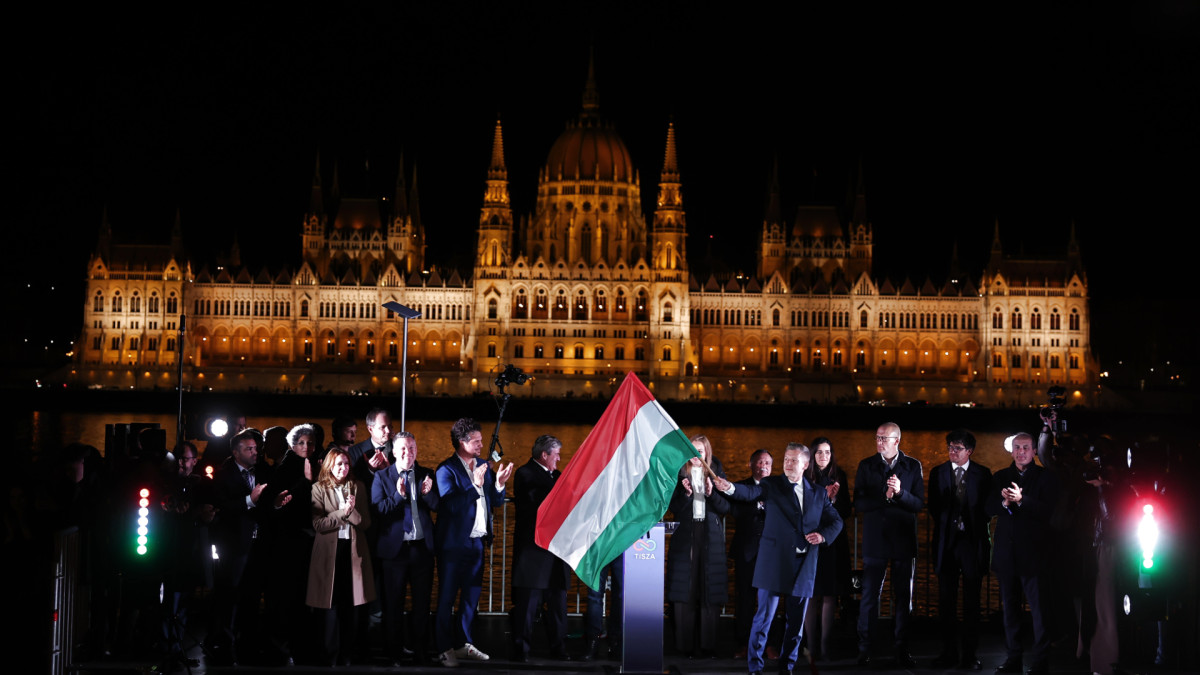
The victory of Péter Magyar in the Hungarian parliamentary elections marks a turning point for Hungary and for the European Union as a whole. After more than a decade and a half of political hegemony, the electoral result represents the rupture of a power model that had consolidated itself by combining institutional control, media hegemony, and a deeply rooted national-conservative political narrative. The question now opening is not merely why Orbán has lost, but what kind of political and systemic transition is possible in a context marked by institutional erosion and polarization.
Hungary has been considered the laboratory of the so-called “illiberal democracy,” a concept that the very Orbán himself advocated as an alternative to the European liberal model. This system has been built on three fundamental pillars: an institutional architecture tailored to the needs of the ruling party, a highly concentrated media ecosystem, and a political strategy based on identitarian mobilization in the face of external threats, ranging from immigration to the very relationship with Brussels. What is significant about the result is that these three pillars have not disappeared, but they have ceased to be sufficient to guarantee the reproduction of power. In this sense, Péter Magyar has been able to exploit them to seize the Government. And to achieve this he has brought together several elements without which this victory cannot be explained.
Why has Orbán lost?
The first explanatory element is the reconfiguration of the opposition space. Unlike previous attempts, marked by fragmentation and lack of leadership, Magyar’s candidacy managed to articulate a unified political offer capable of transcending traditional ideological divisions. It is not so much about a conventional coalition as about a strategic aggregation around a shared objective, which was to end Orbán’s political cycle. This plebiscitary logic — Orbán yes or no — has simplified the electoral competition and has enabled the mobilization of sectors that, in previous contexts, had remained demobilized or skeptical.
“Unlike the traditional opposition, he has managed to present himself as a figure capable of understanding and reforming the system”
Secondly, Magyar’s insider status — someone who comes from the very political milieu of the system now challenging it — has granted him a particular credibility. Unlike the traditional opposition, often perceived as disconnected from broad swaths of society, he has managed to present himself as a figure capable of understanding and reforming the system from within. This positioning has been especially effective in attracting voters disenchanted with Fidesz itself, thereby eroding the party’s electoral base in key segments.
The socioeconomic context has also played a relevant role. Persistent inflation, the erosion of purchasing power, and tensions over European funds have weakened one of the government’s main assets, the promise of prosperity and economic stability. In political systems with features of uneven competitiveness, economic performance tends to be a key source of legitimacy. When it deteriorates, a window of opportunity opens for the opposition, even in adverse institutional contexts. And this is exactly what has been happening in Hungary, especially since 2020.
“The narrative of constant threat — so effective in the past — has shown signs of fatigue before an electorate increasingly concerned with material issues and governance”
Added to this is an element of accumulated political wear. After sixteen years in power, the Orbán government faced not only concrete criticisms but a structural fatigue associated with prolonged incumbency. This kind of fatigue does not automatically translate into alternation, but it does erode the capacity to mobilize and reduce the effectiveness of traditional discourse frameworks. The narrative of constant threat — so effective in the past — has shown signs of exhaustion before an electorate increasingly concerned with material issues and governance. Undoubtedly, betting on the war gambit did not pay off as he expected, and moreover portraying Brussels as the adversary to beat did not convince a large portion of the electorate who, in the east-west framing proposed by Magyar during the campaign, opted for the second option.
Another key factor has been the transformation of the media and communication ecosystem. While government control over traditional media remains important, the growth of digital platforms and independent outlets has expanded access to alternative information, especially among younger and urban voters. This diversification of the information space has limited the government’s ability to monopolize the political narrative, introducing greater plurality in the formation of public opinion. In this sense, Magyar has shown the ability to operate in a media environment and connect very well with this audience seeking a change in political power.
“It has been demonstrated that, in systems where there are structural asymmetries in competition, a significant rise in participation tends to benefit the opposition”
The high electoral participation constitutes, in this context, a particularly relevant indicator. The mobilization witnessed in these elections has surpassed all expectations. They were the elections with the highest turnout, including those of the early nineties. Interestingly, something similar happened in the 2023 Polish parliamentary elections, when Donald Tusk achieved the premiership by defeating the Law and Justice (PiS) party. In both cases it has been demonstrated that in systems with structural asymmetries in competition, a significant increase in participation tends to benefit the opposition, by bringing into the electoral process voters less accustomed to voting and potentially more critical of the status quo. Thus, both now in Hungary and then in Poland, the election has been seen as a decisive moment, which reinforced its plebiscitary character, in both cases to fight what their leaders called illiberal democracies.
The new scenario for Hungary, the Visegrád Group, and Europe
Nevertheless, Magyar’s victory does not automatically imply an immediate transformation of the political system. The institutional legacy of the Orbán era poses significant challenges. The presence of loyal figures in key bodies, the structure of the judiciary, and the configuration of the media constitute potential obstacles to any reform attempt. In this sense, the central question is not merely about power alternating but about the capacity to rebuild mechanisms of control and institutional balance in a setting deeply conditioned by prior reforms.
At the European level, the result carries high-stakes implications. Hungary has long been a disruptive actor within the EU, challenging norms, blocking decisions, and forging alliances with other governments critical of the integration process. A change of government could facilitate a reconfiguration of these dynamics, opening the door to greater cooperation and to resolving conflicts around the rule of law and the management of European funds. However, this evolution will depend to a large extent on the new government’s capacity and its own political will to consolidate internally and manage the tensions inherent in any transition process.
“Windows of opportunity open to implement changes in the country, but questions also arise”
Thus, these elections should not be read solely as a electoral defeat of Orbán, but as the symptom of a major upheaval in Hungarian society. The combination of economic, political, geopolitical, and generational factors has markedly impacted the political model installed in the country or, at least, in its leadership. Magyar has won the elections with promises of greater willingness to negotiate in Europe than his predecessor, betting on alliances with European right-wing forces, and he has managed to dodge the most thorny issues in public debate. In order to group a broader electoral base, he has avoided topics such as migration or security, where there are no major differences with Orbán, and has focused on the day-to-day economy of Hungarians, while at the same time firmly defending the country’s sovereign autonomy, both in the face of J. D. Vance’s presence and in response to threats against Orbán, for example from Zelenski. That is where he won the elections. Because, let us not forget, Magyar is not a liberal conservative: he is a nationalist conservative.
In any case, Hungary is entering a transitional phase whose outcome remains open. Windows of opportunity open to implement changes in the country, but questions also arise about the resilience of institutions, the capacity to govern in a polarized context, and Hungary’s role in the European project. It has a blank page; we will see how it writes it.
