
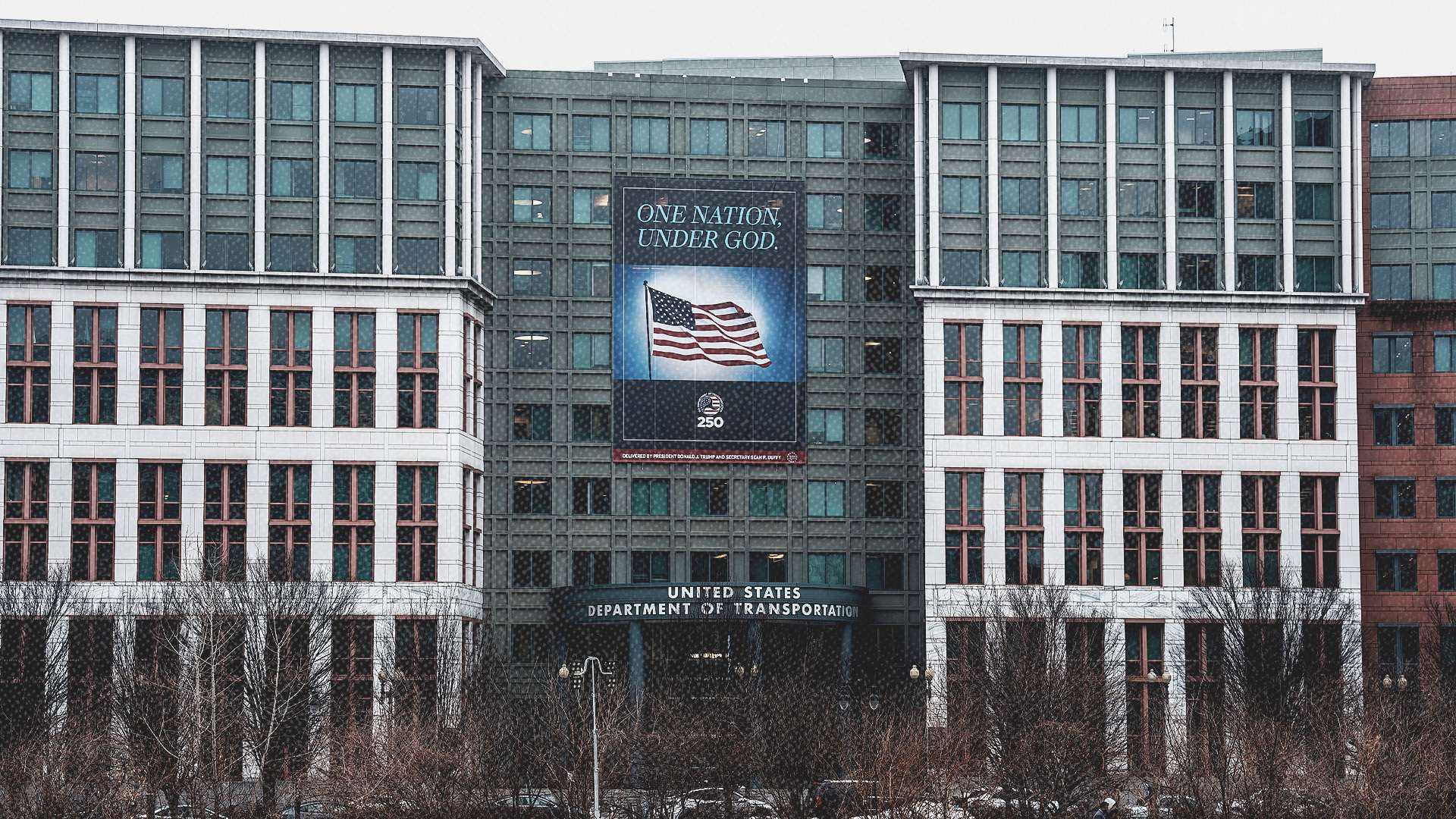
According to a new study, almost 90 percent of the Department of Transportation’s owned or leased facilities are more than half empty.
On his first day in office, President Donald Trump instructed every executive-branch agency to end remote work and require staff to return to their assigned duty stations in person full time, with only individual exemptions allowed.
Nevertheless, a fresh report indicates that the office spaces of one department are markedly underutilized, costing taxpayers a substantial sum.
“The Department of Transportation (DOT) and its component agencies are underutilizing their office space department-wide,” the Government Accountability Office (GAO) notes.
The Utilizing Space Efficiently and Improving Technologies (USE IT) Act, enacted in 2023, imposes a minimum occupancy requirement of 60 percent for all federal agencies and authorizes the government to “consolidate federal agency headquarters buildings in the National Capital region,” if needed, to reach that standard.
According to the report, when GAO auditors examined DOT facilities from August 25 to September 19, 2025, they “found that 89 percent of DOT’s 189 office buildings, including the DOT and the Federal Aviation Administration (FAA) headquarters complexes, were underutilized,” based on that 60-percent criterion.
In fact, the underutilization was more pronounced than mere underuse: “Our analysis found that average utilization rates among owned and leased buildings were similar, at 37 and 41 percent, respectively.”
The DOT and FAA headquarters buildings stand as the department’s largest and most costly properties: together they span about 1.8 million square feet and are capable of housing more than 12,000 employees, with annual rental costs exceeding $100 million and operating costs approaching $25 million. Yet, on the day of the survey, each building was only roughly one-third full.
The DOT’s third-costliest structure is One Aviation Plaza in Queens, New York. Although its estimated capacity is under 1,000 people, the facility incurs more than $15 million in annual rent, and during the GAO survey period it was only 13 percent occupied.
The report categorized all DOT buildings into four size-based groups; of these, the sole category that averaged occupancy above 50 percent consisted of the smallest facilities, with an average capacity of a mere 16 people.
This issue goes beyond merely sparsely populated offices; it reflects, as is common with federal matters, a sizable misallocation of taxpayer funds.
“DOT’s underutilized office space costs hundreds of millions of dollars annually to lease, operate, and maintain,” the GAO concluded. “Of the 189 DOT buildings included in our analysis, we found 168 buildings were underutilized, totaling $370 million in annual rental, operations, and maintenance costs.”
Unfortunately, this problem is not new, nor is it restricted to the DOT alone. In 2023, the GAO surveyed the 24 agencies that account for the majority of federal buildings, a group representing about $2 billion in yearly operating costs. It found average occupancy ranging from 25 percent or less on the low end to 49 percent on the high end.
At that time, DOT sat in the second-lowest quartile among agencies, using only around 16 percent of its available space on average.
The report notes that the DOT has made little effort to optimize its existing space, particularly at its secondary locations. For instance, the department operates several subordinate agencies that do not share office space with one another. In practice, this means multiple similar agencies within the same department occupy separate, half-empty offices.
The report also highlights that certain DOT offices could implement a desk-sharing approach. Although agencies are required to work in person, many DOT field-office personnel “conduct investigations or inspections at offsite locations, such as airports or aircraft manufacturing facilities,” and as a result, they “spend roughly half of their time working offsite.” Yet, the department provides each of them with a dedicated desk that sits unused half the time. The GAO notes that a desk-reservation system, which the department has resisted, could reclaim space that is currently vacant.
Granted, the DOT has taken some steps to address the problem. Last year, the department announced plans to relocate FAA staff to the DOT headquarters and return the FAA’s building to the General Services Administration (GSA). The GAO observed that this move “will allow DOT to avoid paying $56 million annually to GSA for rent, operations and maintenance,” plus “an estimated $131 million in deferred maintenance costs,” depending on what steps the GSA takes next. (Ideally, the plan would involve selling the building, and many others, freeing up valuable commercial real estate for private-sector use and reducing taxpayer costs in the process.)
But for now, those savings remain theoretical: the GAO notes that not all FAA personnel would relocate to the DOT building, leaving about 950 FAA staffers without a place to go.
Given that the FAA employs more than 45,000 people in total, perhaps relocation into the private sector could also be considered for them?
