
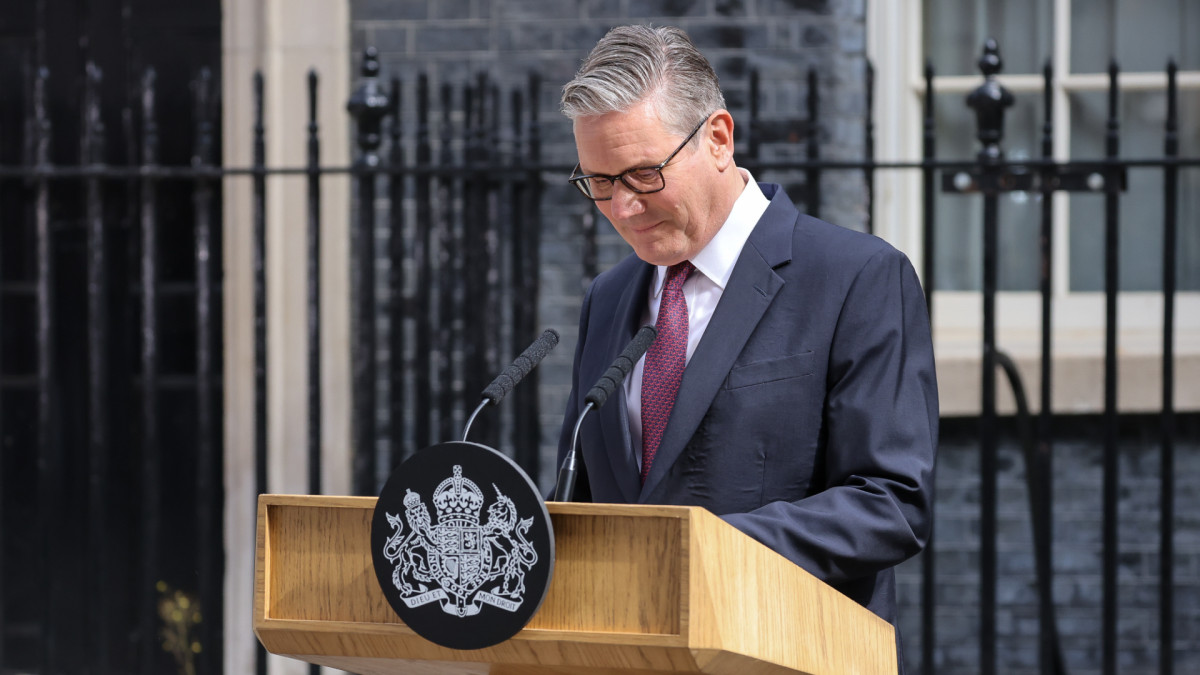
La dimisión de Keir Starmer apenas dos años después de la victoria arrolladora del Partido Laborista es algo más que una historia sobre los fracasos del partido o del propio Starmer. Dice algo más amplio sobre las condiciones cada vez más difíciles en las que hoy gobiernan los ejecutivos de las que antes se llamaban “democracias liberales avanzadas”. En Europa y más allá, la fragmentación política, la volatilidad electoral y el auge de partidos populistas de oposición han hecho que gobernar sea considerablemente más complicado. Incluso instituciones políticas mayoritarias como las del Reino Unido, que favorecen las mayorías de un solo partido y la estabilidad del ejecutivo, ya no protegen a los gobiernos de los cambios en el estado de ánimo de la opinión pública con la misma eficacia que antes.
When Starmer arrived at Downing Street in July 2024, many expected the United Kingdom to revert to a more stable political era. After a decade marked by Brexit, constitutional crisis, the dizzying succession of prime ministers and deep political polarization, Labour’s victory seemed to promise a return to moderation and normality. In fact, this is how Starmer himself described it after the elections. Barely two years later, he resigned.
“Political fragmentation, electoral volatility and the rise of populist opposition parties have made governing considerably more challenging”
The immediate explanations are well known. His government accumulated a series of political missteps, damaging controversies and unpopular shifts in some public policies. The Labour Party performed poorly in the May 2026 local and regional elections, and many pointed to Starmer’s leadership failings, particularly his weak communication skills and his inability to establish an emotional connection with voters. All of these factors doubtless played a role. But they are only part of the story.
The Starmer government
Starmer’s caution and incrementalism led to several damaging political U-turns, especially around digital identification, the inheritance tax for farmers and winter heating payments, reinforcing the image of a government reacting to events rather than shaping them. Other political missteps continued to erode his political capital. The controversy over gifts and donations reinforced the perception of a political class disconnected from ordinary voters. The appointment of Peter Mandelson as ambassador to the United States became a political problem when Mandelson’s links to the discredited billionaire Jeffrey Epstein came to light.
“Starmer’s tenure was not an obvious failure, which makes the speed of his downfall particularly striking”
At the same time, by most indicators—and especially when compared with some of his recent predecessors—the Starmer era was not an obvious failure, which makes the speed of his fall particularly striking. The Labour Party came to power with a substantial parliamentary majority and moved relatively quickly to implement key parts of its programme. This was notable given the uneven support for Starmer within the Labour parliamentary caucus and the precarious electoral position of many party MPs. The government strengthened workers’ rights through reforms to sickness absence, parental leave and zero-hours contracts. It introduced greater protections for tenants, advanced its green energy agenda and made progress in reducing NHS waiting lists. After years of political turbulence, it also restored some credibility to the United Kingdom’s international standing at a time of considerable geopolitical uncertainty.
Local elections, May 2026
The immediate trigger for Starmer’s downfall was Labour’s poor showing in the May 2026 local elections. In 136 English councils, the party lost around 1,500 councillors. At the same time, the radical right populist Reform UK, the latest political vehicle for Nigel Farage after UKIP and the Brexit Party, won 1,452 councillors—roughly the same number Labour lost. The Greens also posted a solid result, while the Conservatives continued their decline. The picture wasn’t much brighter for Labour in the Scottish and Welsh regional elections. In Scotland, the party recorded its worst result—17 seats, five fewer than its previous minimum in 2021—since the creation of the autonomous Parliament. In Wales, Labour lost control of the Senedd for the first time since devolution, falling from 30 to just 9 seats despite the expansion of the regional assembly from 60 to 96 seats.
The political consequences of the defeat were immediate. Starmer’s leadership came under mounting pressure. A week after the vote, four junior ministers resigned, followed two days later by Wes Streeting, the health secretary and Labour leadership hopeful. On the same day, Labour MP Josh Simons stood down in Makerfield to allow Andy Burnham, the mayor of Greater Manchester, to contest the by-election with a view to challenging Starmer’s leadership. Under Labour Party rules, leadership contenders must be sitting MPs. Burnham’s bid took on extra significance because just a few months earlier Starmer had blocked his return to Parliament via another by-election, a move widely interpreted as an attempt to ward off a future internal challenge.
Burnham entered Parliament with a landslide victory, winning 54.8% of the votes, almost 10 percentage points more than Labour had won in 2024. Having run openly as a future leadership contender, he emerged from the by-election with considerable political momentum. Four days later, Starmer resigned. Unless highly unlikely events occur, Burnham is likely to become prime minister within a matter of weeks.
A volatile and fragmented political landscape
Yet, while the scale of Labour’s defeat in the local elections was significant, it would not necessarily have forced the prime minister to quit if British politics had not undergone a deep transformation over the past decade. Historically, especially in so-called “majoritarian” democracies like the UK, poor local election results might have led at most to a limited reshuffle or some policy adjustments. They usually did not compel a prime minister to resign. The fact that they now do so stems more from the radically altered political environment of the past decade than from Starmer’s or his government’s failures.
The long period during which Labour and Conservative parties dominated electoral competition has gradually given way to a more fragmented and volatile political landscape. Smaller parties capture ever-growing shares of the vote. Voter loyalties are weaker than before. The 2024 elections accelerated these trends.
The figure 1 illustrates the scale of these changes. Electoral volatility reached historical highs in 2024, while the combined vote share for Labour and the Conservatives fell sharply and the effective number of parties almost doubled. Source: https://doi.org/10.1093/pa/gsaf016.
“The long period in which Labour and Conservative parties dominated electoral competition has gradually given way to a more fragmented and volatile political landscape”
These developments are not limited to the United Kingdom. Similar patterns can be observed in many liberal democracies around the world. Traditional centre-left and centre-right parties have experienced a long-term decline. More voters switch party allegiance from one election to the next. Populist political entrepreneurs have managed to mobilize dissatisfied voters. Politics has become, at the same time, more fragmented and more polarized.
This kind of environment makes governing considerably harder. Electoral victories are shorter-lived because the coalitions that produce them are less stable. Local victories by parties previously excluded become a signal that cannot be ignored or patched up with marginal adjustments. Governments face huge pressure to respond immediately to shifts in public mood. Political setbacks that could once be absorbed become potentially existential threats.
The rise of Reform UK
The marked rise of Reform UK in the polls—an opposition party that, if it rose to power, would likely imitate the policies and governing style of American President Donald Trump—strengthens the sense of urgency in the face of sharp shifts in electoral mood. Since the 2024 general elections, Reform has moved from a party of opposition to being one of the central actors in British politics. By mid-2026, it led several national surveys and had established itself as the main vehicle for discontent with the system.
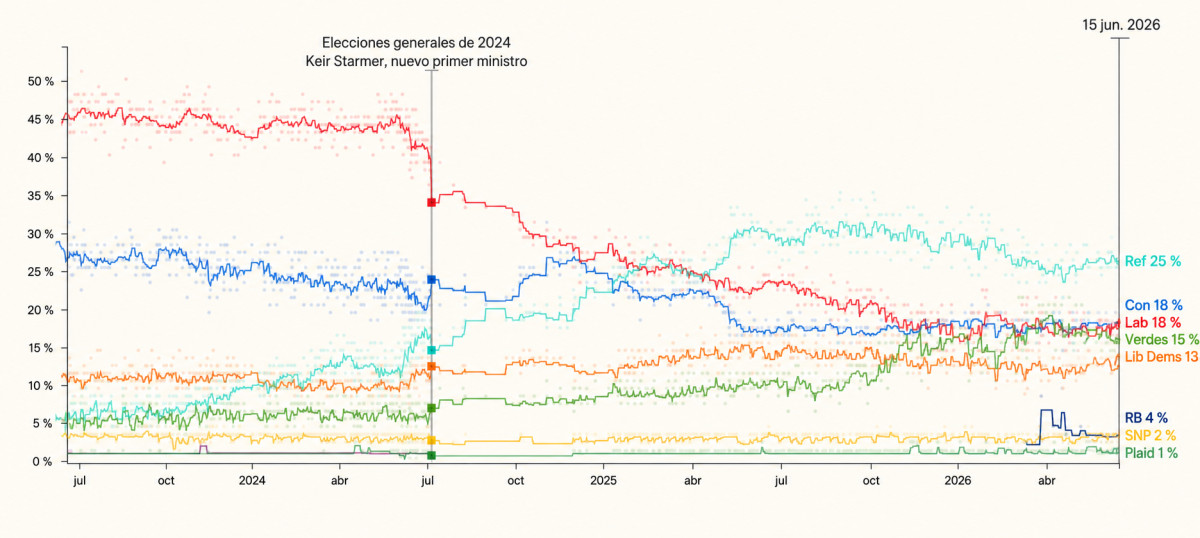
Poll of polls in the United Kingdom. Source: POLITICO
Como muchos partidos de centroizquierda en las democracias liberales, el Partido Laborista ha sufrido una fuerte sangría de votantes durante las dos últimas décadas. Ha perdido apoyos tanto por la derecha como por la izquierda. Las consecuencias del voto del Brexit permitieron a los conservadores abrirse paso de forma significativa en antiguos bastiones laboristas del norte de Inglaterra, en particular en las elecciones de 2019. El Partido Laborista recuperó muchos de esos escaños en 2024, pero normalmente solo gracias a la división del voto de derechas entre Reform y los conservadores. Starmer intentó atraer a esos votantes endureciendo las políticas de inmigración y asilo bajo la ministra del Interior Shabana Mahmood, y limitando el acercamiento a la Unión Europea, aunque muchos sostenían que el débil crecimiento británico exigía una estrategia europea más ambiciosa. Sin embargo, eso no bastó para impedir las victorias de Reform en 2026.
“The consequences of the Brexit vote allowed the Conservatives to break through significantly in former Labour strongholds in the north of England”
As many analysts have emphasized, the immediate electoral threat to the Labour Party now comes from the other end of the spectrum: from the Liberal Democrats and, especially, from the Green Party, which is rising fast. In the 2026 local elections, Labour losses to Greens are estimated at around 22%, while losses to Reform were about a quarter of that figure. Recent research suggests that economic insecurity is the main driver of Labour defections across the political spectrum, while concerns about immigration play a particularly important role among voters who swing—now in smaller numbers—toward Reform. The Labour Party thus faces simultaneous pressure from both directions, albeit with different intensities. If Reform, as polls suggest, replaces Conservatives as the main viable right-wing competitor, many Labour seats in northern England will be at serious risk.
Of course, this is not just a British problem. In different forms, it is present in nearly all of today’s liberal democracies and significantly constrains the room for manoeuvre of centrist and centre-left governments. Attempts to address concerns about immigration and cultural change risk alienating progressive voters. Moves designed to satisfy progressive electorates can strengthen radical-right contenders.
A story of our times
These are structural features of contemporary British politics and there is no guarantee that Burnham, regardless of his political skills, can open a path to Labour victory in the next general election. How can growth-promoting policies be pursued to reduce economic insecurity and consolidate Labour support without prospects for stability and with the imperative of delivering results in the short term? How can the country’s economic prospects be improved if truly rebuilding the relationship with the European Union remains a taboo for a broad segment of the British electorate? It is not clear that any political leader can easily resolve these problems.
Starmer represents a type of politician that postwar liberal democracies in Europe have traditionally produced and often rewarded: serious, pragmatic, institutionalist and committed to gradual reform. He is not a charismatic populist. His appeal largely rested on competence and moderation. What makes his downfall politically significant is not that those qualities failed to generate enthusiasm—this has been true many times—but that they increasingly seem inadequate to sustain political authority.
Political polarization, electoral fragmentation, the perpetual campaign, social media dynamics and the erosion of trust in institutions have made political support more volatile and less durable, in the United Kingdom as elsewhere.
“Starmer represents a type of politician that postwar liberal democracies in Europe have traditionally produced and, indeed, often rewarded”
Starmer’s resignation does not necessarily mean that moderation is impossible or that liberal democracy is doomed. But it does illustrate how difficult it has become for moderate political leaders to govern. His downfall recalls the increasingly demanding environment in which contemporary democracies must operate and the challenges awaiting not only Starmer’s successors but governments across the democratic world.
