
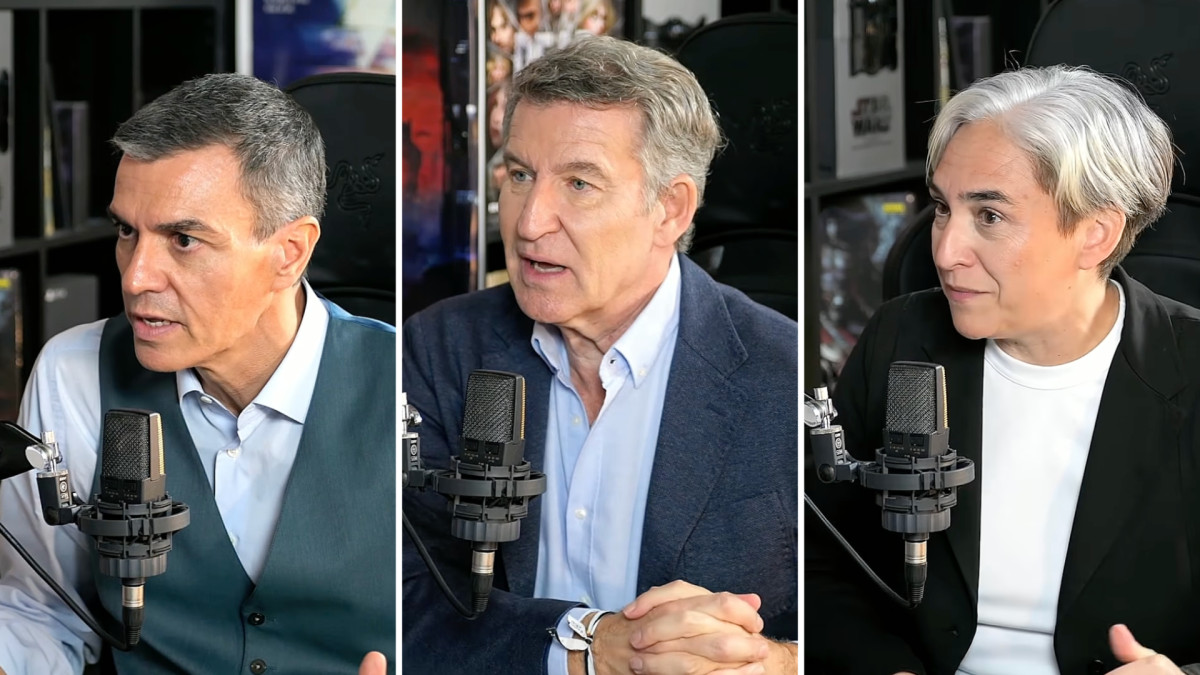
Santiago Abascal did not sit down with Jordi Wild in the interview cycle that the YouTuber had proposed to the four major candidates in these elections. Although the conversation was agreed and was to be recorded this week, at the last moment Vox canceled its participation following the controversy over the editing of the interview that Abascal granted to La Revuelta on RTVE. The Vox leader is the only invited candidate who ultimately has not spoken with Jordi Wild. By contrast, Pedro Sánchez, Alberto Núñez Feijóo and Ada Colau have done so. The result will be seen in the coming hours.
Thus, the first consequence of Abascal’s absence is not hypothetical: all his political opponents have had a space to speak that reaches millions of viewers, predominantly a young audience (under 35). Could this cost Vox? Although we can only answer with certainty as time passes, current data allow us to sketch, at least, four possible scenarios.
Applying scenario planning without turning it into a prediction
The theory of scenario building (scenario building or scenario planning, in academic nomenclature) is a strategic methodology that allows exploring possible futures based on the analysis of trends and uncertainties. Its application to this case cannot serve as a prospective study or demoscopic research, but it is indeed an interesting analytical exercise. I should note that, in these lines, the reader will not find an answer to how many votes this cancellation will cost Vox (we have no evidence to calculate it). However, you will be able to assess a projection of the possible effects that this cancellation may have on the reputation and credibility of the far-right party.
To perform this projection, I consider two variables: on one hand, whether the controversy over the cancellation fades or persists during the campaign; on the other, whether the argument used to justify the cancellation is understood by voters as a legitimate defense of the participation conditions (Vox’s argument) or as an evasion of public scrutiny (as Jordi Wild argues). The combination of both shapes the following four likely scenarios.
Table 1
Four possible scenarios after the cancellation of Santiago Abascal’s interview with Jordi Wild
| The controversy of the cancellation fades away | The controversy of the cancellation persists | |
|---|---|---|
| Calms Vox’s argument (legitimate defense of the participation conditions) | Scenario 1. Withdrawal accepted and offset | Scenario 3. The stand-off as a legitimizing banner |
| Calms Jordi Wild’s argument (the cancellation is an evasion of public scrutiny) | Scenario 2. Limited wear | Scenario 4. The absence weighs and takes its toll |
Scenario 1. Withdrawal accepted and offset
The controversy loses momentum and the audience that still remembers the episode ends up accepting Vox’s explanation or, at least, stops questioning it. For this to happen, the party would have to maintain its new conditions for future interviews in a coherent manner and continue to accept questions in other spaces. Thus, the current cancellation would be understood as a disagreement about the guarantees of the interview and not as a decision to avoid public debate.
The main advantage would be having avoided an exposure that the party might consider risky, limiting possible mistakes arising from the interview. This would weigh more than having missed the opportunity to participate in the YouTuber’s cycle, since it would not have impacted its audiences.
Scenario 2. Limited wear
The controversy disappears from the headlines, but among part of the public there remains the impression that Abascal avoided a conversation that the other participants did accept. This would not trigger a major reputational crisis, but it would have a cost, albeit low-intensity, among a portion of the electorate, especially among those less tied to the party.
The party could have lost the opportunity to capture the attention of undecided voters, but the consequences would not have a great impact among its most loyal supporters.
Scenario 3. The stand-off as a legitimizing banner
The controversy continues, but Vox wins the dispute over the meaning of the cancellation: the party anchors its message in the public, convincing them that it always agrees to participate, but without yielding to certain conditions. Abascal has publicly defended the decision, arguing that, in no case, the cancellation implies “hiding one’s head.” That statement constitutes a starting point for this narrative, not proof that it has been accepted by the audiences.
To turn the conflict into an asset, the justification must be clear, comprehensible and consistent. The biggest difficulty for Abascal is that Jordi Wild maintains that, by contract, there was an absolute guarantee that the broadcast would be complete. If that version prevails, Vox will have to explain what additional guarantee was indispensable and why.
Scenario 4. The absence weighs and takes its toll
The controversy persists and Abascal loses the narrative. The mechanism is cumulative: each Vox explanation generates another question and each subsequent appearance returns the candidate to the initial episode. The decision intended to limit exposure ends up conditioning the following ones.
“The mechanism is cumulative: every Vox explanation generates another question and each subsequent appearance returns the candidate to the initial episode”
The Feijóo precedent in 2023 illustrates this risk especially clearly. His absence from RTVE’s debate did not prevent the decision from being questioned, his absence from being mentioned and discussed repeatedly, nor did he have to respond later on about it. This does not prove that Abascal will suffer the same outcome, but it does show that the mechanism is possible. A mechanism that, incidentally, may have already set the stage for Xokas, one of Spain’s most well-known content creators and streamers, by publicly urging not to vote for Vox for having canceled his interview with Jordi Wild.
From visible absence to limited wear
Given Vox’s notoriety among Jordi Wild’s largely young audience, under-35s, my wager is that, in the long run, limited wear is the most probable atmosphere, although in these early days it may combine with elements of the fourth scenario, especially when the publication of the rest of the interviews makes Vox’s absence in the conversation very visible.
“Limited wear is the most probable atmosphere, though in these early days it can blend with elements of the fourth scenario”
The cancellation has spared us an interview whose ending we will never know. However, it remains to be seen whether this decision has minimized risks for Abascal or, on the contrary, has shifted them: from answering Jordi Wild to explaining to the audience why he did not do it.
