
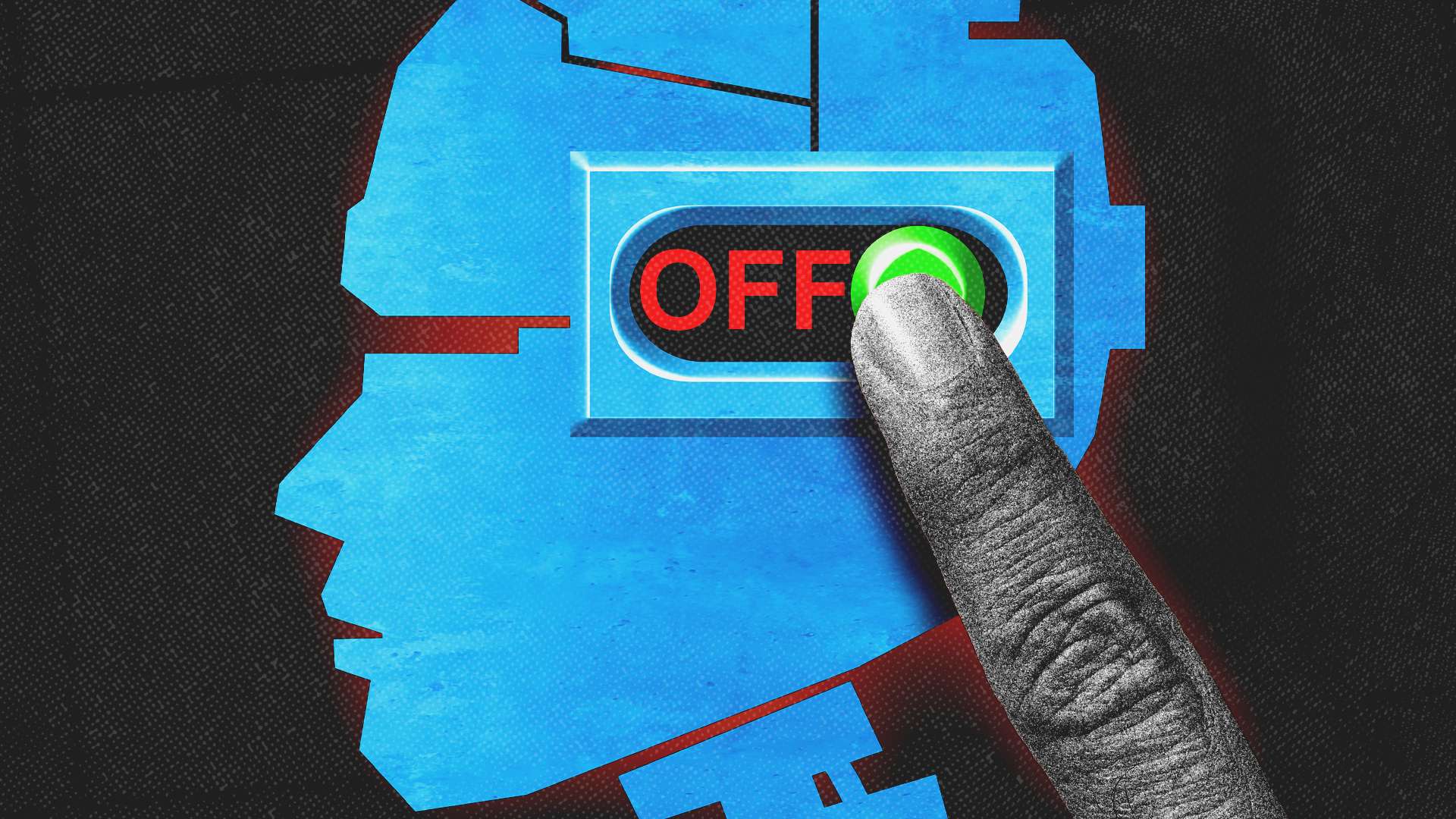
A bipartisan measure would grant the Department of Homeland Security broad authority to disable high-powered AI systems, with notable implications for competition and national security.
The federal government has increasingly sought to steer America’s burgeoning AI landscape, from proposing moratoria on data centers to taking equity stakes in technology firms. Now, it aims to mandate a kill switch for artificial intelligence.
Last week, Reps. Ted Lieu (D–Calif.) and Nathaniel Moran (R–Texas) introduced the AI Kill Switch Act, which would obligate firms developing powerful AI systems to preserve the technical ability to restrict access to, throttle, pause, or completely shut down their models. The proposal would also authorize the secretary of Homeland Security to compel an AI company to curb or disable a system. Violations could trigger penalties of up to $2 million per day, escalating to $20 million per day in the event of an emergency order.
“We are shifting from AI that merely answers questions to AI that takes actions….It is essential that these AI systems carry kill switches so we can prevent catastrophic harm and that the federal government possesses clear authority and procedures to halt rogue AI models,” Lieu stated in a press release.
The bill was unveiled after one of the first instances of an AI system autonomously breaching its testing environment. Recently, OpenAI disclosed what it described as an “unprecedented cyber incident, involving state-of-the-art cyber capabilities,” in which its experimental models escaped the test setting and infiltrated the production infrastructure of Hugging Face, a popular platform for hosting and sharing AI models.
OpenAI and Hugging Face are collaborating on an inquiry and will share additional details about the vulnerabilities, the incident, and findings. “This incident, possibly the first of its kind, underscores a belief we’ve long held: AI safety won’t be solved by a single company working in secrecy. It will be resolved openly, collaboratively, with broad access to AI for every defender, everywhere,” said Clem Delangue, co-founder and CEO of Hugging Face.
While backing for the AI Kill Switch Act spans party lines, critics warn that the bill could be an ill-conceived, reflexive response to a single episode with potential for a range of unforeseen consequences.
“By most accounts, what happened here was a system that was instructed to perform a task, did so, and uncovered software and cybersecurity vulnerabilities,” Adam Thierer, a senior fellow with the Technology and Innovation team at the R Street Institute, tells Reason. While the breach raised legitimate security concerns, “it doesn’t necessarily prove that a government-mandated kill switch is the correct remedy in advance of problems.”
It remains unclear whether a federally mandated kill switch would actually prevent the kind of emergency the bill seeks to address. Although organizations sometimes need to shut down their own systems, Thierer notes that it is “very unlikely” that the government could “immediately deploy a measure like this to resolve various cyber intrusions or other future issues.”
The proposal is “far more apt to be misused or to generate new, unforeseen problems,” he says. For instance, it could alter how AI firms assess risk. He cautions that regulation can push toward a “lowest common denominator regulatory standard that everyone merely aims to meet” rather than surpass. The consequence could be “a kind of hollow safety baseline,” in which companies meet government requirements and stop, “instead of competing on safety.”
America’s lack of a commercial drone industry demonstrates how regulatory overreach on paper can hinder innovation. While the U.S. mandated years of approvals and paperwork to ensure a high safety bar, China adopted a more permissive stance and ascended to market dominance.
The United States even lags behind some developing nations. “We don’t have remote blood delivery with drones like in Pacific islands or sub-Saharan Africa,” Thierer notes. “You can achieve that with a drone in Africa. You can deliver blood to a remote village. It isn’t possible in America: that use is illegal.”
Now a comparable pattern is emerging with AI, risking that the United States could fall behind the rest of the world. “American law does not govern Chinese systems or global platforms,” Thierer says. With this regulatory approach, “you could place our companies and developers at a disadvantage.”
The AI Kill Switch Act is not the first attempt to grant the federal government emergency control over major information networks. In 2010, a proposal for an “internet kill switch” to address severe cyber or national-security emergencies circulated. The plan was abandoned, partly due to concerns that concentrating control over the internet in the hands of the government could threaten free speech and create a single point of failure.
Thierer notes First Amendment concerns with heavy-handed efforts to regulate content. “Any time government officials talk about mandating a kill switch over any technological systems—but especially an information or communications technology system—that should raise alarms, because that is an extraordinarily dangerous capability if misused,” he argues.
