Galicia is one of the autonomous communities that has attracted considerable interest from China. Its president, Alfonso Rueda, knows this well, and although he acknowledges that competition to win Chinese investment has been intense, he explains that “it is worth it.” “Within ten years, it will be seen as normal that these companies have chosen to settle here,” he argues.
The president of the Xunta, taking part again this year in the La Toja Forum, is disappointed by the news about potential European cuts in agriculture: “I am critical from start to finish,” emphasizes Rueda, who up to last June led the Spanish delegation in the European Committee of the Regions. He also defends the role of the autonomous communities against the possibility that they lose functions tied to European budgetary expenditure. “It would be a mistake that, for political convictions or to want to return power to the States in the face of external threats that the European Union faces, that management be recentralized.”
Returning to part of his discussion in La Toja alongside presidents Salvador Illa and Imanol Pradales, the Galician expresses his view on the model of regional financing. In his view, what must be done is to negotiate: “Let all of us sit down and all lose a little. That is the key. If we all lose a little, in the end we will all come out ahead,” proposes Rueda.
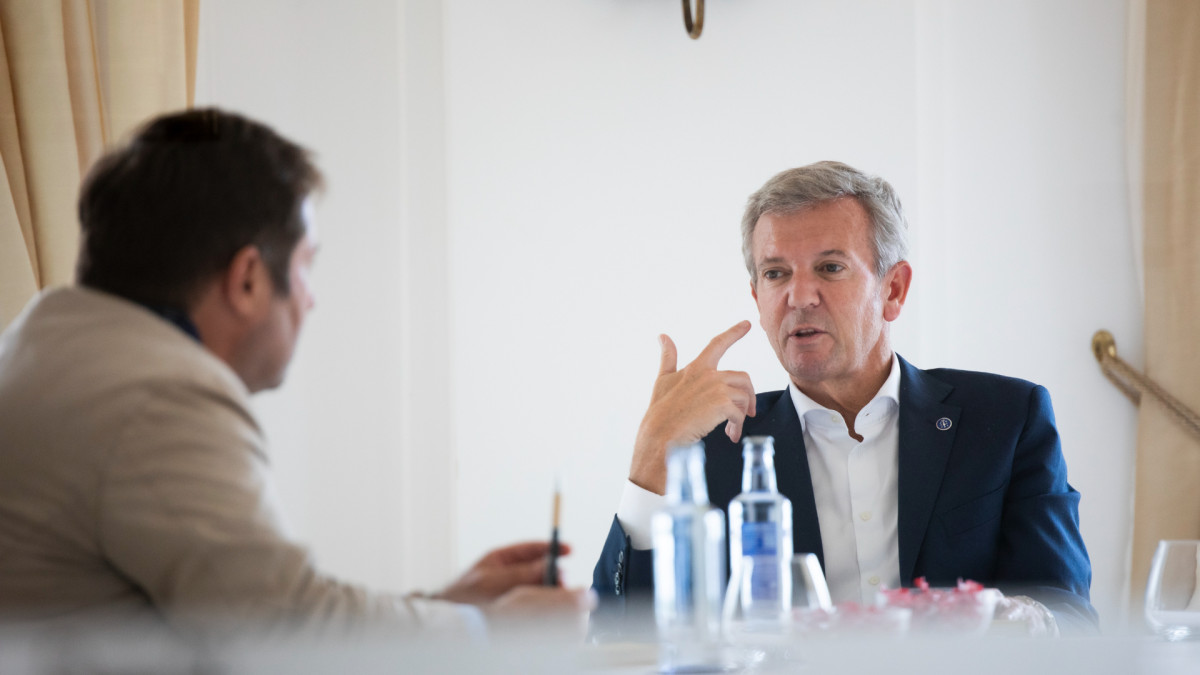
Alfonso Rueda, during the conversation with Agenda Pública at the La Toja Forum. Photo: Agenda Pública / Yanka Soto
How should we organize the relationship with China from Spain and from Galicia, where, as is known, a major investment is in a very advanced stage?
We see China as an opportunity. There are already Chinese investments in Galicia, though it is true that they are not as significant as the scale currently being contemplated. We have, for example, something intrinsically Galician like the canning industry. A very Galician canned goods factory was acquired by a Chinese company and operates normally. It was in a difficult situation and now it is boosted and functioning very well. There is also Chinese presence in the heavy metallurgy sector.
And now we have been presented with a huge opportunity. At the time, in collaboration from the very beginning with the Government of Spain —and I publicly acknowledged this yesterday to President Sánchez—, the most important Chinese car company, SAIC, MG in Europe, was considering starting not merely to assemble but to build its vehicles here. Among the various European possibilities, Spain stood out and, within Spain, a number of sites, including Galicia.
We entered that competitive process, first in Europe and then in Spain. The circle narrowed as possibilities were discarded. In the end, there were two candidates. We traveled to China, they met us, and they got to know us, something I think is very important.
“A very Galician canning factory was acquired by a Chinese company and operates normally”
I didn’t have any experience with Chinese businessmen, and I perceived that for them personal relationships matter. We were there and subsequently they have come here several times. I always say the same thing, despite all the controversy surrounding these investments. It’s true that, even if only for novelty and for what China represents, its investment in Europe sparks debate. But it’s clear that Chinese companies are landing in Europe. If not in Galicia and Spain, they will do so in other European locations that are also competing for those investments.
After witnessing the almost ferocious competition we faced with other sites to secure SAIC’s settlement here, I think it’s worth it. It could be a very significant investment in its own right. We are talking, at minimum, about 200 million euros of initial investment and the beginning of many other things.
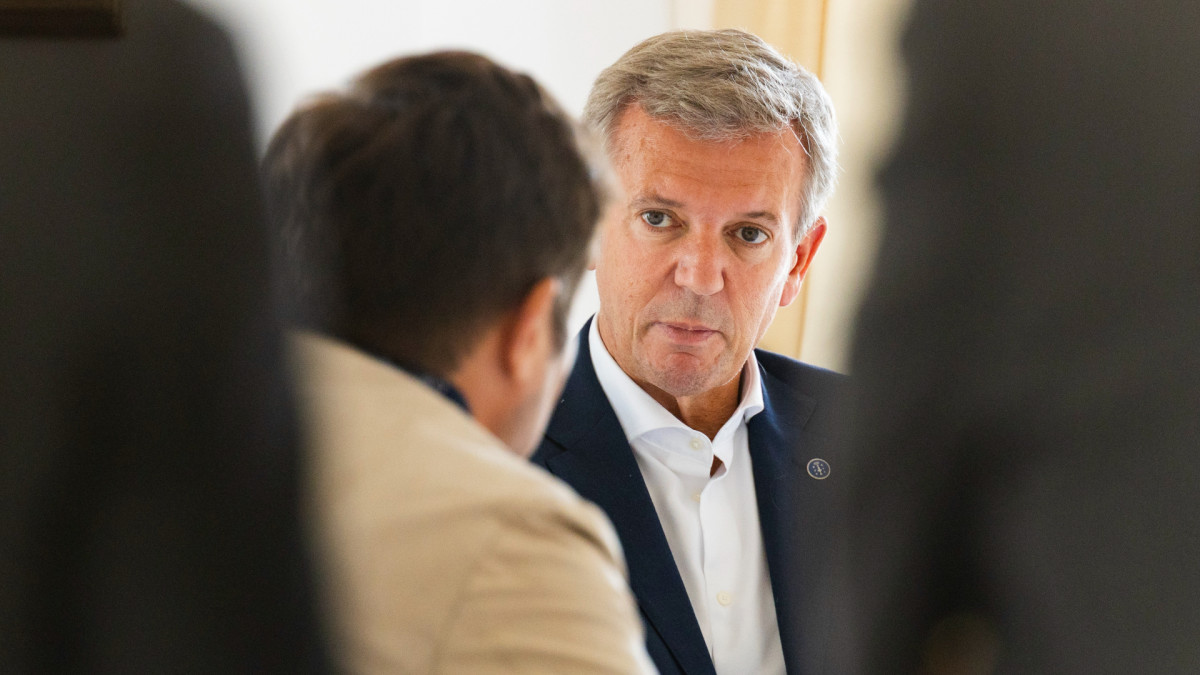
Rueda talks with Marc López Plana about Chinese investment in Galicia and Spain. Photo: Agenda Pública / Yanka Soto
Spain is currently receiving many Chinese investments and there is some concern in France and Germany. How do we reconcile the need to attract these investments — and the argument you just used, that if they don’t come here they will go elsewhere — with the current international situation?
I understand that this is a complex scenario, but I return to what I said earlier. Chinese companies, with a very close relationship to the Chinese government, have decided to start settling in Europe. There can be many theories and many misgivings, which are understandable. They are competitors and operate in sectors where Europe already has production. But they will come. It is a fact.
“It is clear that Chinese companies are landing in Europe. If not in Galicia and Spain, they will do so in other European places”
China’s circumstances are what they are: there is excess production capacity compared to domestic consumption, they produce high-quality products —quality has risen enormously over the last few years— and they have decided to take the plunge into Europe. In fact, they already have. Just look at the cars on our roads. I pay more attention now that we are immersed in this process and we see vehicles from Chinese brands that were already present.
Now they have decided to take the leap to manufacture those vehicles in Europe and, moreover, they do not hide that one of the reasons is to avoid the tariffs that exporting them from China would entail.
It’s clear to me, because I participated in this competitive process, that other places in Europe that were probably not selected will begin to express misgivings and tried to be the recipients of these investments until the last moment.
Therefore, I would not say that Spain is more pro-China. I think Spain has taken advantage of the benefits of maintaining a closer relationship and, therefore, we are also in a favorable position for Chinese companies to see Spain as a friendly environment. Let’s take advantage of that.
“Spain has taken advantage of the benefits of maintaining a closer relationship […] we are in a favorable position for Chinese companies to see Spain as a friendly environment”
In ten years, I believe all this will be normalized. And naturally, in ten years the companies that settle here now will have a decade of production here and wealth creation behind them. I fully understand current misgivings, especially since we are talking about commercial competition. But I think that in ten years, those companies choosing to settle here will be seen as normal. I imagine something similar occurred when Japanese automobile companies or Korean companies arrived. We have an opportunity with China and we will seize it.
One of the issues currently under European discussion—and which directly affects you as the president of Galicia—is the Union’s budget. It seems the system could evolve toward a model more like Next Generation EU, a model that would reduce the capacity of the autonomous regions to manage funds. Are you critical of this system?
Yes, without any doubt. I am critical from start to finish. Until three months ago I was the representative of all the regions of Spain in the European Committee of the Regions and there I defended precisely that position: beware of recentralization. And I say it based on empirical facts.
In my view, and I think this is a fairly general view, decentralization in Spain has worked well. It has not entailed higher costs. Some say it has, but the numbers are there: facts outweigh narrative. With the same money, decentralized management has allowed for far better service delivery. And we are seeing examples right now. In Ceuta, for example, health management is still centralized, and you can observe the differences.
There is currently a trend toward centralization in Europe. It is real. In my capacity as a representative on the European Committee of the Regions I had the chance to meet many European commissioners, and they did not hide that the current trend, perhaps due to the sociopolitical circumstances Europe is experiencing, is to concentrate everything again in the States. I think that is a mistake.
“Decentralization in Spain has worked well. With the same money, decentralized management has enabled much better service delivery”
And if we want a practical demonstration, we can look at Next Generation EU. I am waiting for the Spanish central government —I don’t know what happened in other countries, but I can speak about ours— to compare the execution of funds that were reserved by the State with the funds that were transferred to the autonomous communities.
We are going to approach or exceed 90% execution. That remaining 10% may be due, in part, to inefficiencies —I will not deny it, no one is perfect— and in part to conditions attached to funds transferred with a set of requirements. I am sure that the execution by the central government of the portion it reserved, which is also larger in amount than what was transferred to the autonomous communities, will be much lower. It will depend on sectors, but overall I think it will not exceed 70%.
There you have a demonstration of the problems of centralized management. It can also reproduce difficulties like those we are currently experiencing with autonomous funding: harming some territories to benefit others. It adds bureaucracy, returns responsibilities to an administration that has not managed this type of funds for a long time and leaves certain administrations that have specialized a lot in doing so without capacity.
All autonomous communities have specialized executive bodies to manage European funds, and I think they do so quite well. It would be a mistake that, for political convictions or to want to return power to the States in the face of external threats that the European Union faces, that management be centralized again. I think it would be a huge mistake and we will try to prevent it.
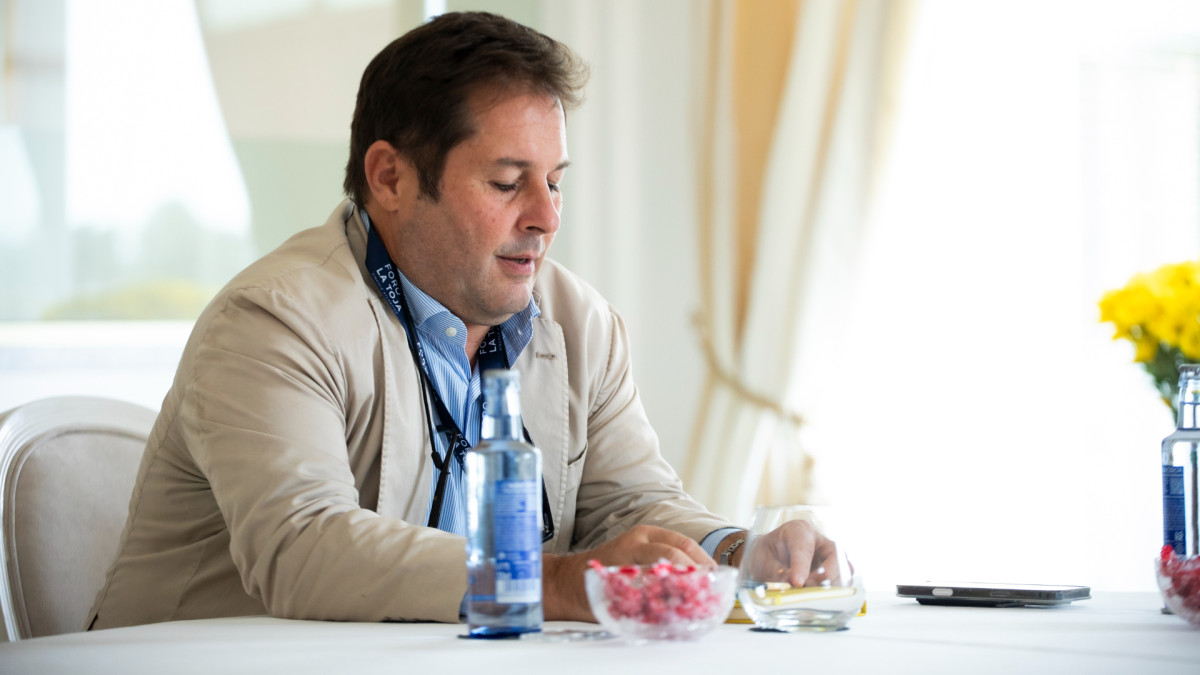
Marc López Plana delves into Galicia’s European perspective. Photo: Agenda Pública / Yanka Soto
Let’s talk about the Common Agricultural Policy. Are you worried about the amounts currently on the table for the CAP, especially given the weight of the primary sector in Galicia?
I’m very concerned. Galicia accounts for, for example, 50% of Spain’s dairy production. Moreover, unlike a few years ago, almost all of it is processed here now. We also hold 60% of the forest exploitation. Therefore, a great deal is at stake in the CAP.
Again, something similar to what we discussed earlier is happening. Now the new European budget is taking shape and, as far as I have been able to learn —my role as a representative on the Committee of the Regions allowed me to have direct meetings with European commissioners— everyone tells you to stay calm.
But what is announced, and what I am increasingly perceiving as reality, is a concentration and redirection of funds toward new priorities that I do not dispute. There is a priority for defense; this will happen because the current situation is what it is. There is also a priority toward new technologies. But Europe would be absolutely mistaken if suddenly it cut funds allocated to matters that remain priorities.
The Common Agricultural Policy is no longer just about subsidizing crops, as it used to be. In Galicia, for example, with the CAP we are financing generational renewal. We are helping all those young people who have trained, who will join the most modern farms and who need that support.
“Europe would be absolutely mistaken if it suddenly cut funds allocated to matters that remain priorities”
All European support is also needed for all new technologies applied to livestock farming and forestry. If all of that is cut now, while we are in an unstoppable process and perhaps within ten years these aids will no longer be necessary, we would be making a huge error. Right now these funds are essential, even more than before.
Moreover, we constantly talk about Europe needing food sovereignty. We also discuss, now that Mercosur opens, defending ourselves against possible mass arrivals of agricultural products. All of that would be in question.
That’s why I believe that, at a minimum, CAP funding should be maintained and if it must be reduced, the reduction should be very small. The same goes for the fishing policy. Galicia is the leading regional fishing power in Europe and this sector is fundamental.
If Europe makes drastic cuts to these supports because it considers they have been granted for many years and that resources must now be directed toward other priorities, it would be a huge mistake. After all the work that has been done, we would be left high and dry.
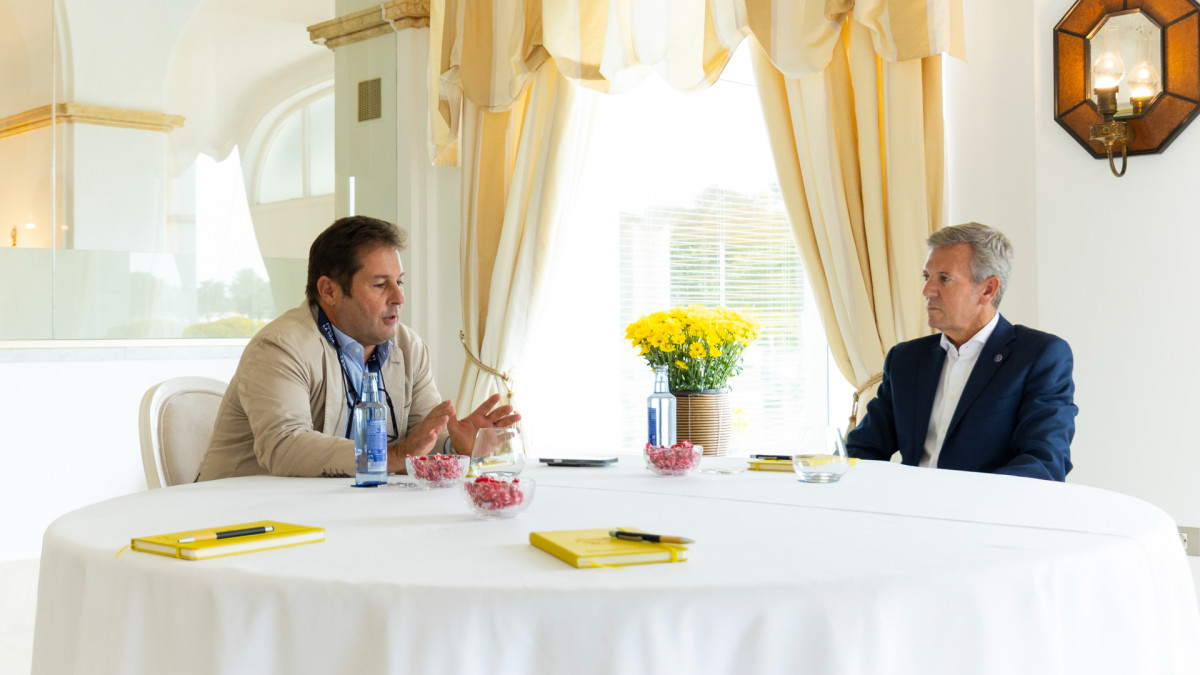
Rueda and López Plana address the autonomous financing model and resource distribution among territories. Photo: Agenda Pública / Yanka Soto
During his discussion at the La Toja Forum, the matter of autonomous financing inevitably came up. You have been quite forceful in your position and spoke of presenting almost twenty objections. What are the main issues raised in them?
We were accused of simply rejecting the model that had been proposed to us. I have explained the reasons. With that model, Galicia would move from being slightly above the national average in autonomous financing to being the second or third last. The damage, therefore, is evident.
Why does this happen? First, because out of those 22,000 million euros in additional funds to be distributed, there are direct transfers to some autonomous communities. I do not deny those transfers, but that already means taking a chunk of the pie. And then, criteria that previously existed but were not as decisive begin to carry much more weight. I’m talking, for example, about population.
“With that model, Galicia moves from slightly above the autonomous-financing average to the second or third from last”
What is Galicia’s position? We say: the point here is to pay what it actually costs to provide services and to guarantee they can be offered across the territory. And obviously, it does not cost the same to provide services to a concentrated population, as in the south or the Levant, as to a dispersed population, as in Galicia and, in general, in the north of Spain.
Let me give an example: half of all Spain’s population centers are in Galicia. If we are talking about sustaining rural populations and preventing people from moving to more populated areas, we have to ensure that basic services can be delivered there. And that costs money. The same goes for an aging population: attending to an older population requires delivering more services.
Therefore, if these circumstances lose weight in the weighting criteria, funding will necessarily be reduced and those services will be underfunded. That is what we have laid out in our objections.
I understand that for communities with more population, less aging and less dispersion it would benefit if the population-based criterion carried more weight. That’s why I say: let us all sit down and all lose a little. That is the key. If we all lose a little, in the end we will all win.
“The point is to pay what it really costs to deliver the services to ensure they can be provided across the territory”
What makes no sense is that some communities suddenly see their funding increase dramatically, because that will necessarily come at the expense of others. That is what we have explained in our objections. That’s our model. And, as I said this morning during the debate, we have not even received a response.
What is Galicia’s project for Spain? You’ve begun to respond in some way by talking about autonomous financing, but I’d like to know how Spain is viewed from Galicia.
I always explain one thing. When people ask us about Galicia’s election results and why a party has governed for so many years with an absolute majority, there’s a circumstance that does not occur anywhere else in Spain. Vox, which is a party clearly growing in the rest of Spain, does not have a single public representative here: not in the Spanish Parliament for Galicia, not in the Galician Parliament, and not in any city council, despite having stood in many elections.
I think this has to do with Galician identity. We are a historic nationality. If you conduct a survey —we do them regularly— and ask Galicians whether they feel more Galician or more Spanish, you’ll get a range of answers. However, the majority response will be, first, to ask why you’re asking that question, as good Galicians, and then say “exactly equally both things.” How do we see ourselves? As a fundamental part of our country.
The other day, at a forum in Madrid, I was asked how Galicians feel about Spain. We feel loved. We have no sense that there is rejection toward Galicia. And we feel that we can contribute a lot. Precisely for that reason we ask —and I return to the previous question— for solidarity to maintain a basic level of services that makes all of us feel part of our country.
I think Galicia is perceived as a land with strong identity and also warmth. We have recovered the motto “Galicia Calidade,” which in Spain is taken as absolutely credible. More and more —or at least that’s what people tell us— we hear: “In Galicia you’re calm, in Galicia it’s a pleasure,” especially when compared with the noise in Spain and with the absolute polarization.
Here, dialogue is still possible. We have just reached an agreement with the Socialist Party on a sensitive issue like language. I think something like that would be unimaginable in many other parts of Spain.
“We feel loved. We have no sense that Galicia is rejected”
There was a lot of talk about Galicia as an island of stability. And being an island of stability in a country as unsettled as Spain is right now, I think, defines Galicia well relative to what is happening elsewhere.
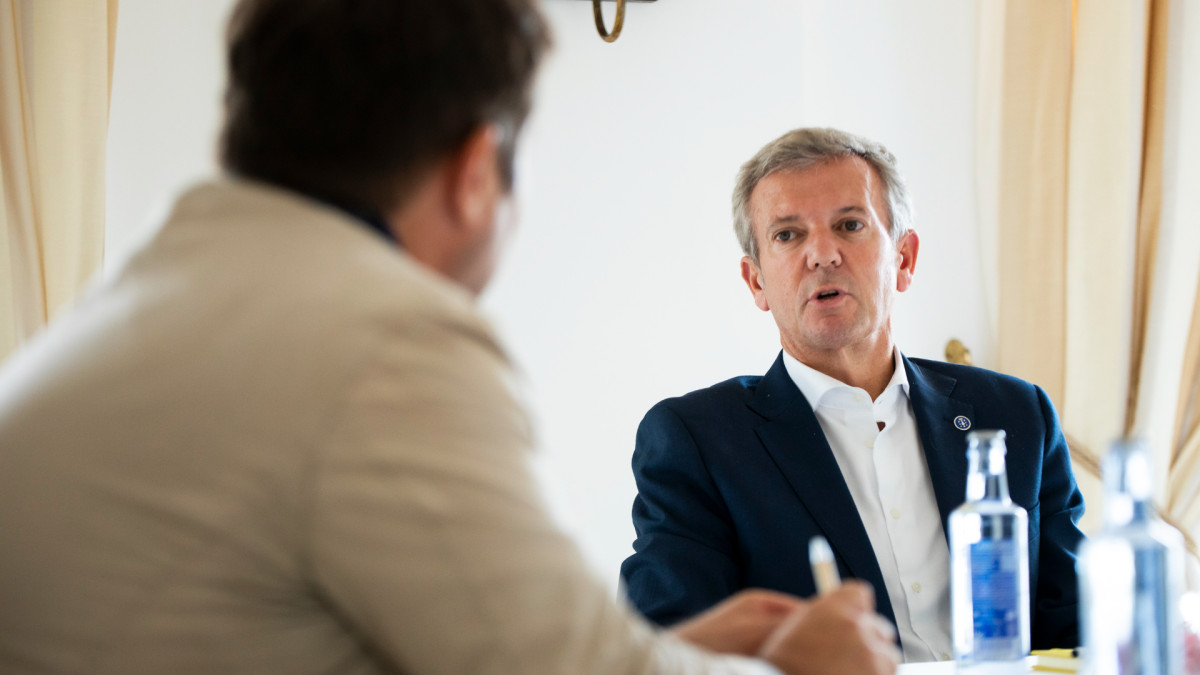
Rueda defends dialogue and political stability as hallmarks of the Galician model. Photo: Agenda Pública / Yanka Soto
And what would Spain need to achieve that Calidade, so to speak, in all senses?
To calm down a bit. I think right now we have a prime minister who, on his investiture day, spoke of building walls. It’s a strong signal of intent.
I said it during the inauguration of the La Toja Forum: when you speak with someone, you must understand that they may have a point. I’m not saying they have all the points. You may legitimately think you have most of the reason. But to say the other person has none, that it isn’t worth listening to them, and that they should be thrown to the lions, is not acceptable.
Here we try to do something different. And perhaps that’s why we don’t have extremisms. We certainly don’t have the far right and we have less far-left than in other places.
I think the ideal would be to calm down a bit, listen, and admit that everyone has something to contribute. Being polarized and tense doesn’t help us move forward. It’s as simple as that. And in the end, that leads to stability. People notice it and say: “Hey, you take charge of all this, as long as you keep listening to others.” I think that is what has been happening in Galicia for a long time.
This morning you also spoke about immigration. In Galicia, we can tie the immigration question to the debate on the so‑called “grandchildren’s law.” How can immigration be incorporated while maintaining social cohesion? And, on the other hand, what experience does Galicia have that could be valuable for the rest of Spain?
In reality, these are two questions that complement each other, because the “grandchildren’s law” is linked to rootedness.
“The ideal would be to calm down a bit, listen and admit that everyone has something to contribute”
When people ask me about rootedness, I have a very easy answer. We have a Galician community abroad that are of Galician origin, and when I say origin, I mean grandchildren or even great-grandchildren of Galicians. Many of them maintain very close contact with Galicia.
We have a specific structure within the Galician Government dedicated to emigration, which at one time held ministerial rank and has a very substantial budget and maintains ongoing relations with Galician communities abroad.
I travel a lot to visit Galicians living abroad. And I always say that the only time I don’t travel is during election campaigns. I think that perfectly explains how we understand our relationship with them and marks a difference with what often happens in other territories.
Every time I travel, I return saying that everyone should visit at least once the Galician communities abroad to understand what they mean and the feeling that exists.
For example, I’ve been in Punta Arenas, Chile, visiting the Galician center where five-year-old girls, great‑granddaughters of Galicians who arrived there in the early twentieth century, have learned Galician dances via the internet. I’ve seen Galician teachers giving classes there to three hundred or four hundred people. People who connect daily to watch Televisión de Galicia. People who, as soon as they can, make an effort to travel to Galicia.
We also have programs to bring young people tied to Galicia here through the Camino de Santiago. And when they finish their studies with good grades, we fund scholarships for them to pursue a master’s degree here. If afterwards they wish to stay and work here, they can do so. That is a huge advantage. When you bring a person in those circumstances, they know where they are coming to and they have family here. Integration is much faster.
We have very successful Galician entrepreneurs scattered around the world who are our best ambassadors. What better Galicia ambassador could there be than someone deeply connected to this land who is also a respected person with large companies, a significant impact, or even media ownership in various countries?
“When you bring a person in those circumstances, they know where they’re going and have family here. Integration is much faster”
That is Galician emigration. And we are leveraging that reality through what we call Estratexia Retorna. For anyone wishing to return to Galicia, we open our arms. They know where Galicia is, they know what happens here, they have family and can integrate quickly.
This has been a successful formula. We are already into the second edition of Retorna a Galicia. After many years of population loss, we are now growing. It’s true that the population has risen across Spain thanks to immigration, but a very important percentage of those who have arrived in Galicia have precisely that origin and that link.
I think that is the path. The tensions related to immigration that we see in other places hardly occur here. We have an advantage, we are making the most of it, we are promoting it, and we believe in it.
“The tensions related to immigration that we see in other places hardly occur here. We have an advantage, we are making the most of it, we promote it and we believe in it”
But really, you have to travel to one of those centers. And I’m not just talking about Argentina, Uruguay or Brazil. Chile was mentioned earlier, but it also happens in Europe, in Switzerland or France. I recently was in Zurich and saw fourteen- or fifteen-year-old kids who speak German, who were born there, and who speak Galician perfectly. When people ask me what rootedness is, for me rootedness is exactly that.
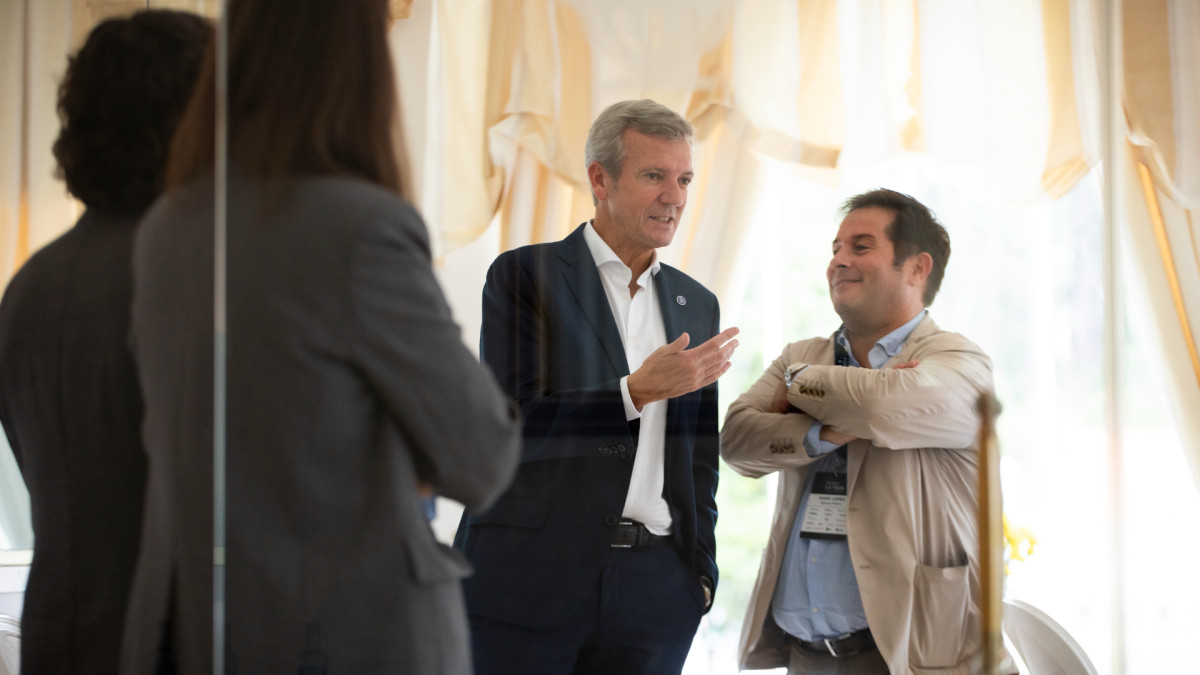
Alfonso Rueda and the Agenda Pública team at the end of the conversation at the La Toja Forum. Photo: Agenda Pública / Yanka Soto
So, where should the “grandchildren’s law” go, which the Partido Popular has criticized so strongly?
In my view, and I have stated it publicly, I think the vast majority of Spaniards do not understand that someone who has never been in Spain, and has no interest in coming, or even in knowing what happens here, should be granted the right to vote.
I cannot understand it. Perhaps that is a bias derived from knowing so well what our relationship with the Galician community abroad is.
I think there should be a certain rootedness. I can admit that the discussion lies in how to define it. In fact, I think it’s easier to identify what rootedness is not than to define exactly what it is. There can be many nuances.
“There should be a certain rootedness. I can admit that the discussion is about how to define it”
But we all know what it means not to have any rootedness: not to have any interest, to show total detachment and to seek only a document. I think that should not be allowed and much less that those people can decide the future of a country. If the “grandchildren’s law” allows that, in my view, it is mistaken.
How is Europe seen from Galicia?
As a huge opportunity for the future. We recently celebrated the anniversary of Spain’s entry into the European Union, and thus also Galicia’s. We prepared an institutional video in which we compared mid-1980s Galicia with present-day Galicia. People are left open-mouthed.
When you start adding subtitles saying “funded by the European Union,” “funded by the European Union,” you realize the enormous force that Europe had in our transformation.
At that time we were almost the poor relations entering Europe, and we had almost everything ahead of us to do. Today Galicia has gone from being the third region with the lowest income to approaching the Spanish average. It isn’t exclusively due to Europe, of course, but to a large extent. Therefore, we see Europe, first of all, with gratitude.
It is true that we have had to make many sacrifices. We have undergone a very important restructuring, especially in primary sectors. Precisely for that reason I insist on the need to complete that process with the next CAP.
But Europe is also a future opportunity and we are not wasting time. Now, for example, many Galician companies are adapting to something that seems inevitable: a very significant share of the European budget will be directed toward defense policies and new technologies. Our companies are already preparing for this. Europe is a permanent opportunity. And whoever does not understand it will have a problem.
“A very significant portion of the European budget will be directed toward defense policies and new technologies. Our companies are already preparing for it”
It is often said that Europe was built with the Camino de Santiago, and we are now seeing it firsthand with the daily arrival of pilgrims. It is spectacular how the proportion of domestic pilgrims is decreasing and foreign pilgrims are increasing. People come from all continents, but Europe still has enormous weight.
That European root was always there, and now we must know how to take advantage of it.
Thank you very much for your time.
In partnership with