
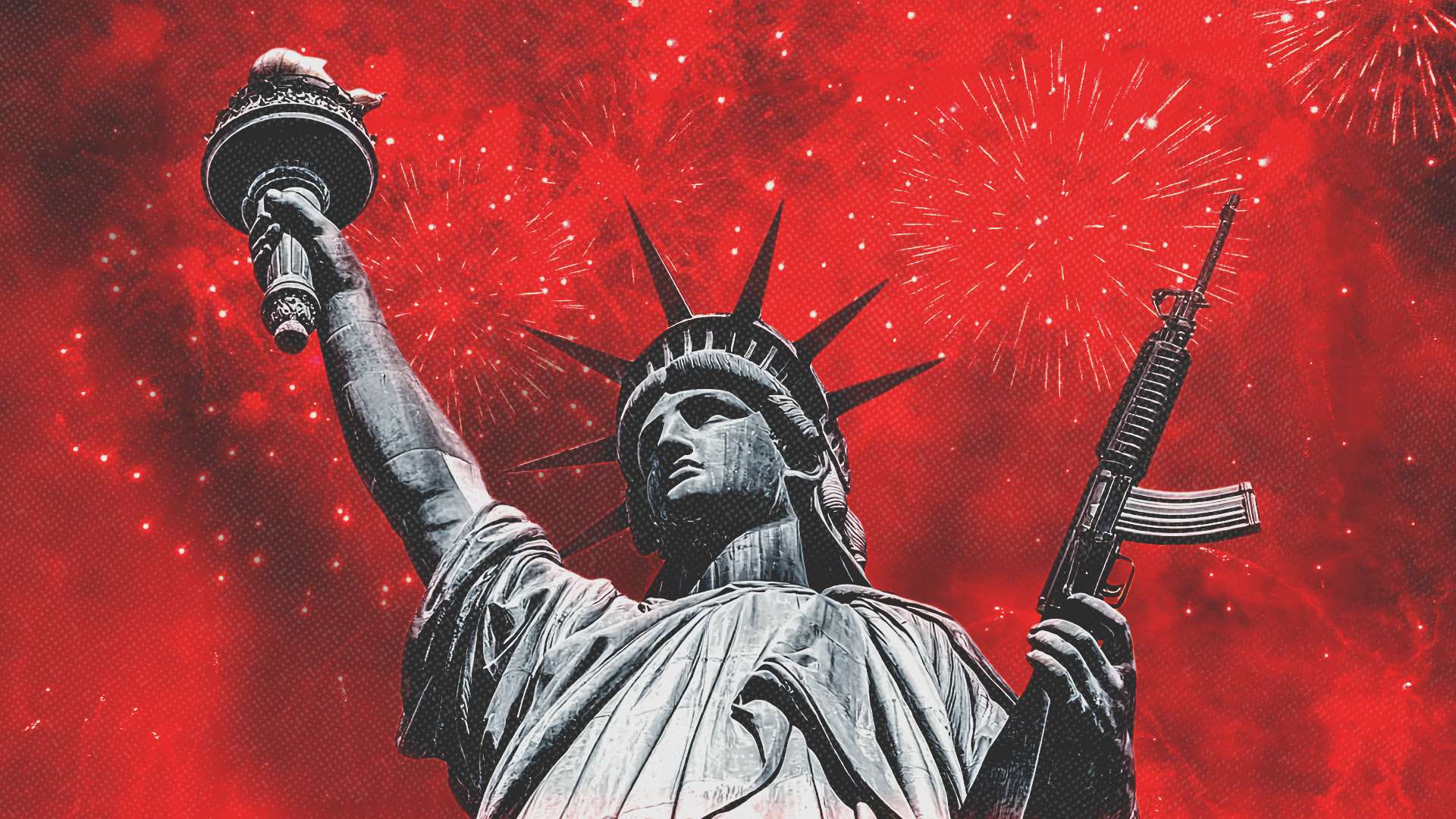
On the Fourth of July, John Quincy Adams warned against the foreign policy trajectory that his successors would later pursue.
The Founding Fathers wrestled with a central question from the very beginning: should the United States seek to spread liberty through force, or through more restrained means? Thomas Jefferson favored backing the French Revolution, while George Washington urged Americans to steer clear of permanent alliances with any portion of the foreign world in his Farewell Address.
What neither of them could have foreseen was a nation that would become a willing patron of absolute monarchies. Yet the course of today’s leadership has moved toward forging a tight alliance among rulers who lack elected parliaments, unlike Britain during the era of the American Revolution. Recently, Trump pressed Saudi Arabia and Qatar to join the Abraham Accords, an alliance underwritten by the United Arab Emirates. Mere weeks earlier, he proposed to act as the “guardian” of these governments in exchange for payment. All three states are monarchies, and none of them even have elected legislatures.
The challenge goes deeper than any single figure. In the first half of the Biden administration, the United States supplied weapons to the majority of the world’s autocracies, The Intercept reported. The situation has persisted since. Reason magazine found that a majority of the world’s autocracies continued to benefit from U.S. weapons or security aid from fiscal year 2022 through fiscal year 2025.
The numbers come from the Defense Security Cooperation Agency (DSCA) sales book, which accounts for both military aid and government-to-government weapons sales, as well as the security aid announcements (including training) on ForeignAssistance.gov. The DSCA data extend only through fiscal year 2024 and exclude direct private-sector weapon sales by American companies, focusing on official government transactions.
According to the University of Gothenburg’s Regimes of the World database, 62 of the world’s 87 autocracies benefited from U.S. weapons or security aid. And Freedom House’s Freedom in the World report shows that 39 of the 61 countries listed as “not free” benefited from U.S. weapons or security aid, while 38 of the 42 countries deemed “partly free” did as well.
If there is a tin-pot tyrant somewhere in the world, odds are that they owe part of their power to the Pentagon. And if a country hovers on the edge between liberty and dictatorship, the forces of repression often arm themselves with American support. That is hardly a comforting thought on the Fourth of July.
Some of these cases are well known. The U.S. government remains one of the largest arms suppliers in the Middle East, distributing weapons to monarchies and authoritarian regimes across the region. Other instances fly under the radar of public awareness. Many of the recent coups across Africa were carried out by U.S.-trained military officers—some of whom later turned against the United States.
It would be easy to chalk these tendencies up to cynical realpolitik. Secretary of State Henry Kissinger famously said foreign policy “should not be confused with missionary work.” If so, the implication would be that the U.S. government can simply choose to act more morally. Reformers, such as former USAID Administrator Samantha Power, have argued that a more principled U.S. aid policy could help democracy prevail over autocracy.
But perhaps the problem lies in trying to perform missionary work at all. After all, many of the United States’ troubling partnerships are legacies of the Cold War. Many administrations not only overlooked the crimes of anti-communist partners but also argued that Americans have a duty to support those forces as a moral good. The same logic has played out in the Middle East, where the U.S. government has suggested that certain dictatorships could serve as “models” of tolerance.
“Efforts to spread liberalism often contained the seeds of illiberalism,” wrote historian Patrick Porter in a paper for the libertarian Cato Institute. He argued that the very act of enforcing any kind of world order, democratic or not, requires “the forceful suppression of revolt” and cooperation with local rulers. In other words, attempting to become the world’s “arsenal of democracy” effectively made America the arsenal of autocracy by necessity.
President John Quincy Adams issued a comparable warning on July 4, 1821. He warned that America “well knows that by once enlisting under other banners than her own, were they even the banners of foreign independence, she would involve herself beyond the power of extrication, in all the wars of interest and intrigue, of individual avarice, envy, and ambition, which assume the colors and usurp the standard of freedom. The fundamental maxims of her policy would insensibly change from liberty to force,” he declared.
That did not mean the American Revolution offered nothing to the world. Adams proposed an alternative model for America: “Wherever the standard of freedom and Independence, has been or shall be unfurled, there will her heart, her benedictions and her prayers be. But she goes not abroad, in search of monsters to destroy. She is the well-wisher to the freedom and independence of all. She is the champion and vindicator only of her own. She will recommend the general cause by the countenance of her voice, and the benignant sympathy of her example.”
