
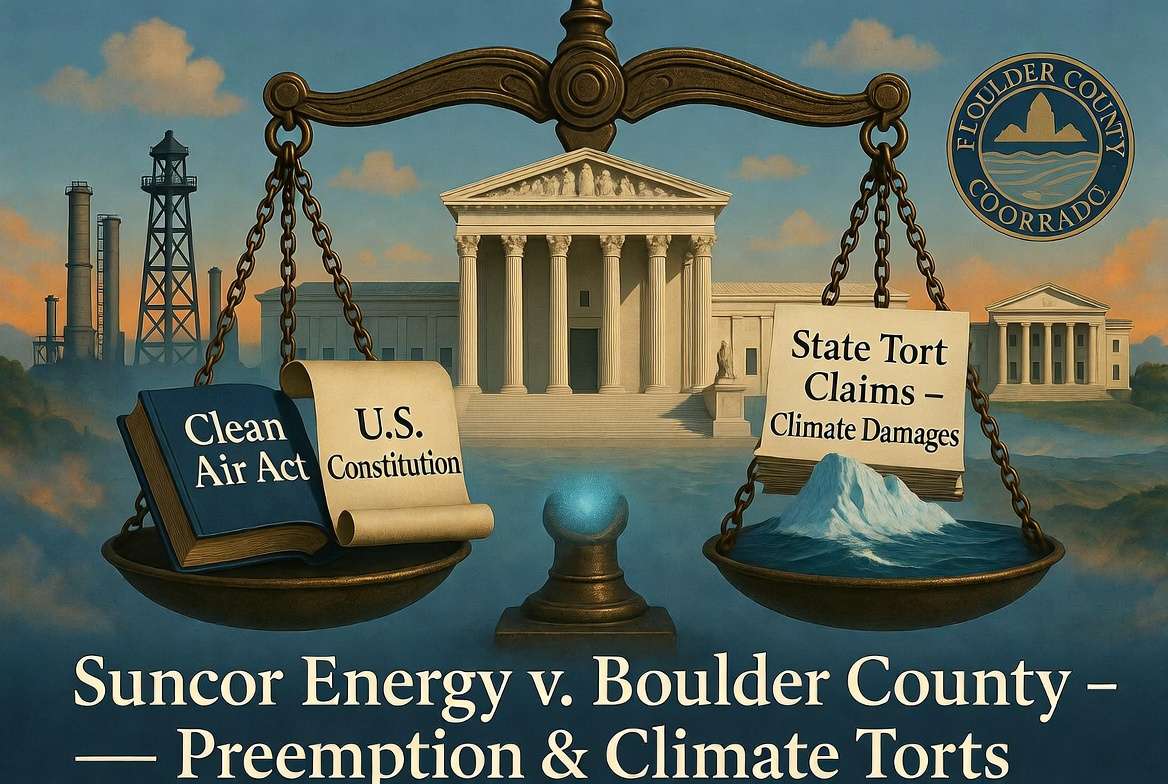
In the forthcoming climate-change case, the Supreme Court should reject industry and Trump administration arguments for preemption by penumbra.
This morning I submitted an amicus brief in Suncor Energy (U.S.A.) Inc. v. County Commissioners of Boulder County. The case, which is likely to be argued in October, will prompt the Court to weigh whether the Clean Air Act or the Constitution foreclose state-law claims seeking redress for injuries allegedly tied to climate change.

As I have argued in prior writings on this topic, I regard the theories of preemption as lacking merit. (I do not take a position on the procedural or jurisdictional questions; for that, the briefs by Professors Derek Muller and Ben Johnson offer a helpful overview.) Consequently, the amicus I filed concentrates on the preemption issues. Here is a reformulated outline of my position:
Global climate change raises a set of intricate and stubborn legal and policy questions. If the Court has jurisdiction, the legal questions before it are comparatively simple and direct. There is no basis in federal law, much less in the Constitution, to preclude state-law claims that seek relief from injuries alleged to have been caused or worsened by the petitioners’ conduct.
The core question is whether aggrieved parties—potentially including subnational governments—may pursue redress under state law against defendants who fall within the jurisdiction of state courts for harms allegedly caused or contributed by those defendants. For these claims to succeed, plaintiffs must ultimately show that the damages they allege stem from the defendants’ actions, that those actions fall within the range of state-court authority, and that such actions are subject to state tort liability. Allowing this case to proceed does not force any state to adopt a universal rule governing all fossil-fuel producers or all greenhouse-gas emissions worldwide. While emissions may be difficult to trace and separate, that difficulty does not justify—let alone require—preemption of the claims.
Petitioners contend that respondents’ claims are barred because both the Clean Air Act and the Constitution categorically prevent any claims for harms caused by interstate pollution. Yet neither the Clean Air Act nor the Constitution imposes such a blanket prohibition. To the contrary, as this Court has long understood, such suits may proceed, subject to certain limitations, even if they are viewed as efforts to obtain redress for interstate pollution within federal regulation.
That the Clean Air Act could be characterized as a broad, comprehensive regulatory framework does not mean it blocks state-law remedies for harms arising from greenhouse-gas accumulation in the atmosphere. Like other federal environmental statutes, the Clean Air Act was enacted with a backdrop of extensive, essential state environmental protections, including common-law causes of action. Its text, history, and structure reveal an intent to complement, bolster, and encourage state-level efforts rather than to supplant or preempt them. This is a point this Court has acknowledged as well.
The Constitution’s architecture provides no greater basis for shutting courthouse doors on the relief sought by respondents. Federal common law may have preempted state attempts to control interstate air pollution under state law in the past, but federal common law has since been displaced, and it no longer serves that function. No constitutional provision or doctrine identified by petitioners justifies wholly preempting state-law claims seeking redress for harms like those alleged here. Petitioners’ attempt to assemble a constitutional preemption rule based on penumbras and emanations from various constitutional provisions lacks the weight to sustain the proposed rule. There is no federal pre-emption in vacuo, absent a constitutional text or a federal statute that authorizes it.
State law—through statutes, regulations, and longstanding court decisions—has played a vital role in our nation’s environmental protections. Foreclosing resort to state law simply because these claims may threaten economically significant interests or rely on expansive theories of liability would be inappropriate. If such suits are to be preempted, that determination lies with Congress, not the courts.
And later in the brief:
The Court should reject petitioners’ invitation to create a new constitutional rule that would categorically bar States from using state law to address environmental problems connected with interstate pollution. Environmental problems rarely respect political boundaries. Yet this has never prevented the use of state-law approaches to environmental concerns, nor has it hindered efforts by state policymakers and affected parties to employ state law to remedy environmental harms.
The Constitution grants the federal government ample authority to guide climate-change policy and to limit or preempt state laws that are ineffective or ill-advised. That authority lies with Congress and, if appropriate, the President, exercised through the legislative and executive branches. The idea of adopting an unprecedented, boundless rule governing interstate environmental issues through this Court is unsupported, and that is a sufficient reason to reject the petitioners’ arguments.
While I do not address the foreign-affairs preemption argument, I find it even less persuasive than the other arguments I consider, largely because it lacks a limiting framework. The United States is not presently a party to any treaty—or even engaged in an international negotiation—that would threaten a damages award. The notion that suits like this could be preempted on foreign-affairs grounds merely because the defendants operate across borders, or because the atmosphere is global in scope, does not alter the analysis. Congress could certainly preempt this litigation on foreign-affairs grounds, and, under current precedent (including Garamendi), the executive branch might also be relevant—but there is no action by the political branches here that could or should produce such an effect.
I also do not address the First Amendment arguments raised by some leading amicus briefs, mainly because those issues are not presently before the Court. As I note in my brief, there could be constitutional limits on tort liability for certain marketing claims, but that would not validate a preemption of these suits at their outset.
I expect to provide further commentary on some issues raised by this litigation (and perhaps on some of the numerous amicus briefs submitted). For those who are listening, here are links to my prior discussions on this topic:
- Why State Common-Law Nuisance Claims Against Fossil-Fuel Firms Aren’t Preempted, Oct. 27, 2021;
- Third Circuit Rebuffs Oil Companies’ Attempts to Transfer Climate Claims to Federal Court, Aug. 17, 2022;
- Oil Companies Fail to Persuade the Eighth Circuit Climate Cases Should Be Removed to Federal Court (Updated), Mar. 25, 2023;
- Is Climate Change Returning to the Supreme Court? (Minnesota Edition) [UPDATED], Dec. 11, 2023;
- D.C. Circuit Rejects Oil Company Attempt to Remove District’s Climate Suit to Federal Court, Dec. 19, 2023;
- William Barr Responds on American Petroleum Institute v. Minnesota, Dec. 26, 2023;
- Supreme Court Passes on Minnesota Climate Change Case, Jan. 8, 2024;
- Are State Law Climate Change Tort Suits Preempted by Federal Law?, May 3, 2024;
- Supreme Court Denies Certiorari in Climate Tort Suits, Jan. 13, 2025;
- Supreme Court Rejects Red State Attempt to Sue Blue States Over Climate Suits, Mar. 10, 2025;
- William Barr Discloses the Economics of Tort Law (and Misstates the Law Governing Interstate Pollution), Nov. 3, 2025;
- Placing Climate Tort Litigation in Context (Updated), Nov. 7, 2025;
- A Second Round with William Barr on Litigation Over Interstate Pollution, Dec. 2, 2025;
- Court Dismisses Trump Administration Effort to Block Michigan Climate Lawsuit, Feb. 4, 2026
- Climate Change Goes Back to the Supreme Court — Colorado Edition, Feb. 23, 2026.
- Previewing Suncor Energy v. Boulder County, Mar. 6, 2026.
