
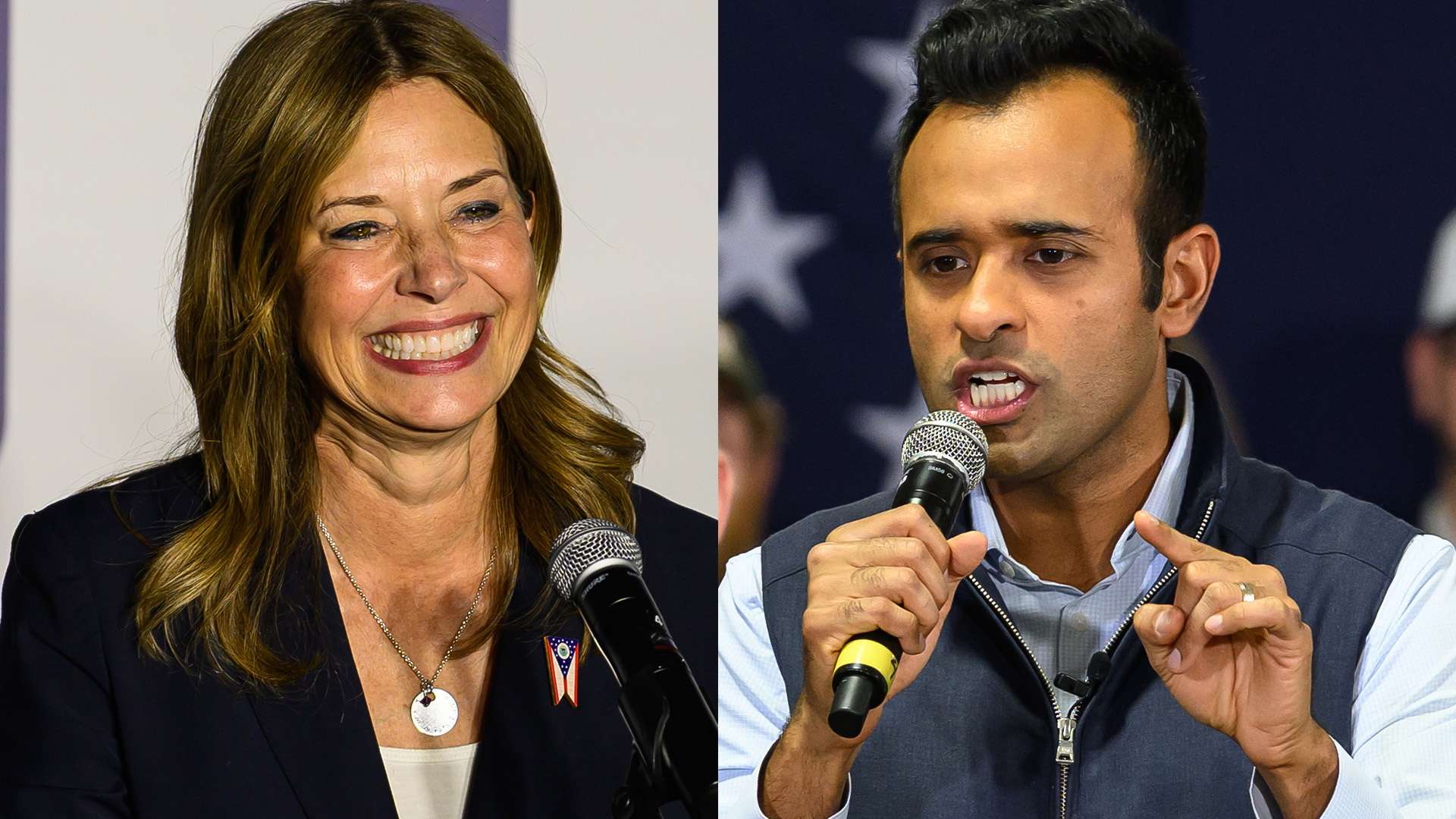
A conventional Democrat triumphs over a distinctive MAGA contender.
Amy Acton has been chosen as Ohio’s next governor. A physician who led the state’s Department of Health at the outset of the coronavirus crisis faced off against entrepreneur Vivek Ramaswamy, who drew national attention as a candidate in the 2024 Republican presidential primaries before dropping out and throwing his support to Donald Trump.
The Associated Press has projected Acton as the winner, with about 50.7 percent of the vote.
Acton appears to be, by all appearances, a fairly conventional Democrat. She has faced sharp criticism for her pandemic lockdown measures, which were not among the strictest in the country but were still deemed by a Ohio judge as “impermissibly arbitrary, unreasonable, and oppressive.”
Looking ahead, she is likely to exhibit a mix of strengths and weaknesses typical of mainstream Democrats in 2026.
Among Acton’s campaign pledges were a Child Tax Credit, a proposal to implement some form of age verification for app stores, and a moratorium on new data centers in Ohio until they “exclusively build with union labor” and meet additional criteria. She also critiques Ohio’s school voucher system and offers a set of familiar Biden-era commitments, such as ending “surprise markups” on sporting and concert tickets, cracking down on employers who misclassify workers as independent contractors, and confronting price gouging (without specifying who would be protected, turning it into a broad catch-all issue).
On the plus side, she pledges to safeguard reproductive freedom and to support legal marijuana. She is reported to have voted in favor of marijuana legalization when it appeared on the ballot in 2023, while Ramaswamy opposed that measure.
For those who need a reminder that the country isn’t in 2020 anymore, her site accuses Ramaswamy of wanting to “defund police” (by eliminating property taxes) while promising to “fully fund our local law enforcement.” And she has stated “I do not support boys playing in girls’ sports” when asked about the Supreme Court’s ruling on transgender athletes.
The contest between Acton and Ramaswamy grew increasingly acrimonious toward the end, with an ad from Ramaswamy’s campaign that featured Acton’s mother — with whom Acton has been estranged since her stepfather was charged with raping her when she was 12 — branding the candidate a liar. The ad drew praise from President Donald Trump and Vice President J.D. Vance but was largely condemned by other prominent Republicans.
That advertisement may seem tangential to how Ramaswamy would govern, but it isn’t entirely irrelevant. The decision to air the spot and to persist with it when challenged underscored Ramaswamy’s long-standing affinity for Trump, and Trump’s influence on him. A victory for Ramaswamy would have represented a win for Trumpian politics, at least to some extent.
The son of immigrant parents, Ramaswamy advanced somewhat more moderate views on immigration than those of the president and many of his supporters. He also argued against identitarian politics on both ends of the political spectrum. And from a libertarian standpoint, there are several points in his favor. In the past, he criticized economic protectionism and rejected the notion of a “right-wing nanny state.” He is pro-cryptocurrency and pro-housing, and he campaigned on eliminating property taxes, phasing out income taxes, and expanding school choice.
But his gubernatorial bid also featured a moratorium on data-center construction “until they’re legally required to subsidize their neighbors with free electricity and other community benefits,” as Reason‘s Christian Britschgi explained. He proposed a “libertarian-nationalist alliance.” During the 2024 election, “there were times when Ramaswamy seemed like the only person in the field willing to speak some impolitic truth,” as Jesse Walker wrote in Reason at the time. “It’s just that he mixed those truths with some of the most godawful positions you could imagine.”
Does Ramaswamy’s loss suggest a shift away from MAGA in Ohio? Perhaps—though it’s hard to discount the fact that two major liabilities weighed against him in the state, one of his own making and one not. The decision to run that ad featuring Acton’s mother may have alienated moderate swing voters, especially women. Meanwhile, his skin color, his parents’ status as Indian immigrants, and his Hindu faith may have repelled some far-right voters who might otherwise have backed a pro-Trump candidate.
As a native Ohioan, I found myself torn between supporting Ramaswamy and opposing him. I couldn’t bring myself to vote for Acton, despite feeling a certain thrill at the prospect of a woman leading Ohio and despite recognizing that there are areas where she could outperform Ramaswamy. Yet I also couldn’t bring myself to back a man who seems eager to win Trump’s favor and imitate the worst instincts associated with him.
Ultimately, I abstained and voted for Libertarian Don Kissick. Kissick ended up with 3.4 percent of the vote, per AP.
