
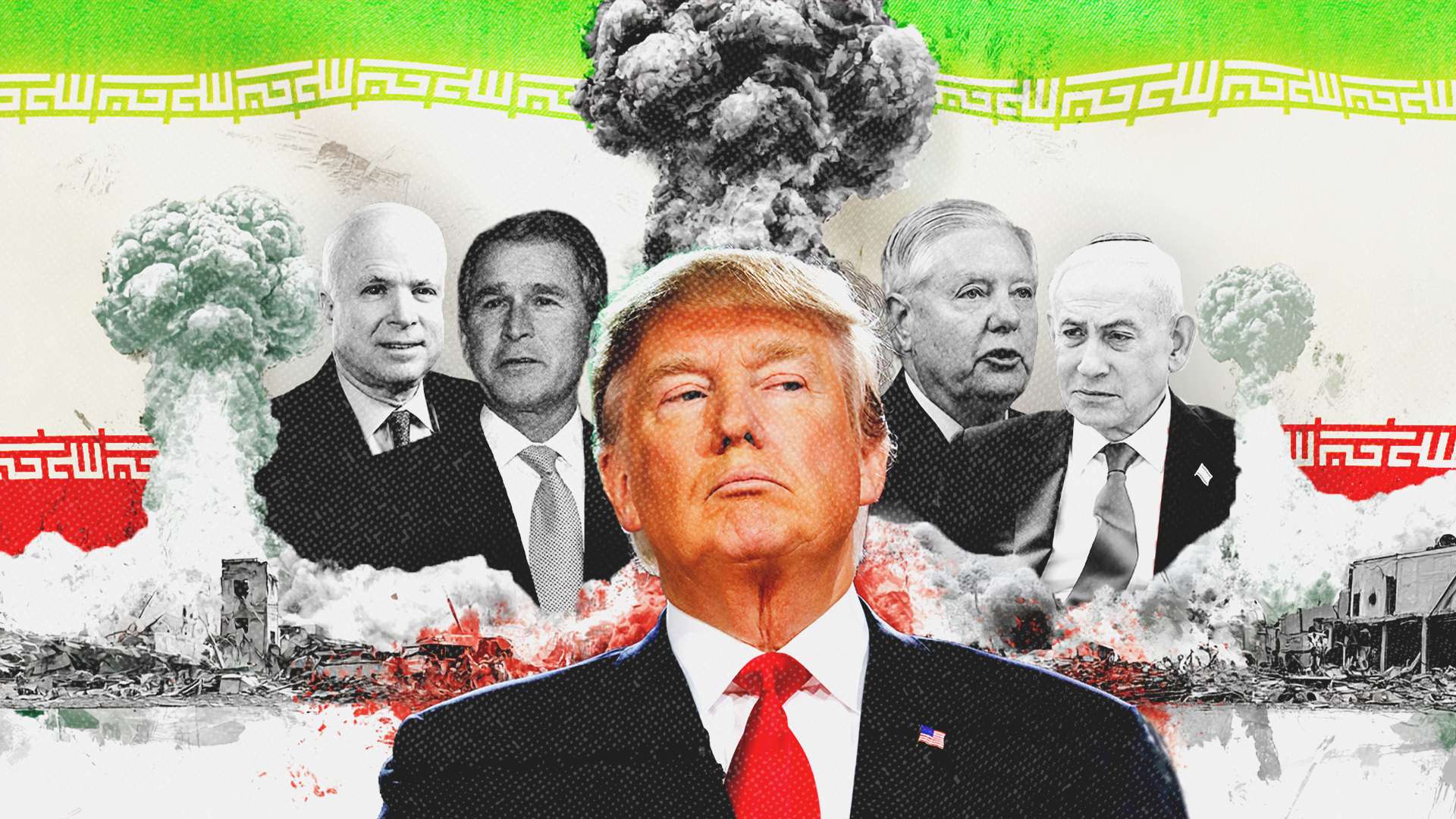
President Donald Trump and his predecessors spent decades steering the United States toward the prospect of war with Iran.
The Strait of Hormuz reads like a tale from long ago. Its name hails from an ancient Persian deity, and the 24-mile-wide channel threads between jagged shores, inlets that resemble a desert cousin of Nordic fjords, and banks of vividly colored salt formations. Castles built by Portuguese voyagers from centuries past scatter the banks, while traditional sailboats called dhows continue to skim these waters, ferrying tourists and small goods.
Hormuz—the sole link between the oil-rich Persian Gulf and the wider sea—also functions as the lifeline of today’s industrial economy, and it is acutely vulnerable to conflict. On February 28, 2026, soon after Israel and the United States attacked Iran, the Iranian military announced by radio that the strait would be shut to shipping. Two days afterward, a weapon—likely Iranian—struck an oil tanker, killing two crew members. Iran began demanding multimillion-dollar ransoms for the handful of vessels that still managed to pass.
Global crude prices nearly doubled during the early weeks of the war, yet the story runs deeper than oil. A multitude of essential manufacturing processes worldwide depend on inputs from the Gulf’s petrochemical sector, which Iran has also targeted directly and which will take months to restore even after hostilities cease. Electronics producers in South Korea and Taiwan suddenly face helium shortages essential for semiconductor production. Thus ends an era of uninterrupted artificial intelligence expansion. The plastic, metal, and pharmaceutical sectors confront analogous scarcities in raw materials. And the world faces the prospect of a food crunch next year as farmers scramble for fertilizer for the current planting window.
President Donald Trump elevated reopening the strait to a principal objective of the war and the diplomacy aimed at ending it during the mid-April 2026 ceasefire. In other words, Trump’s challenge now is to reverse the consequences of opting to initiate the war.
Choosing to start this war was, indeed, a decision. The Trump administration spent months assembling forces in the Middle East while repeatedly shifting its demands. Iran had agreed to negotiate; the United States attacked over a weekend that interrupted scheduled talks.
Even though the war appeared suddenly to many Americans, Iran hawks had been cultivating a long effort to place the United States in this very position. They made it politically simpler to go to war than to avoid it. Lawmakers treated Israel’s and the Arab monarchies’ conflicts with Iran as America’s own. Yet hawkish factions in both major parties thwarted attempts at resolving those tensions through compromise or containment with Iran. They pressed the United States to assume ever greater risks while steering clear of a public debate about war.
“If Iran is an existential-like threat, diplomacy becomes a political liability and sanctions fail to compel, what remains besides military force?” wrote Robert Malley, the Biden administration’s envoy to Iran, in a recent New York Times piece that criticized his former boss for helping create the conditions for war. “If the United States wants to stop slipping into Middle East conflicts, it must prioritize its own interests over the animosity it holds for old adversaries.”
The hawks’ shifting benchmarks—designed to render war unavoidable—haunted the conduct of the fighting itself. Since fighting began, the Trump administration has advanced a chorus of contradictory success criteria: toppling the Iranian government, striking a deal with Iran, dismantling Iran’s nuclear program, crushing Iran’s entire industrial base to the “Stone Age,” unleashing a thriving and radiant future for Iran, seizing control of the Strait of Hormuz, or simply letting the strait “open itself.”
For many in the hawk camp, the precise rationales for battling Iran hardly mattered. What they sought was someone to fund the United States’ decades of missteps in the Middle East. The Trump administration and its allies have sought to pin blame on Iran for Al Qaeda’s attacks and for galvanizing resistance to American troops during the Iraq War—the last major intervention Obama-era strategists warned against. At the same time, hawks from both parties argued that this time would be different—this regime‑change effort would be more decisive.
“Iran is not Iraq. Anyone saying otherwise misses the intricacies of Middle East geopolitics, the Iranian people, their neighbors, or the diaspora. The Iranian people despise this regime,” argued Rep. Nancy Mace (R–S.C.) in March 2026. Yet that line of reasoning harks back to how the Bush administration sold the Iraq War in 2002: Deputy Secretary of Defense Paul Wolfowitz contended that Iraqis were “the most educated people in the Arab world, who would welcome us as liberators.”
To be sure, two parties participate in any dance. The Islamic Republic of Iran emerged from a 1979 revolution that deliberately antagonized America, even seizing U.S. diplomats and broadcasting its intent to spread that revolution by arming rebels across the region—including the Lebanese militia Hezbollah, which attacked U.S. troops deployed to halt Lebanon’s civil war in 1983. Over the years, Iranian leaders have issued threats (including the annihilation of Israel) that have been aggressive enough to invite a response, yet vague enough to cast Iran as weak.
Nevertheless, most Americans and Iranians were not alive to witness most of those disputes, and the world has shifted considerably since. Iran, worn down by the consequences of its revolution, has sought an exit from the cycle of confrontation.
The Grand Bargain
In the wake of the September 11, 2001 attacks on America, the Iranian intelligence services actually cooperated in the U.S. retaliation campaign in Afghanistan. Two years later, Iran quietly suspended its nuclear weapons program, and a Swiss diplomat delivered a note from Iran proposing a “grand bargain.” Iran would allow access to its nuclear facilities for inspections, help stabilize Iraq, back Israeli–Palestinian peace talks, and urge Hamas and Hezbollah to lay down their arms. In return, Iran sought normalized relations and an end to American threats of regime change.
The Bush administration was internally divided over whether Iran’s offer was serious and how to respond. Secretary of State Condoleezza Rice argued that the seriousness of Iran’s overture signaled weakness, meaning the United States should refuse and demand even more. Her view carried the day.
That became the familiar pattern of U.S.–Iranian diplomacy for the next twenty years. Each time Iran offered a compromise, hawks in Washington leveraged the gesture to argue that more pressure would yield greater Iranian concessions. This circular logic—the demand should always exceed what Iran has proposed—made real diplomacy nearly impossible. Yet there would never be another offer from Iran as favorable as the grand bargain.
The next major diplomatic moment arrived under President Barack Obama. Although Iran had halted its covert nuclear weapons program, it was openly enriching uranium, ostensibly for fuel for power plants. In response, Israel threatened war and assassinated Iranian scientists while the United States imposed sanctions to sever Iran’s access to foreign markets and carried out covert actions against Iranian enrichment facilities. Then, in agreements signed in 2013 and 2015, Iran accepted a package of temporary and permanent nuclear constraints in exchange for the United States and five other powers lifting economic penalties.
Hawks despised the deal, insisting they could have achieved a superior agreement with a bit more pressure—or that any agreement with Iran was a cowardly “appeasement.” The debate took on a surreal quality: Senators Lindsey Graham (R–S.C.) and John McCain (R–Ariz.), both long outspoken about bombing Iran, feigned outrage when Obama suggested that war was not the only option if diplomacy failed.
Iran’s regional rivals lobbied against the agreement as well. They were deeply unsettled by Obama’s remarks that Saudi Arabia would need to learn to “share the neighborhood” with Iran while the United States redirected its focus toward Asia. Israeli Prime Minister Benjamin Netanyahu castigated Obama’s “terribly flawed agreement” with a regime he painted as Nazi-like in 2015. Saudi Crown Prince Mohammed bin Salman condemned “the new Hitler in Iran” in a 2017 interview with The New York Times.
The United Arab Emirates pursued a familiar split-the-difference tactic—siding with the sanctions lobby in Washington while continuing to profit from Iran‑sanctions busting in Dubai.
Opponents argued that the deal did not resolve two essential non-nuclear questions: Iran’s conventional missile arsenal and its regional proxy wars. (Beyond arming Lebanese, Palestinian, and Iraqi paramilitaries, the Islamic Republic had since become entangled in Syria and Yemen.) Asking Iran to quit its neighbors’ conflicts was one thing; demanding stronger conventional weapons capabilities was another. Even the capability to retaliate against external attacks was considered unacceptable.
The hawks achieved what they wanted from the first Trump term, which ripped up the nuclear accord in 2018 and launched a strategy of “maximum economic pressure.” Those who favored regime change interpreted the initial results as vindication. In November 2019, a sharp rise in Iran’s fuel prices sparked the fiercest internal unrest since the 1979 revolution. Two months later, Trump ordered the assassination of Iranian General Qassem Soleimani, and Iran answered with a one-off military operation that did not kill Americans (though it inadvertently destroyed an airliner full of Iranian civilians).
Although President Joe Biden pledged to return to diplomacy during his 2020 campaign, his advisers believed that pressure had produced better-than-expected results. Ariane Tabatabai, who later joined Biden’s negotiating team, warned in a pre-inauguration essay that the next president should avoid rushing back to a deal, because continued pressure over time would erode Iran’s position. Ilan Goldenberg, another future Biden official, authored a paper suggesting “calculated risks” against Iran, modeled on Israeli raids into Syria that Israel dubbed the “campaign between wars.”
And the hawkish chair of the Senate Foreign Relations Committee, Bob Menendez (D–N.J.), later convicted of sharing information with Egyptian spies, threatened to block any return to Obama’s agreement. Biden’s negotiators spent years pressing Iran to offer a longer and stronger agreement than before. Meanwhile, Biden offered defense pacts to Arab monarchies that would guarantee permanent U.S. military protection, even as Saudi Arabia quietly pursued a separate peace with Iran.
Protests in Iran against hijab laws in September 2022 and Hamas’s attacks on Israel on October 7, 2023, further poisoned the atmosphere for negotiations with Iran in the United States. The surprise violence of October 7 also seemed to vindicate Israeli factions who believed enemies could not be deterred, only defeated. In response to Hezbollah’s cross-border shelling, Israel launched a full-scale invasion of Lebanon in autumn 2024. Contrary to Biden administration concerns—and contrary to some of my own expectations—this campaign did not explode into a broader international war. Following the Israeli–Lebanese ceasefire in November 2024, a revolution in Syria forced Iranian forces out, another sign of Iran’s growing weakness. By the end of Biden’s term, members of his camp were publicly and privately endorsing a strike on Iran itself.
After taking office again, Trump leaned into the sense that taking risks against Iran pays off. He reopened—and then closed again—conflicts in Gaza and Yemen, seemingly at his discretion. In June 2025, he took the boldest risk to date, backing an Israeli strike on Iran during U.S.–Iranian negotiations, joining the assault on day twelve, and offering an immediate ceasefire. Iran responded with a limited retaliation against U.S. forces, and then accepted the terms.
The Green and the Dry
The defining moment for Trump probably occurred far from the Middle East’s sandy expanses, on the verdant Caribbean coast. On January 3, 2026, a unit of U.S. special operators slipped into Caracas by night and arrested Venezuelan President Nicolás Maduro on drug-trafficking charges. Vice President Delcy Rodríguez promptly bent to Washington’s will. Overthrowing foreign leaders had never looked so effortless.
The same week as the Caracas raid, inflation protests in Iran swelled into a nationwide uprising against the Islamic Republic. (U.S. Treasury Secretary Scott Bessent boasted that the unrest marked the “grand culmination” of American sanctions.) A significant segment of the Iranian opposition now openly sought foreign military aid. One Iranian told the Financial Times that Venezuela had given her hope for a “clean, bloodless regime change.”
On January 8, the Iranian government shut down the internet and began clearing streets with gunfire, killing thousands. Four days later, Trump posted a message on social media, “Iranian Patriots, KEEP PROTESTING—TAKE OVER YOUR INSTITUTIONS!!! Save the names of the killers and abusers. They will pay a high price. I have canceled all meetings with Iranian officials until the senseless killing of protesters STOPS. HELP IS ON ITS WAY.”
The unrest subsided as the government imposed martial law. People inside Iran told me at the time that everyone, whether supporters or opponents or bystanders, waited to see what Washington would do next.
Then Trump un-cancelled the talks, sending Special Envoy Steve Witkoff to negotiate Iran’s nuclear future, which had suffered badly during the June 2025 clash. Witkoff’s team openly disdained spending time on technical details of the nuclear issue, refusing to bring in engineers for the final rounds. What Trump really desired, Witkoff told Fox News on February 22, was for Iranian leaders to explain “why they haven’t capitulated” in the face of a continuing American military buildup.
Trump still expected a quick and unequivocal surrender when he and Netanyahu launched the war a few days later. Israel killed Iran’s Supreme Leader Ali Khamenei in a first strike, and Trump said he anticipated a situation “like with Delcy in Venezuela.”
A month into the war, Trump admitted at an Easter dinner that he had told the British prime minister the war would last only three days. He gave a similar timetable to “skeptical” Middle Eastern leaders before the war began, telling them it would “only take 100 hours,” according to Trita Parsi, executive vice president of the Quincy Institute for Responsible Statecraft, who also broke the story of Iran’s 2003 invitation.
At the same time the Trump administration pursued a Delcy-like figure, Israel’s intelligence services promised they could spark another uprising in Iran. That did not come to pass, either. Even Kurdish militants directly armed by the CIA hesitated to rush into what they feared would end in “a massacre of our own people,” as one Kurdish commander told New Lines Magazine.
Instead of collapsing, Iran fought back and escalated. The U.S. military found itself in a Whac‑A‑Mole struggle against Iranian missiles and drones, burning through precious munitions that were also meant to deter Russia and keep Taiwan and Ukraine safe. Bessent even lifted sanctions on Iranian oil exports, hoping to ease some of the shortages caused by the Hormuz conflict. Iranian civilians bore the heaviest burden, with between 1,700 and 2,400 killed in bombing by mid-April. The fighting spilled beyond Hormuz, reigniting clashes in Lebanon and Iraq.
By mid-April 2026, Washington and Tehran accepted a “fragile ceasefire,” as Vice President J.D. Vance put it. Immediately, both sides attempted to rewrite the terms. Pakistani mediators announced the ceasefire would extend to “everywhere, including Lebanon”—a point Trump privately endorsed, according to CBS News—but the Israeli government intensified its bombardment of Lebanon, and the White House rushed to justify it. Despite assurances of “safe passage through the Strait of Hormuz” during the lull, Iranian authorities continued to curb shipping and demand ransoms.
Whether the truce endures beyond April, Trump has effectively lost control of the conflict he dragged the country into. With the pressure mounting, Iran discovered it held significant leverage over global markets. Israel and the Arab states learned they could push the United States to adopt more extreme, maximalist objectives.
The war produced an outcome none of the principal actors wanted, but it accomplished a longstanding aim of Prime Minister Netanyahu, who proclaimed from the Tel Aviv headquarters that bringing the United States directly into the conflict “let us do what I have been hoping to do for forty years.”
Paradoxically, it also delivered a forewarning to the late Hamas leader Yahya Sinwar, who had foretold in a 2022 speech: “By God, I see it with my own eyes—a war that will alter the globe, a regional religious war that will burn both the green and the dry.” The American political class helped kindle much of that fire, and now it struggles to extinguish it.
