
The online right keeps weaponizing memes in an ongoing effort to misconstrue the Star Wars lead in a major way.
Over the past several days, Anakin Skywalker has been the star of a dedicated appreciation surge on X, and this well-known Star Wars prequel revisionist is fully aboard the celebration. I’m glad that, two decades on, this figure—portrayed by Hayden Christensen in Attack of the Clones (2002) and Revenge of the Sith (2005)—is finally receiving recognition in an era when social media gives fan communities more power to challenge established critiques.
Yet a number of these Anakin appreciation posts — which have begun to carry a distinctly right-wing political tone — seem to miss the core point about the character, which certainly isn’t that he was a virtuous person who never steered wrong. Anakin is fascinating precisely because he is flawed and ultimately falls to evil, not because his malevolence is somehow vindicated. This distinction matters, and it’s one that right-wing voices on X should keep in mind.
The argument becomes obvious when you compare Anakin to other popular, deeply compelling fictional leads who commit terrible acts; no reasonable observer believes Walter White from Breaking Bad or Tony Soprano from The Sopranos are exemplary role models. Yet when it comes to Anakin, a sizable slice of right-wing commentators on X appear to genuinely think his plan was sound, perhaps because they imagine his politics align with theirs on a deep level.
To be perfectly clear, I am not claiming that it is inherently problematic to joke about Anakin as a right-wing culture-warrior alongside liberal institutionalists like Padmé (his wife) or Obi-Wan Kenobi (his mentor). Many of the memes are funny — I enjoy “For the better, right?” as well — and such humor is not a novelty. Political conservatives have long drafted contrarian, half-satirical tirades about the Star Wars villains — back in 2002, The Weekly Standard published “The Case for the Empire.” If I’m honest, I doubt those writers truly espoused empire as policy, but rather aimed to provoke liberals.
Heck, perhaps this present wave of Anakin enthusiasm has a similar impulse (though it feels distinct), which, as far as I can tell, traces back to an appearance by the Education Department (?), which posted the following image on X:
There’s Magic in Learning 🪄 pic.twitter.com/2Vkzkhsfn3
— U.S. Department of Education (@usedgov) October 30, 2026
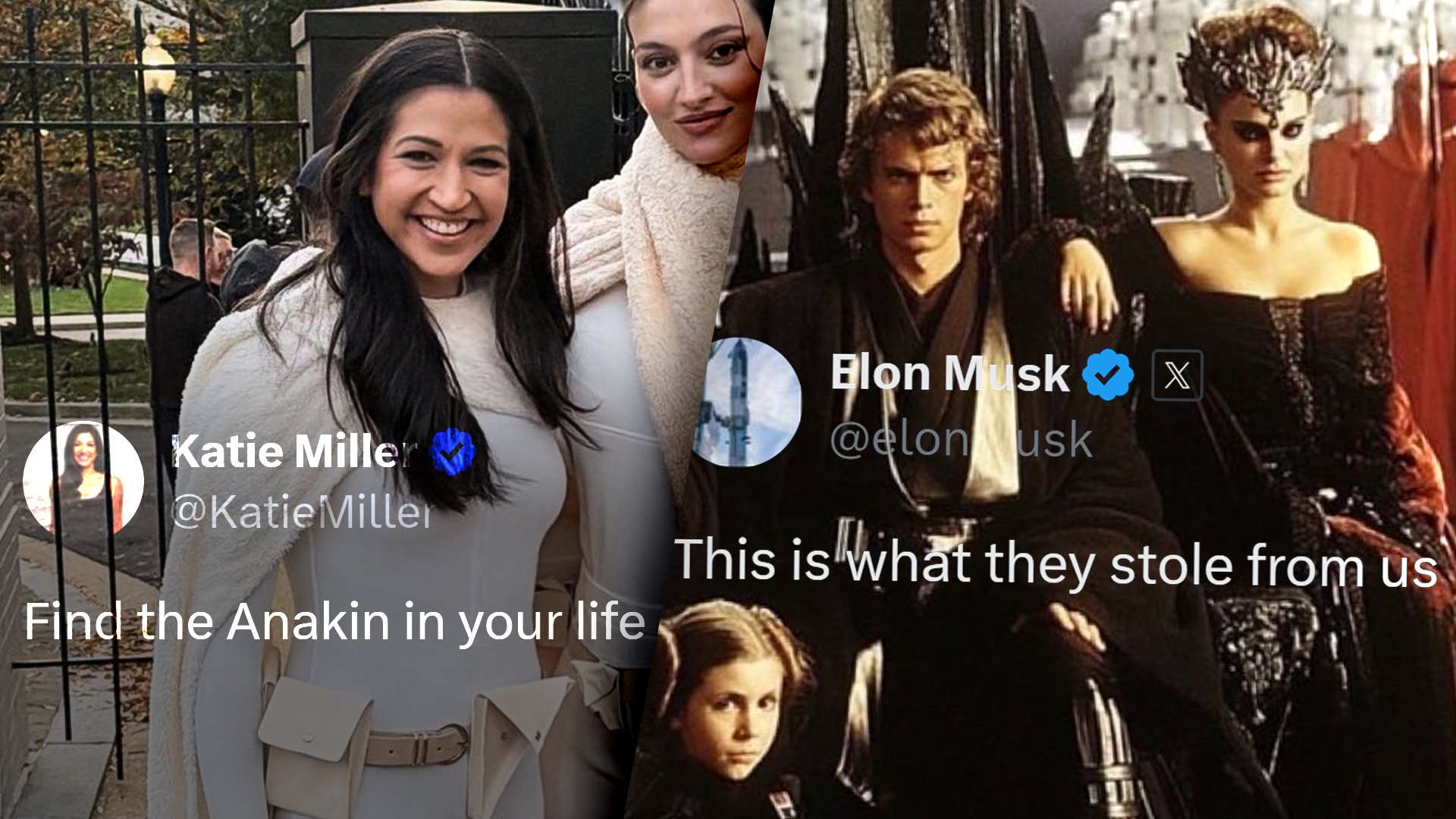
Before you could utter the line “now this is podracing,” a slew of conservative accounts began posting similar Anakin memes, depicting his romance with Padmé, the two of them ruling the empire together, and imagining what their family might have looked like had it endured. “This is what they stole from us,” wrote Elon Musk, accompanying an AI-generated image of Anakin presiding over the galaxy with Padmé, with young Luke and Leia nearby and the praetorian guard at their side. Like most social-media posts of this genre — vague laments about life not being as it ought to be — the exact identity of “they” and what exactly was “stolen” remains left unsaid.
Some entries lean more overtly political. Logan Hall of The Blaze shared a screenshot of Anakin clashing with Obi-Wan during their famed duel and inserted this dialogue box: “Anakin we are a GALAXY of IMMIGRANTS!” (Musk retweeted it.) Another viral post framed a younger Anakin standing before a Jedi Council composed of aliens as “the White male experience.” And there are countless memes in which a frightened Padmé accuses Anakin of sending “racist memes” to a group chat. (In the original scene, she confronts him about murdering children.)
Let’s step back for a moment.
As many people know, the Star Wars saga centers on a band of rebels fighting an oppressive empire. The Galactic Empire is steered by Emperor Sheev Palpatine, who is ultimately revealed to be not only an authoritarian ruler but also a formidable occult sorcerer—on par with Voldemort from Harry Potter or Saruman from The Lord of the Rings. (If anything, he’s a less sympathetic villain than either of those icons.) Palpatine’s devoted enforcer is Darth Vader, once a promising Jedi—a noble sorcerer-knight named Anakin Skywalker. The intent of the prequel trilogy, as described by creator George Lucas, was largely to illustrate how Palpatine corrupts Anakin and draws him into his service.
What the prequels reveal is that Anakin, like many teens, wrestled with a patchwork of personal issues, and Palpatine skillfully exploited his distrust of authority and fear of losing loved ones to steer him toward evil. The appeal of Anakin for many young viewers lies in its relatability up to a point: he longs to spend more time with the girl he loves — who becomes his wife — but the rigid rules of his workplace keep such things out of reach. Anakin is immensely talented at swordplay and at wielding arcane powers, yet he is treated as if he’s only ever a junior participant on the team. He is repeatedly asked to undertake dangerous missions and to compromise his imperfect sense of right and wrong, all while being denied the promotion he feels he deserves. He begins to experience increasingly vivid visions of loss, and his mentors—Yoda and Mace Windu—advise him to avoid dwelling on them.
In the end, Anakin betrays the Jedi because he believes that is the sole path to saving Padmé. In doing so, he massacres friends and foes alike, including many young Jedi-in-training. Yet, in the end, Padmé is lost anyway, he is hideously burned in a climactic duel with Obi-Wan, and Palpatine places him into a mechanical suit. He becomes the emperor’s primary instrument, a deeply broken man who has been hollowed out from within.
The tragedy of Anakin provides compelling dramatic material; it does not, however, render him admirable.
While the audience—especially younger men—may empathize with his fierce determination to keep Padmé alive at any cost, Anakin’s later deeds—murder and betrayal—are undeniably monstrous, and they fail utterly in saving Padmé. Undone by pride, he falls for Palpatine’s deceit: he makes a deal with the devil, and the devil doesn’t honor his end of the bargain. In truth, when Padmé and Obi-Wan alert him throughout the film that he is becoming the very evil he claims to fight, they are strikingly on point.
Perhaps that explains why I find the payoff of these Anakin memes a bit irksome, given that they almost always imply that Anakin’s solution is correct and that everyone else is mistaken — that, from a political vantage point, his reactionary approach is the proper one, while Obi-Wan and Padmé are naive liberals. How did that strategy turn out for him, again? Oh, right — he ends up roasted by lava.
So, by all means, embrace the love for the character: I certainly do. (I’ve dressed as Anakin for Halloween, and, like a tongue-in-cheek nod to political theatrics, made my partner wear a Padmé costume.) Yet, as with various figures from contemporary politics who identify with fictional villains, there is a meaningful distinction between admiring a character’s coolness and allowing memes to drag you into agreement with a murderous figure.
