
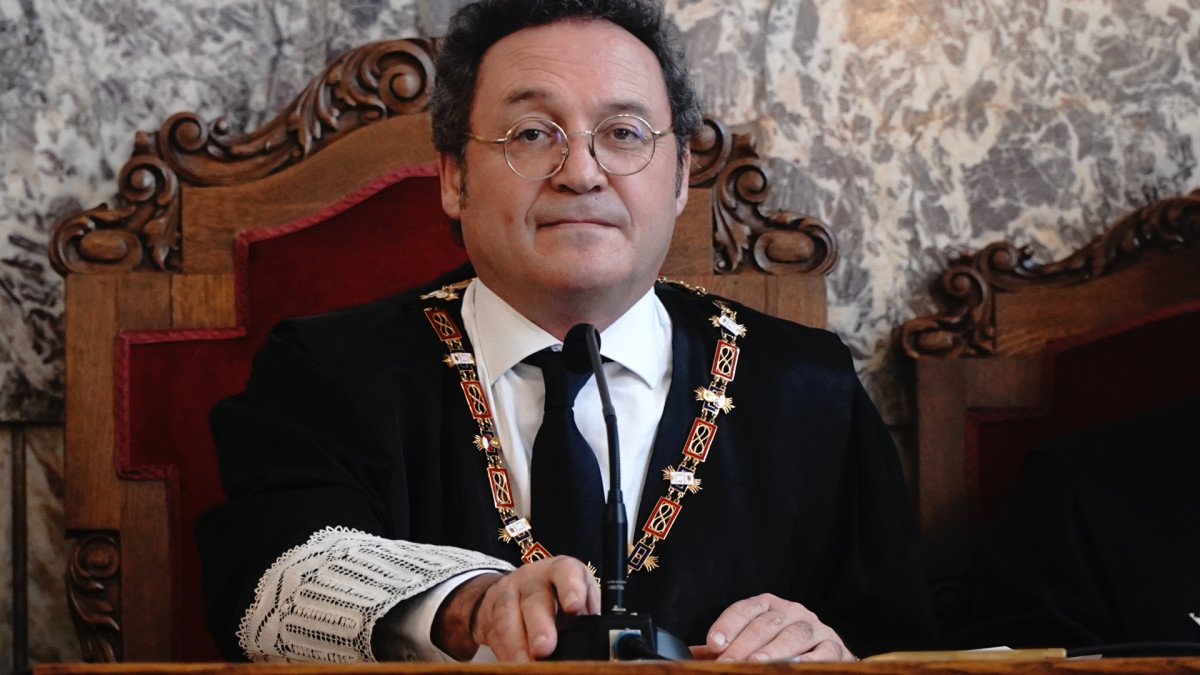
Two weeks after the announcement of the conviction for the crime of disclosing reserved data concerning Mr. Álvaro García Ortiz, up to that moment the Attorney General of the State (FGE), we have learned the sentence that motivates that ruling. This is, incidentally, one more instance of the irregularities that have taken place since the proceedings of this case began, many of them the subject of preliminary issues raised by the Prosecutor’s Office and the defense of the accused.
“Indeed, neither the convicted person nor the public can be certain now whether the sentence has been the object of an uncontaminated deliberation by the Court
Indeed, neither the convicted person nor the public can be certain now whether the sentence has been the object of an uncontaminated deliberation by the Court, or rather, whether responses to the objections raised by the pre-announced verdict have already been introduced into it. And, more gravely still, it is not clear what exactly the Court’s deliberations were aimed at: this is not about voting on whether one agrees with the verdict, but about deliberating on the argumentative path that leads to that verdict, agreeing not only on the outcome of the resolution but also on its foundations. Yet that cannot be achieved without a draft judgment that, once deliberation is finished, becomes the text of the judgment itself.
In any case, this will not be the focus of my attention, but rather the evidentiary reasoning that makes up the motivation of the Court’s majority decision. That motivation, to be sufficient, should contain at least three substantial parts: 1) the justification of the reliability assigned to each piece of evidence presented for and against the charges; 2) the justification of the degree of corroboration attained by the prosecutorial hypothesis in light of the totality of the evidence; and 3) the justification for overcoming the applicable standard of proof by that prosecutorial hypothesis, or, in other words, the justification that there is sufficient proof of the defendant’s guilt. Unfortunately, the published judgment fails in each and every one of these parts.
A deficient evidentiary reasoning
I will try to make what has been asserted understandable, but first it will be useful to specify what the prosecutorial hypothesis that the Court deems proven actually is. Thus, according to the sentence, the State Attorney General would have requested that all documentation and emails related to a potential tax fraud case involving the spouse of the President of the Community of Madrid, Mr. Alberto González Amador, be sent to him, since on the day events unfolded there was talk within the President’s circle that the Prosecutor’s Office was acting in the case for political reasons. The FGE received all the requested information on March 13, 2024 at 21:59, and from then on “the information gathered, specifically the email of February 2, was communicated from the State Attorney General’s Office, with direct involvement or through a third party, but with full knowledge and acceptance by Mr. García Ortiz, to the Cadena Ser journalist, Mr. Miguel Ángel Campos,” who disseminated it in the same night’s news broadcast.
The following morning, the Prosecutor’s Office issued an informational note containing reserved case data. This could not constitute a crime of “data disclosure” if the data were already public knowledge, but the matter changes if the person who provided them to the press is also the one who later seeks to reap the benefits of their public nature. All of this returns us to the fundamental question that was the subject of the oral trial: who leaked the email from González Amador’s attorney?
In a prior article I argued that the prosecutorial hypothesis lacked any supporting evidence, in line with what the magistrates Ferrer and Polo state in their separate vote. Nevertheless, the majority of the Court reached the opposite conclusion with inferential steps that are very questionable. Let us examine them.
Six journalists from different outlets testified at the trial that they had had access to the content of the mentioned email before the FGE received it on March 13, 2024. Although they did not reveal their sources, all agreed that it was not the FGE who leaked it, and in some cases they provided evidence supporting the claim that they knew about the leaked email before it reached Mr. García Ortiz.
“Six journalists from different outlets testified in the trial that they had had access to the content of the mentioned email before the FGE received it”
The Court’s approach to evaluating these testimonies has a dual aim: first, to diminish the credibility of their statements “because the manner in which a person aware of their right to confidentiality and their constitutional duty of loyalty to their sources faces interrogation is not identical to that of others without similar safeguards”; and second, to reshape the prosecutorial hypothesis, anticipating that if the leak could not have been carried out directly by the FGE, it must have been by a third party with the FGE’s knowledge and explicit authorization. With the latter, the probative value of those exculpatory witness testimonies would be weakened. The problem is that there is not a single piece of evidence in the process identifying who carried out that leak, far less that it was done with the FGE’s knowledge and authorization. Although it may surprise readers and should never occur in a trial, the Court pulls this rabbit out of the hat without any supporting evidence. As the separate vote states, the judgment does not “explicitly recount how the state attorney general could have promoted, carried out, executed, or brought about the criminal act, according to the narrative, with a wide range of direct or indirect, mediated or immediate authorship; or how he could have personally transmitted the information, or through which people, or to whom he gave his acceptance to carry it out (…).”
And even though it does not specify who, how, or when, the hypothesis that the FGE leaked or ordered the leak of the disputed email to journalist Miguel Ángel Campos is deemed proven. For the Court, what matters is that it has been established that Mr. Campos called the FGE on his mobile at 21:38 on the day of the leak. Although the call record shows a duration of four seconds, that is deemed sufficient for the leak “and it is suggestive of a personal communication indicating further electronic contacts.” I must confess that my ability to imagine “suggestions” is less than that displayed by the Court, but the point is that the conviction does not require supposed suggestions or hypothetical possibilities, but evidence: what proves that there were those other contacts would indicate, through what telematic means? There is no indication of any proof. Moreover, given that this four-second call was immediately followed by the receipt of a text message on Mr. García Ortiz’s phone, it seems entirely plausible and it is compatible with what the journalist and the FGE stated—that the call may not have been answered and could have gone to voicemail.
By contrast, the judgment gives absolute reliability to the statements of several prosecutors during the proceedings, claiming that it is “very hard to imagine even a concession to mendacity, or a conscious and deliberate deviation from reality.” The Court highlights especially the testimony of Ms. Lastra, the Senior Prosecutor of the Community of Madrid, who expressed during the trial her suspicions that, if all the case information related to González Amador was sent to the FGE, it might be leaked. Here too the argumentation should be challenged, because suspicions are not the same as facts: in fact, Ms. Lastra did not state that she knew the email had been leaked by the FGE or by order of the FGE, but rather that she suspected it, which does not even make her a relevant witness to a fact of which she had no knowledge.
Finally, there are two post-event actions by Mr. García Ortiz that the Court regards as having particular evidentiary relevance: the erasure of his phone and the lack of an internal investigation or audit to determine who could have leaked the email. Thus, it was established and admitted by the accused that he had erased the data on his device, which prevented access to his messages from the day in question. The Court infers from this that those messages could be incriminating, not giving credence to the accused’s claim that such erasure was routine practice in order to avoid leaks or capture of highly sensitive data from active cases in the Prosecutor’s Office.
“Nor was value attributed to the statement of Prosecutor Agustín Hidalgo, the Data Protection Delegate of the Prosecutor’s Office, who justified the convenience of periodic deletions”
At this point, the statement of Prosecutor Agustín Hidalgo, the Office’s Data Protection Delegate, who defended periodic deletions to prevent security breaches, was also not given weight. Although it was said that even a concession to the possible mendacity of the prosecutors could not be made, no justification was given for valuing this particular declaration.
Moreover, the Court asks, what explains why, in a case as politically sensitive as González Amador’s, there was no internal investigation or audit ordered to uncover who leaked the information? The answer is simple: only one possibility: that the leak was carried out or ordered by the very FGE. Again, however, the Court’s evidentiary inferences do not stand up to scrutiny: why not initiate investigations or audits in response to persistent leaks of files or evidence during investigations subject to a secrecy order? I suppose the Court will not consider that as indicative of the leak being carried out or ordered by the case’s own judge.
The exculpatory alternative the Court rejects
To conclude, in our system a conviction in a criminal trial can occur only if the prosecutorial hypothesis is supported by evidence that proves it beyond any reasonable doubt. But it helps to know what that threshold of sufficiency actually requires or under what conditions we can say that this requirement to defeat the presumption of innocence has been met. Instead of defining the sufficiency criteria and justifying their fulfilment, the Court opts to indicate when it would not be sufficient, i.e., when there would be reasonable doubt. For this purpose, it relies on the STS 136/2022, of February 17 (the opinion by Javier Hernández): “Reasonable doubt must be based on intersubjectively shareable reasons and justified in light of the circumstances of the case. For this, the alternative hypothesis on which it rests must: first, offer an explanation that covers all the data deemed relevant; second, the consequences derived from such a hypothesis cannot be incompatible with the existing data; and third, it must withstand, at least, attempts at falsification arising from the proven evidence in the process”. If the defense hypothesis satisfies those requirements, there would be reasonable doubt and conviction would be impossible.
“Conversely, the strength of the conviction hypothesis is not measured in itself, but by its capacity to neutralize the absolution proposal”
Nevertheless, the same ruling 136/2022 also noted that “the coherence of reasonable doubt is not justified by itself but in contrast with the arguments that ground the conviction. Likewise, the strength of the conviction hypothesis is not measured in itself, but by its capacity to neutralize the absolution proposal.” And what is the compatible innocent alternative hypothesis that could introduce reasonable doubt about Mr. García Ortiz’s guilt? The answer is fairly simple: that the leak occurred without his knowledge or acceptance by another person from the Prosecutor’s Office who had access to González Amador’s case documents. That hypothesis is reinforced by the fact that the email the González Amador’s attorney sent acknowledging his client’s offenses was addressed to an institutional prosecutorial account accessible to dozens of people, most of whom were never investigated.
Well then, after stating the requirements for there to be reasonable doubt, the Court does not perform the slightest analysis to justify whether they are met in the case at hand. It is dismissed, instead, that the leak could have come from other people in the Prosecutor’s Office who did not act under the FGE’s direction with a somewhat astonishing argument: to suppose that the leak could have been carried out by a third party is “a serious accusation that would reveal an abnormal functioning of a public service (…). Such a claim would require, before its insinuation, a minimum of evidence so that it could reach a level of likelihood; especially when the Prosecutor’s Office already has regulations and internal organization designed to align its actions with the legal data-protection requirements.” In other words, the hypothesis that the leak was carried out by another person in the Prosecutor’s Office cannot be assumed, because that would imply an abnormal functioning of the service!, but it is possible to assume that it was the FGE who did it. The Court seems to think that if the alternative hypothesis (innocence) is not proven, then the guilt hypothesis is proven. But, as STS 136/2022 —to which the Court itself appeals— states, “an absolution does not derive from proof of innocence but from the frustrated proof of guilt beyond reasonable doubt. Hence, a minimally plausible exculpatory hypothesis ruins the probative probability—the conclusiveness—that the aforementioned standard demands.”
“
