
As the Cultural Revolution marks its sixtieth year, this piece revisits the fantasies people projected onto it—and highlights a moment that suggested a hint of foresight.
Six decades have passed since Mao Zedong issued the May 16 Notification, a document often perceived as the opening volley of the Great Proletarian Cultural Revolution. In this era, Mao targeted his rivals within China’s power structure by branding them counterrevolutionaries and urging the nation to mobilize against them. Young radicals known as the Red Guards heeded the dictator’s summons, and soon a loose array of groups engaged in chaotic clashes. The years that followed witnessed violent rebellions, even bloodier repression, and fierce attacks on culture deemed reactionary. The death toll among hundreds of thousands of people rose—likely exceeding a million.
At a moment when Americans and Europeans had little direct contact with China, most Western observers approached the events through a murky lens. Some projected their own political ideals onto what unfolded. This wasn’t merely the familiar pattern of starry-eyed leftists aligning with a socialist upheaval: this time, some believed they were watching an anti-authoritarian leader fomenting a revolt against bureaucratic power.
Paul Berman once described three “grand tendencies” within the New Left: the traditional Marxists, the neo-Marxists, and the “inconsistent libertarians.” He did not refer to libertarians in the free-market sense—though there was overlap in places. He meant people who were “anarchist at heart, allergic to bureaucracies, allergic to anything like a Marxist-Leninist centralized organization,” yet who “kept falling for the Third Worldist fantasies of the modern Marxists, kept wanting to celebrate Ho Chi Minh or some other tropical Communist as a hero of the libertarian cause.” The fantasy grew especially strong around China, aided by the Cultural Revolution (and by Mao’s interest in local self-sufficiency, which a distant observer might misread as a milder form of decentralization). The notion that something semi-anarchist was taking place in China drew more adherents than one might expect:
• David Dellinger, an antiwar activist with anarchist-pacifist roots, reported from China in 1967 that “strongly libertarian attitudes” were “noticeable among the Red Guards and (contrary to the assumptions of most Westerners) in Chinese society generally.”
• The composer John Cage admired the Spooner-Tucker circle of individualist anarchists—he was continually giving away copies of a book about them—and his politics blended their form of anarchism with Buckminster Fuller’s futurism. For a time he even incorporated Mao into the mix, citing the dictator’s youthful interest in anarchism and his exhortation to the Red Guards that “it is right to rebel.”
• The counterculture staple The Whole Earth Catalog carried a strong libertarian streak, as did its founder and primary editor, Stewart Brand. Yet one issue carried a special section praising Mao’s China as “one of the great social and political experiments of all time”—and Brand himself casually remarked, while reviewing Ursula Le Guin’s novel The Dispossessed, that the book had “changed his mind politically” by steering him “toward Kropotkin and Mao.” The left-anarchist writer Peter Kropotkin, to be precise.
• The British anarchist Colin Ward proposed the same unusual pairing. Writing in 1974 about the decentralized economic development envisioned in Kropotkin’s Fields, Factories and Workshops, Ward cited China as one of three “actual human societies which exemplify the ideas set by Kropotkin in this book”—though he acknowledged that the country remained so centralized that “some great shift in policy might reverse the trends we admire from afar.”
• In continental Europe, the German New Left leader (later vice chancellor) Joschka Fischer occasionally spoke of “anarcho-Mao-spontex,” an anti-hierarchical current that fused anarchy with, in Berman’s words, “an imaginary Mao—a Mao who, unlike the real Mao, was not a totalitarian.” This phenomenon reached its most bizarre form in Italy, where a movement styled itself partly tongue-in-cheek as “Mao Dada.” (That’s Dada the anti-authoritarian art movement, not Dada as the benevolent father.) In France, a Mao-spontex party named Gauche Prolétarienne included several prominent intellectuals; Michel Foucault collaborated with many of its members (including his partner) in creating a militant anti-prison group.
Needless to say, Mao wasn’t abolishing prisons in China. Yet in France, Gauche Prolétarienne stood as the most prominent assembly of self-described Maoists.
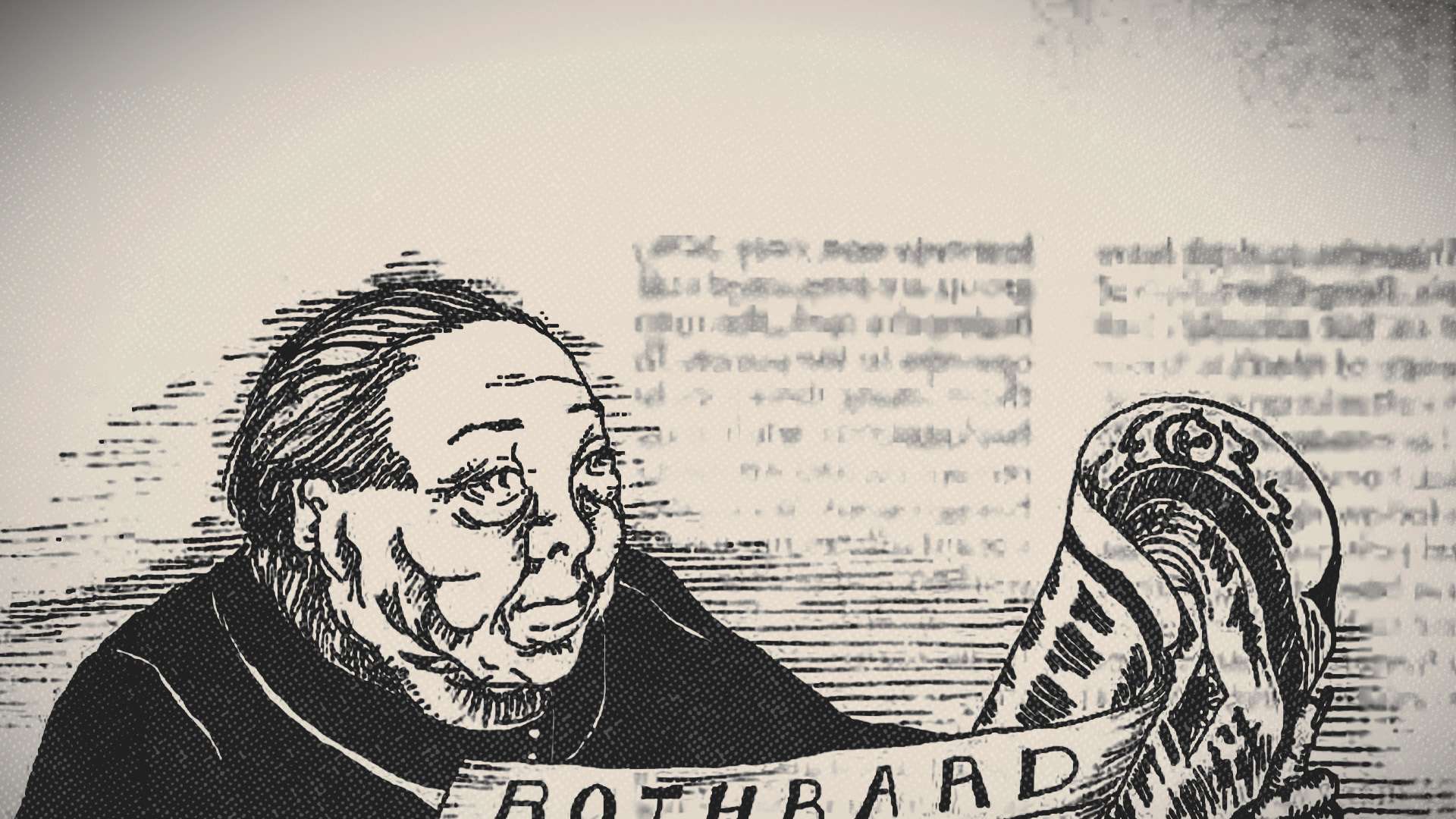
• In the libertarian-free-market orbit, the future gun-rights advocate Stephen Halbrook argued for an exotic lineup of leftists within the libertarian fold, describing V. I. Lenin as “one of the great libertarians of our age” and presenting Fidel Castro’s network of informants, the Committees for the Defense of the Revolution, as an anarchistic alternative to “huge central bureaucracy.” Halbrook’s bid to fuse libertarianism with Leninism culminated in two pieces that praised Mao, one in Libertarian Analysis and the other in Outlook. The latter bore the title “Mao, Economy, and State”—a riff on Murray Rothbard’s pro-market treatise Man, Economy, and State—alongside a cartoon of the Great Helmsman perusing Rothbard.
Some of his pieces’ claims were plainly inaccurate: Halbrook asserted, for instance, that “all forms of coercion were taboo” during the Great Leap Forward. Others were cherry-picked: He cited a 1934 Mao note stating, “As regards the private sector of the economy, we shall not hamper it; indeed we shall promote and encourage it,” without quoting the rest of the sentence—“so long as it does not transgress the legal limits set by our government.” Halbrook essentially assembled every example he could locate of Mao promoting local self-sufficiency or easing economic controls, and presented them as a coherent, “free, decentralized economy.” Most readers did not find the argument persuasive.
Nevertheless, at least two notable libertarians found something compelling in Halbrook’s case. One was Leonard Liggio, future president of the Mont Pelerin Society, who had publicly praised Halbrook’s take on Lenin and published an article invoking “Lenin’s basic anarchism” and the “anarchistic nature of [China’s] cultural revolution.” (Liggio would later adopt a more critical stance toward that part of Chinese history.) The other was Karl Hess, the Goldwater speechwriter who became an anarchist, treading more cautiously but still dipping a toe into the water.
Outlook’s editors asked Hess to draft an introduction to Halbrook’s piece, perhaps on the theory that a benediction from a libertarian figure widely admired in circles might ease the reception of a controversial thesis. Hess approached the topic from a different angle: He did not claim that China was free, but argued that libertarians should heed the “direction of political and social movement within all nation-states” and thus should note if the Chinese were “moving—at least moving—away from command socialism and toward a form of participatory democracy.” Hess largely left it to Halbrook to supply evidence of that movement, yet he enumerated changes he believed were occurring in China: shifts toward militia-based defense, unarmed police, local direct democracy, and cooperative rather than state ownership.
By presenting the issue as a shift toward liberty rather than an actual arrival at liberty, Hess placed some distance between himself and the Chinese regime. A few years later, when Reason columnist Edith Efron claimed that Hess “now calls himself a Maoist,” he wrote to call that an “actual libel” and to note that the “only other place beside Miss Efron’s article that I have been described as a Maoist, as far as I know, is in the FBI’s intelligence files.”
By then, Hess was not merely distinguishing movement from destination; he was distinguishing the party-state from the hinterlands. In a 1976 interview with Playboy, he dismissed Mao as “an elitist, a bureaucrat” and argued that the country was freest where Mao’s power was weakest: it lay “far left out in the countryside and still right-wing in Peking.” (In the mid-1970s, Hess used “left” to denote dispersed power and “right” to denote concentrated authority.) He echoed a similar sentiment in his 1975 book Dear America. Each time, he was vague about what precisely was happening in those rural areas. Yet in that vagueness, and in that lingering suspicion of the Beijing regime, Hess accomplished something I doubt any other Mao-curious anti-authoritarian managed to do: He anticipated a transformation that would soon sweep the country.
You see, there truly was something anti-authoritarian and decentralist in the Cultural Revolution’s effects, though not in the way the anarcho-Mao-spontex faction imagined. The period’s chaos so devastated the party and the state that authorities no longer had the strength to hold the countryside in check. By the time Playboy interviewed Hess, many villages enjoyed substantial de facto autonomy—and used it to parcel out communal property, dodge planners’ dictates, expand private landholdings, and trade on a growing black market. Before long, millions participated in what amounted to a vast, spontaneous civil-disobedience movement. When the post-Mao leadership later introduced market reforms, it was legalizing what local people had already begun illicitly on their own. As the Chinese-American political scientist Kate Xiao Zhou observed, “When the government lifted restrictions, it did so only in recognition of the fact that the sea of unorganized farmers had already made them irrelevant.”
Thus when Hess wrote in Dear America that China was “very far to the left out in the countryside while still being much more to the right in the seats of power,” he struck a crucial truth. He may have stumbled upon it, but he hit the mark nonetheless.
There is, moreover, one more notable group from the late ’60s who embraced the anarcho-Mao-spontex idea that genuine Maoism entailed eradicating hierarchies. This was the ultra-left faction among the Red Guards themselves. In the 1968 tract “Whither China?,” a Shengwulian spokesman argued that the party was a privileged class and that a decentralized democracy modeled on the Paris Commune should replace the state. If you need proof that Maoist orthodoxy and Mao-spontex heresy were two different species, consider that the essay was formally denounced and its author sent to a labor camp (he later became a free-market economist). Another group of ultra-left ex–Red Guards fled to Hong Kong, where they mingled with anarchists and other anti-Mao leftists in a journal called Minus and a group known as the 70s Front. No longer anarcho-Mao-spontex, they had become simply anarcho-spontex.
These leftist critiques of the Maoist state captured an American politician’s eye. “The main thrust of the 70s Front is the claim that Red China has evolved into a gigantic monopolistic corporation,” he announced. “The economy is governed by raw political power rather than the law of supply and demand. The state corporation has become a religious cult, and criticism of the regime is suppressed.” He conceded that these “new Chinese libertarians” were “not defenders of Western-style private enterprise,” but they did acknowledge the perils of monopoly and the need for civil liberties.
The politician in question was Ronald Reagan, listening to a radio script written by a libertarian Republican who had never viewed Mao as anything but a tyrant—a certain John McClaughry. Should someone ever create a movement dubbed anarcho-Reagan-spontex, they could point to the moment in that broadcast when the Gipper read aloud directly from a 70s Front manifesto. “We oppose all dictatorships, all governments, all forms of statism, and all authority,” he quoted approvingly.
