
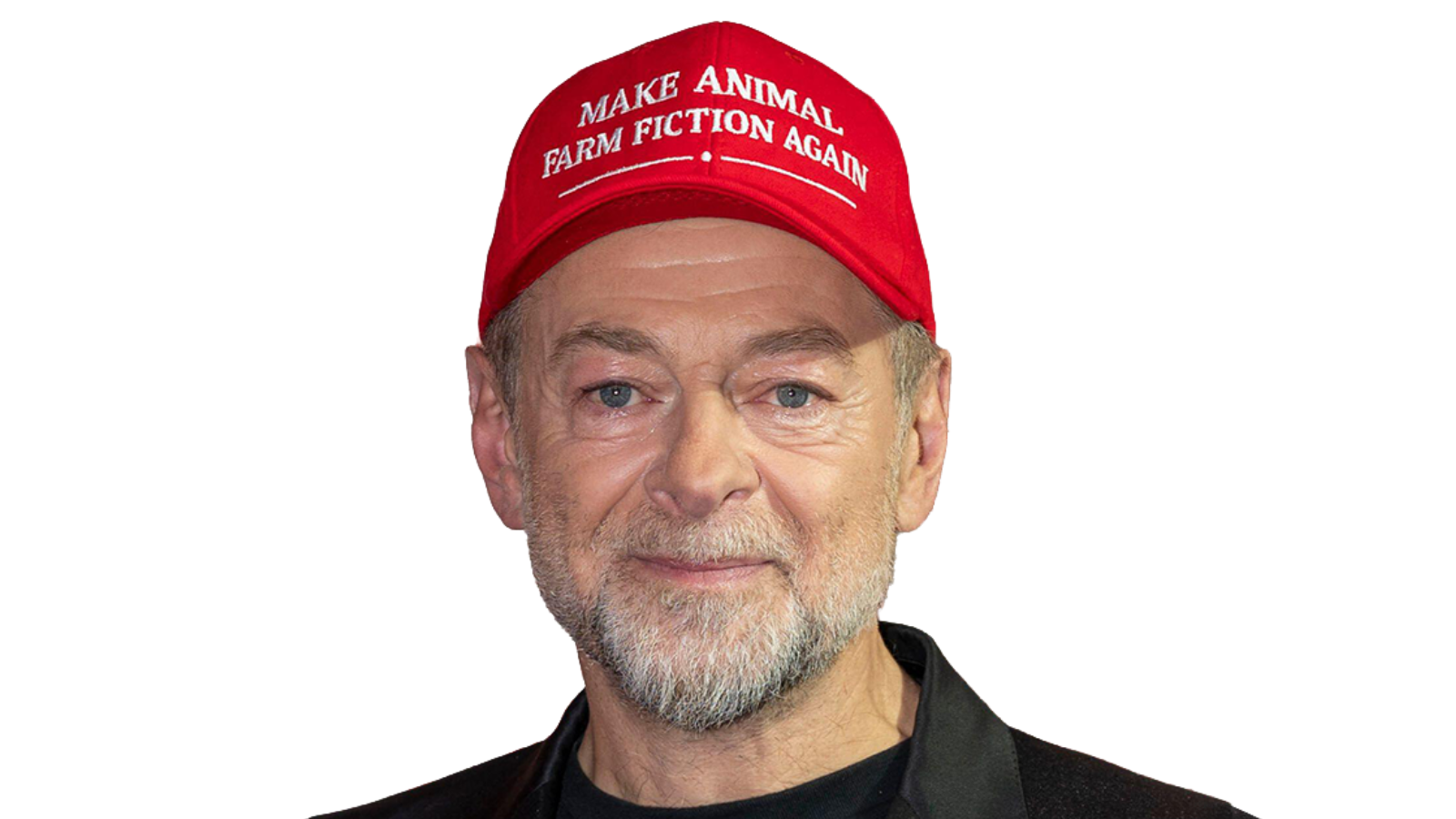
“If Orwell were writing that story now, what would his targets be?” the Animal Farm director asks Reason‘s Nick Gillespie.
:15
:15
Download
Andy Serkis: How Orwell Perceived Tyranny
Andy Serkis has given life to some of modern cinema’s most enduring personas: Gollum from the Lord of the Rings and The Hobbit sagas, Kong in the reimagined King Kong, Caesar in the Planet of the Apes reboot, the proto-punk icon Ian Dury in Sex & Drugs & Rock & Roll, and the arms dealer Ulysses Klaue in the Marvel Cinematic Universe.
He has also moved behind the camera: he directed a CGI-driven adaptation of George Orwell’s Animal Farm, which hit theaters on May 1. Later in the month, Serkis spoke with Reason‘s Nick Gillespie about his latest project, the forces behind autocracy, and the throughlines that connect his most recognizable parts.
Q: Let’s discuss Animal Farm. What drew you to the source material?
A: I first encountered the book when I was around ten or eleven, en route to school on the bus. At that age you sense there are deeper currents at work, even if you don’t fully grasp what those currents are driving toward. It felt innocent on the surface, yet beneath there was an entire world waiting to be uncovered. It’s one of those works that never quite leaves you. I returned to it at various stages in my life.
Q: This version revises and updates the original. The critique isn’t aimed at socialism or global communism. Where does your focus lie?
A: No. When we began, we spent a lot of time consulting with the Orwell estate. If Orwell were writing that story today, who would he set his sights on? He detested tyranny on a grand scale. Back then, he directed his rage at a specific regime. But if he were to craft Animal Farm now, who would be his targets?
A lot of the core themes remain the same. The difference lies in the various governance models around the world that employ oppression to persevere, models that are, sadly, thriving. This isn’t an attempt to single out any particular leader within the allegory; it’s a critique of the broader machinery that governs us, of authoritarian structures abroad, including the manipulation of information, the phenomenon of fake news, and all the other elements the book touches on—the corruption that power breeds. The aim was to translate these ideas into a contemporary context for a younger audience, just as the book was originally meant to be accessible to children.
Q: Orwell penned Animal Farm some eighty years ago, during a period when authoritarian tendencies seemed to be on the rise in several places. By today’s standards, would you say the situation has improved?
A: I wouldn’t go so far as to say we’re in a better position. A central theme here is history’s tendency to repeat itself and our continual propensity to repeat the same missteps. Even so, that doesn’t absolve us of the duty to attempt corrections. That’s really the heartbeat of our adaptation: there is no final answer, and it’s likely that history will keep looping, but we must persist in seeking understanding.
It’s fundamentally about listening. In creating this version for younger audiences, we hoped to spark conversations in living rooms where parents and grandparents—likely holding divergent views—could come together to interrogate the material through dialogue. It was designed to provoke discussion, while remaining a family-friendly movie that might foster intergenerational debate.
Q: You’ve contributed to some of today’s most successful film franchises. Is there a common thread to the characters you’ve played? Is Gollum a manifestation of someone corrupted by the lure of greater power? Is that the shadow self you pursue across many roles?
A: An actor’s job, and the craft of storytelling, is to broaden how audiences perceive the world. To inhabit a character’s mind, you must accept that the person believes in a morality they deem right. For every role I’ve taken, I’ve sought to probe that moral compass, which naturally invites empathy toward places you might otherwise avoid. That is the challenge of acting—and you can’t deny it—because you must believe that the character sees the world through a valid lens. We humanize monsters to a degree so that we can understand them and, ideally, learn from them.
This interview has been condensed and edited for style and clarity.
