
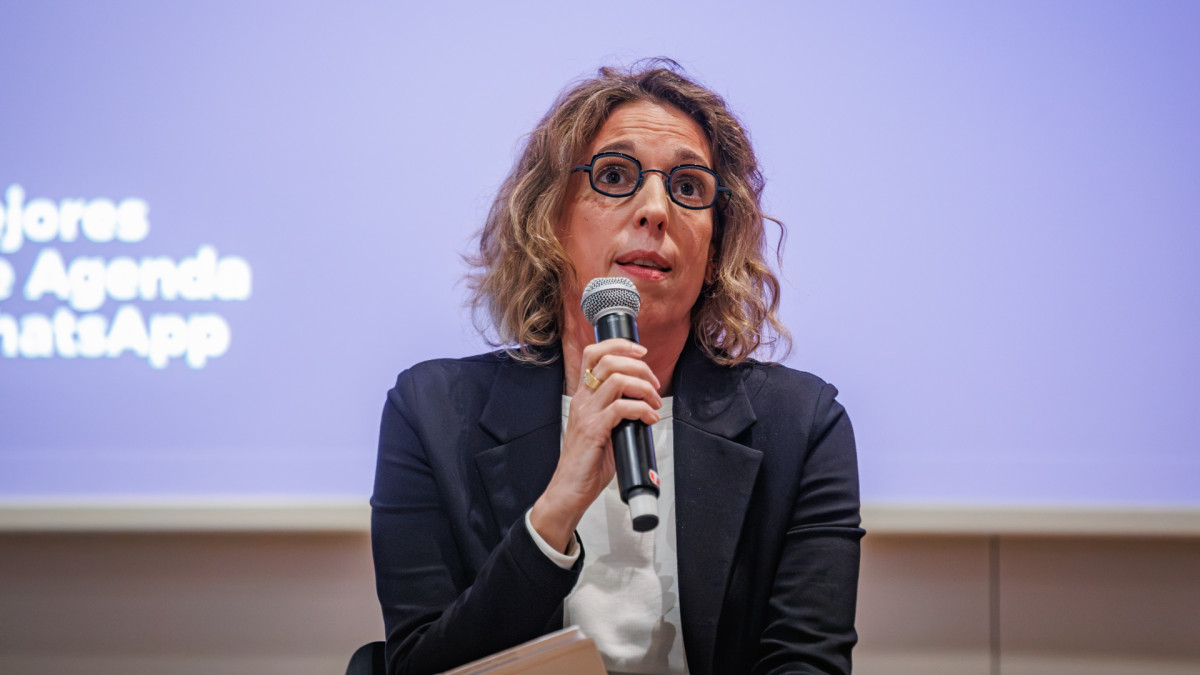
Àngels Chacón recurrió a una imagen de la antigua Roma para explicar lo que considera uno de los principales problemas de la política española. La vida pública, desde su perspectiva, se parece cada vez más a un anfiteatro en el que los espectadores esperan que uno de los contendientes derrote al otro, y cada vez menos a un ágora donde los ciudadanos intercambian argumentos. La diferencia trasciende lo meramente estético, porque mientras en el anfiteatro importa quién vence, en el ágora lo decisivo es qué se acuerda. Una democracia que organiza toda su conversación alrededor de la victoria sobre el adversario corre el riesgo de olvidar para qué sirve gobernar.
The former Minister for Business and Knowledge at the Generalitat of Catalonia and former secretary-general of the PDeCAT participated on November 20 in Madrid in a conversation organized by Agenda Pública together with four other women from different political traditions and with extensive institutional experience. From her municipal and industrial background, Chacón advocated an increasingly undervalued capacity in public life: to recognize that people with different convictions can share a concern for the collective future.
“A democracy that organizes all its conversation around victory over the adversary risks forgetting what governance is for.”
“Hoy en día yo creo que la vida política se parece más a un anfiteatro, si miramos de la Roma imperial, más que un ágora o que un foro donde hay debate”, she stated. Chacón linked this transformation to the erosion of respect for the opponent and the tendency to interpret agreements as renunciations of one’s own identity. Sometimes voters behave like fans of a team, more interested in defeating the other than in examining their arguments. In that climate, politics adopts a language of combat and winning the narrative ends up becoming an end in itself.
The former Catalan official also drew on philosopher Byung-Chul Han to reflect on the loss of recognition of the other. His argument began from the conviction that a plural society must admit different interpretations of the same problems, and that diversity is an essential part of democracy. The difficulty arises when recognizing others’ reasons is perceived as a weakness and negotiating seems incompatible with preserving one’s own convictions. In this sense, Chacón defended the importance of reclaiming respect as a condition for keeping a truly open conversation.
That diagnosis added a social dimension. Economic and technological transformations, coupled with geopolitical uncertainties, fuel a growing unease about the future in European societies. When people perceive their living conditions becoming precarious or opportunities for advancement fading, they may seek security in more radical political identities. The result tends to deepen divides between opposing groups and makes finding shared solutions more difficult, so that confrontation no longer serves merely as a party strategy but also as fertile ground for societal discontent.
The former Minister for Business and Knowledge of the Generalitat shares the conversation with other former political leaders. Photo: Agenda Pública / Tania Sieira
Política industrial y educación: los acuerdos que necesitan tiempo
Chacón insisted on the necessity for policy to recover its capacity to transform reality. Her leadership of the enterprise and industrial policies of the Generalitat gained prominence as the gathering addressed Spain’s economic challenges. Education and productivity, alongside reindustrialisation and technological adaptation, require strategies that must be developed with a long-term perspective, since their results typically come long after a legislature ends. That continuity demands planning capable of outlasting electoral cycles.
“Education and productivity, together with reindustrialisation and technological adaptation, require strategies that must be developed with a long-term perspective”
From there comes her call to pay more attention to the relationship between education, industry and innovation. Economic growth depends on the ability to attract investments, but also on having a solid productive fabric and workers prepared, supported by institutions that facilitate the transformation of companies. That perspective returned to the debate a question often neglected by party politics: constructing an economic strategy capable of generating sustainable opportunities.
The reflection also touched the different political and cultural realities that coexist within Spanish and European institutions. For Chacón, cooperation between territories must start from recognizing their particularities, which can contribute to stronger agreements by allowing a better understanding of what each society needs and what it can contribute to the whole. That diversity, in her view, is an element to be integrated into the formulation of major shared strategies.
On the European front, the former minister revisited the loss of competitiveness relative to the United States and China. The Union needs to strengthen its industrial and technological capacity, as well as its economic position, in an increasingly demanding international environment. To achieve this, sustained investments and strategic decisions are required, supported by cooperation between administrations and companies. The continuity of these initiatives requires commitments that can endure over time, regardless of political changes that may occur.
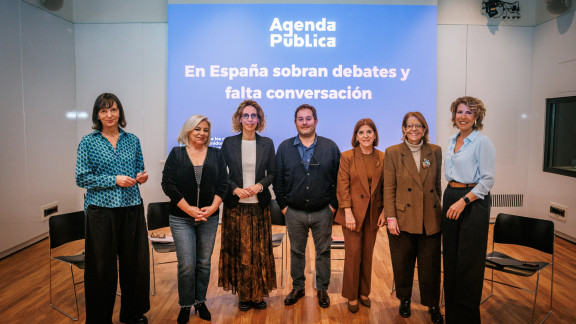
Participants in the gathering, together with the editor and director of ‘Agenda Pública’, Marc López Plana. Photo: Agenda Pública / Tania Sieira
Pensar el futuro en el presente
At the end of the gathering, Chacón challenged both political parties and citizens to what extent they are willing to commit, reach accords, and make concessions with future generations in mind. Her reflection incorporated a demand for collective responsibility for the consequences of public decisions. The measures that we postpone today continue to affect the future, and their costs may fall on those who still lack sufficient power to influence politics.
“The measures that are postponed today continue to affect the future, and their costs may fall on those who still lack sufficient power to influence politics”
The ex-minister then posed one of the questions that marked the day: “What level of hypnosis are we willing to tolerate?”. Her words expressed impatience with a public conversation dominated by simplification and personal confrontation, which finds in algorithms an immediate reward. From her point of view, the underlying issue concerns the opportunities the country loses while maintaining that dynamic and with the shared responsibility to push for more constructive forms of participation.
Her argument raised a reflection on the very nature of democratic government. Parties must compete and defend their programs, while at the same time they must cooperate to develop industrial, educational and economic policies whose results will benefit society as a whole. Governing means accepting that a portion of merit can be shared and that the positive effects of certain decisions will appear when others hold power.
In the amphitheatre described by Chacón, the spectacle ends when one contender wins. Politics, rather, finds after each electoral victory the moment to turn proposals into results. The real test begins when those who have won must prove they can build a future that also belongs to those who did not vote for them.
