
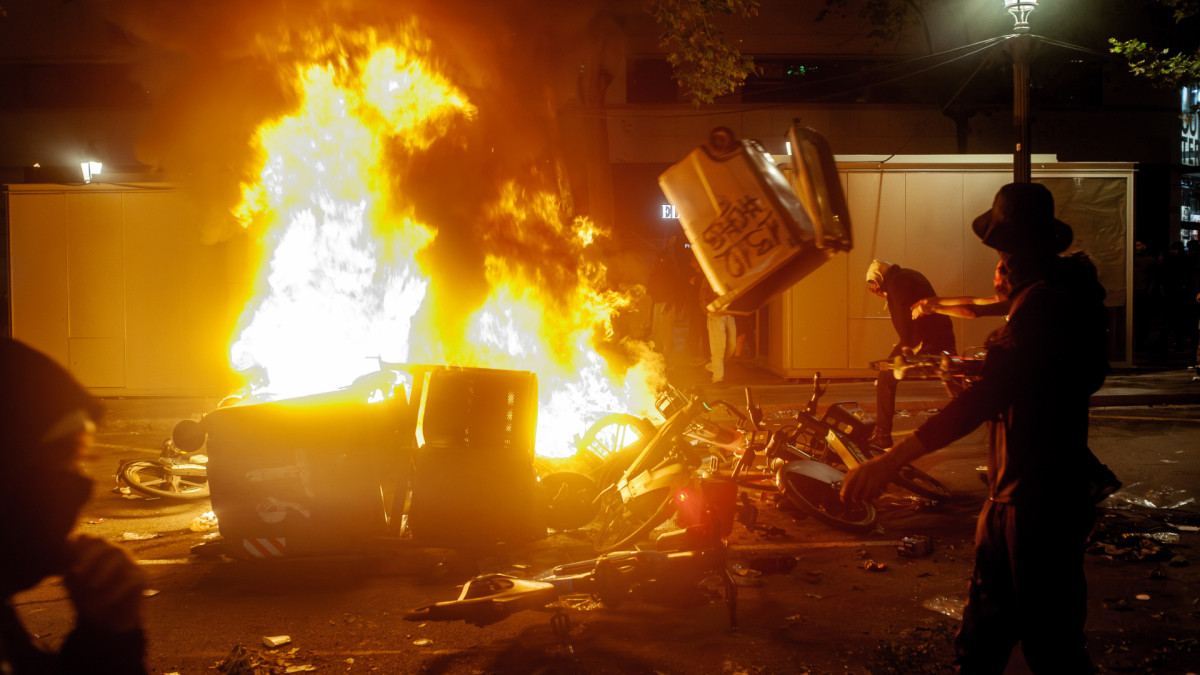
The disturbances in Barcelona and other Spanish cities, after the episodes of violence recorded in France and Italy, should lead us to discuss a question that transcends identifying those who participated in the looting. Regarding their organization, it is worth proposing the hypothesis that foreign actors intervened in the calls, either by helping to promote them, or by steering them toward a certain intensity or orientation, or by finding in them a later opportunity to act. In the face of the persistence of these phenomena of serious public disorder, the State needs to begin responding to these actions, also publicly, as what they are: attacks on national security.
Certainly, the information available does not permit us to deem any of the listed possibilities proven. However, after the episodes recorded in other European countries, it is prudent to examine what capacity Spain has to detect and address actions of that nature before their consequences overwhelm the police response. This problem concerns how an internal crisis can end up serving an external strategy, even if those who participate in it do not know what it is being used for.
“Ante la persistencia de estos fenómenos de grave desorden público, el Estado necesita comenzar a responder a estas acciones como lo que son: ataques contra la seguridad nacional”
First, because European experience shows that mobilizations arising from domestic problems attract the attention of foreign networks that seek to modify their political meaning, intensify confrontation, or exploit their consequences. In the recent French protests, activities of networks linked to Russia were identified that used discontent to question support for Ukraine and to present European societies as unable to sustain their commitments or victims of the alleged belligerence of their elites. Of course, this is not the first wave of Russian disinformation attacks associated with the war launched by Russia against Ukraine.
Spain has witnessed very recent comparable situations. In Ceuta, during the massive entry into Ceuta on July 30 and 31 and subsequently, accounts from various countries took advantage of what happened to spread misinformation and promote particular readings of the crisis, with different target audiences. From this it does not follow that those actors triggered the entry, of course, but the “breach” and the “attack” to Spain’s territorial integrity offered third parties the opportunity to amplify their effects or achieve second- and third-order impacts. A potential simultaneity of attacks, even if disconnected, should form part of our toolbox to prepare responses.
Another case further back in time can be found during the Catalunya process: then we observed how media and networks linked to Russia contributed to projecting a discrediting image of Spanish democracy to move the conflict to other audiences. That prolific activity of foreign interference allows us to recognize how a dispute arising from our own institutional trajectory could be useful for foreign interests. It would have been prudent for that experience to be incorporated more consistently into the discussion of our vulnerabilities, so that each new episode would not find us asking again whether Spain can be the target of such actions.
“A potential simultaneity of attacks, even disconnected, should form part of our toolbox to prepare the responses”
These patterns of action deserve attention because they alter the relationship between the cost of intervening and the effects that can be pursued. Whoever aims to condition Spain’s political landscape can take advantage of an existing controversy, promote certain interpretations and contribute to making it politically harder to take a decision, without needing to control those who demonstrate or share their demands. In such a scenario, the objective could be to divert resources —let us remember that we now have two “fronts” open: both in cities and in the city of Ceuta—, weaken a relationship among allies, raise the domestic price of an international commitment or simply increase the tension in a society that is already strained, even though those who propagate the messages are convinced they are responding only to their own concerns.
Indeed, polarization facilitates that work. If an explanation confirms what each bloc believes about its adversary, there is less incentive to verify it, while corrections can be received as mere maneuvering within the confrontation. Conspiracy theories find an advantage there—and, unfortunately, our country is also prolific in conspiracy theories about traumatic events, deeply anchored in certain political narratives—since they allow incorporating any information contrary to the same cover-up they claim to denounce. Therefore, an external agent could have part of its dissemination work carried out by Spanish actors who had no relation to it.
That is one of the difficulties of acting in the grey area. Uncertainty forces us to calibrate responses, although it should also prompt anticipation: waiting for an investigation to reconstruct the entire chain of responsibilities can leave too much room for those trying to influence an ongoing crisis. Between hasty attribution and an infinite wait for all supposed evidence there exists a decision space that institutions must prepare, with procedures that allow acting in accordance with available indications and revising measures when information changes.
“Waiting for an investigation to reconstruct the entire chain of responsibilities can leave too much room for those trying to influence an ongoing crisis”
Moreover, it would be a mistake to confine the problem to digital conversation. The European precedents in these last months of sabotage, arsons and actions against critical infrastructures advise that our planning should consider scenarios in which a deliberate action affects supply chains, essential facilities or national resources, while an information campaign hinders the response or worsens its consequences.
Therefore, yes, we should consider that a hostile actor may try to provoke an incident that could be mistaken for a spontaneous disruption of public order. These are assumptions for preparation, whose relevance does not amount to attributing foreign intent to every breakdown, protest or episode of violence, logically, but it does imply, instead, assuming such a hypothesis in those critical situations. This sober warning should begin with the political leaders themselves, who must show extreme caution when insinuating causalities.
In light of this situation, the forthcoming National Strategy against Disinformation Campaigns, whose development procedure was approved in 2025, should be a relevant instrument to specify these needs and should not lose continuity after the elections. It would be advisable for it to establish how to share indications among intelligence, law enforcement and other authorities, who should integrate them to inform policymakers, and what decisions can be adopted while uncertainties about authorship persist. Its usefulness will depend on these procedures translating into well-defined responsibilities, on staffing and resource allocation, and on the implementation of joint exercises. For example, we must assume that the catastrophic effects of a natural disaster can be amplified due to a disinformation campaign that parasitizes the emergency, and hence the mandatory nature of its practice.
“The utility of the national strategy will depend on these procedures translating into well-defined responsibilities, on staffing and resources, as well as on the implementation of joint exercises”
Nevertheless, we should go one step further in the State’s action. The strategy should also develop the capacity to act against those who organize these operations: investigate their financing, hinder their functioning using the available legal instruments, and promote, with our partners, diplomatic measures and sanctions when there are grounds for it.
And even more: Spain should possess external influence capabilities with which to dispute the interpretations promoted by hostile actors and expose their actions to other societies. The classic diplomatic rudiments are being surpassed by this already established, but growing and exponentially grave, form of attack. For that action to contribute to our interests, it will require determining criteria for its use and evaluation mechanisms, in addition to the necessary democratic oversight. Thinking about the grey zone not only from prevention but also from defense.
“Spain should possess external influence capabilities with which to dispute the interpretations promoted by hostile actors and expose their actions to other societies”
The government that emerges from the elections will have the responsibility of continuing this work, seeking a parliamentary agreement that would sustain it beyond its term. Perhaps it should be promoted by the new Cortes. Unfortunately, we do not have the best expectations of reaching a political agreement on this matter, but the need is urgent. Otherwise, those who seek to intervene from outside may also count on our inability to agree on the fundamental points to guarantee the security of Spanish society.
