
Antonio López-Istúriz White (born in Pamplona, 1970) speaks as if he were weaving an invisible thread between Brussels and Mexico City: a thread that, when heard, feels as simple as a sobremesa story. He is a man who turns the tangle of regulations, treaties, and negotiations into stories anyone can follow, as if European integration were not an endless labyrinth of indecipherable corridors, but a map drawn with straight, clear lines. And when he focuses on the recently strengthened alliance between Mexico and the European Union, he does so with a cadence that makes the technical seem everyday, the abstract tangible: as if international politics could fit into the voice of a good conversationalist, able to render the complex approachable, almost intimate.
Three days after having taken part in the European Union delegation charged with strengthening relations and guiding diplomatic negotiations with the Mexican government, the European Parliament member from the European People’s Party gave, on that topic, a talk at one of Mexico’s most prestigious academic centers, the Instituto Tecnológico Autónomo de México (ITAM). Once López-Istúriz took the microphone, he did not stop delivering headlines: “I am a friend of this country”, “the EU and Mexico need each other equally; this is a achievement that has taken many years”, “only by uniting Europeans can we survive”, among many other statements that left no doubt about the firm intention to strengthen a relationship that, it seems, is about to enter a commercial idyll. Then he shifted to an idea applicable to all countries, but which, in the unsettled geopolitical context, takes on particular relevance for EU–Mexico relations: “when things go well, we seem to fall asleep, and it is precisely when things go badly that we become more creative, more imaginative”. His line was clear: in today’s changing world, Europe needs reliable partners in the Americas, and Mexico, facing the uncertainty that the current administration has tried to cast a shadow over, needs to open its commercial portfolio beyond U.S. borders.
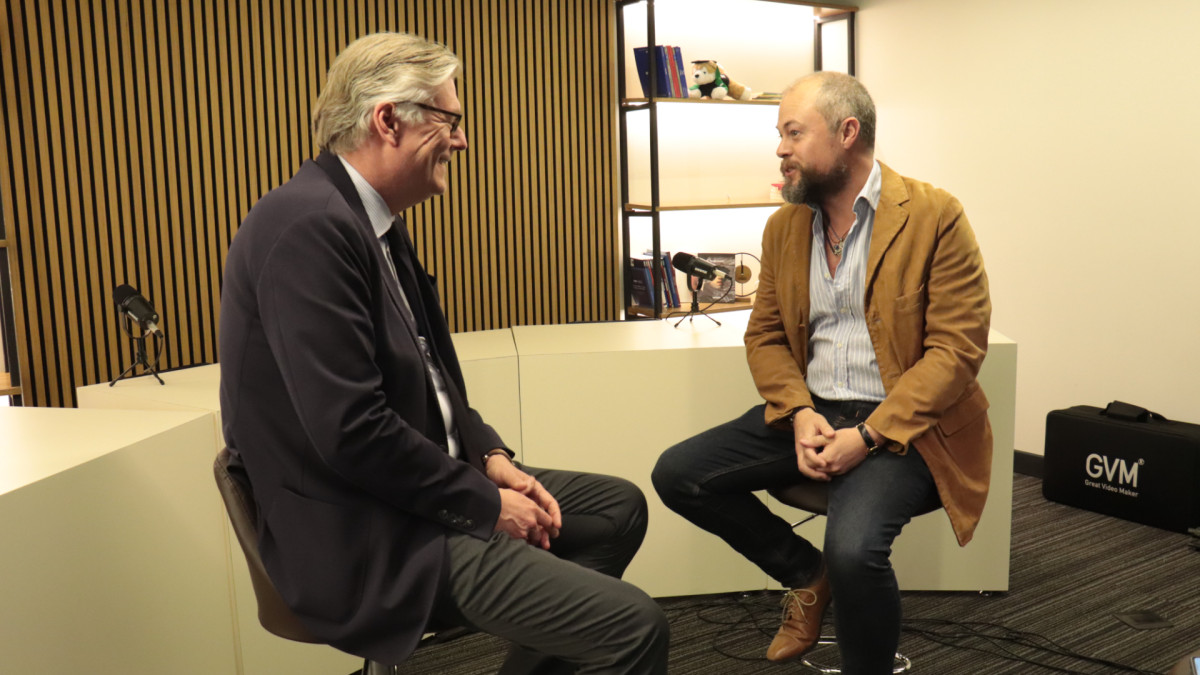
Finally, after his academic presentation, the eurodeputy sat down with the journalist who writes these lines.
López-Istúriz is the head of the delegation to the EU–Mexico Joint Parliamentary Committee. Photo: European Parliament
How important is the signing of the modernization of this agreement, precisely at this moment, after Isabel Díaz Ayuso’s recent and controversial visit to Mexico, which has generated so many radicalized reactions?
It has nothing to do with it. That event has nothing to do with EU–Mexico relations.
I have been testing this issue, even in Brussels, and that has been viewed more as a political matter, but it has not had any impact whatsoever. It has not changed the mood in the relations, far from it. No one has paid attention.
When it happened (a couple of weeks ago), I worried myself, but I haven’t seen it as a matter of major importance. Look, we have more than ten years of technical and political negotiation behind us, which will have a positive impact on the creation of millions of jobs in Mexico and in the European Union, and that issue is not something that can overwhelm what has been built.
Now, it is true that there are factions about it, that there is a lot of polarization on that topic, but I am not in that camp. Nor are they in Brussels.
Fine. Yet, those radical opinions are the ones that build much of the narrative around that visit. Doesn’t that have an impact on the relations between Mexico and Europe?
Of all the years I’ve spent watching Mexico, I don’t see any reflection of that. It is, at most, a political matter, but it does not have, in my opinion, any reflection in society. I mean the way I’m treated by people on the street, my walks with friends, with businesspeople, with civil society. And no one has ever raised to me an issue about those questions.
I am one of those who are on the front line defending, always, the best relations with Latin America as a Spanish euro-deputy, just as Portuguese eurodeputies do. Obviously, other colleagues from other nationalities tend to look toward relations with Eastern Europe, the Balkans, or toward the South, for example. But Spaniards and Portuguese always push with maximum force to consolidate a better relationship with Mexico and the rest of Latin America. And not for personal interest, but for the interests of the European Union. This agreement has to be a reference for the rest of Latin America.
“There has been no political discussion at all, as there was with Mercosur over agriculture”
Let me tell you a case. Regarding the negotiations to modernize this agreement with Mexico, there has been no political discussion at all, as there was with Mercosur over agriculture. But with Mexico there was no political problem. In fact, my sense is that the political and commercial reports, in July, will be approved. I don’t want to be accused of optimism, but I believe everything is moving very well. And, if in September, regarding the Mexican side as well, it is approved, those will be very good news for everyone.
In short, being aware of the years of work this process has required, I’m not going to get involved in external political debates or issues. I represent all Europeans, and I cannot get involved in discussions that do not concern me.
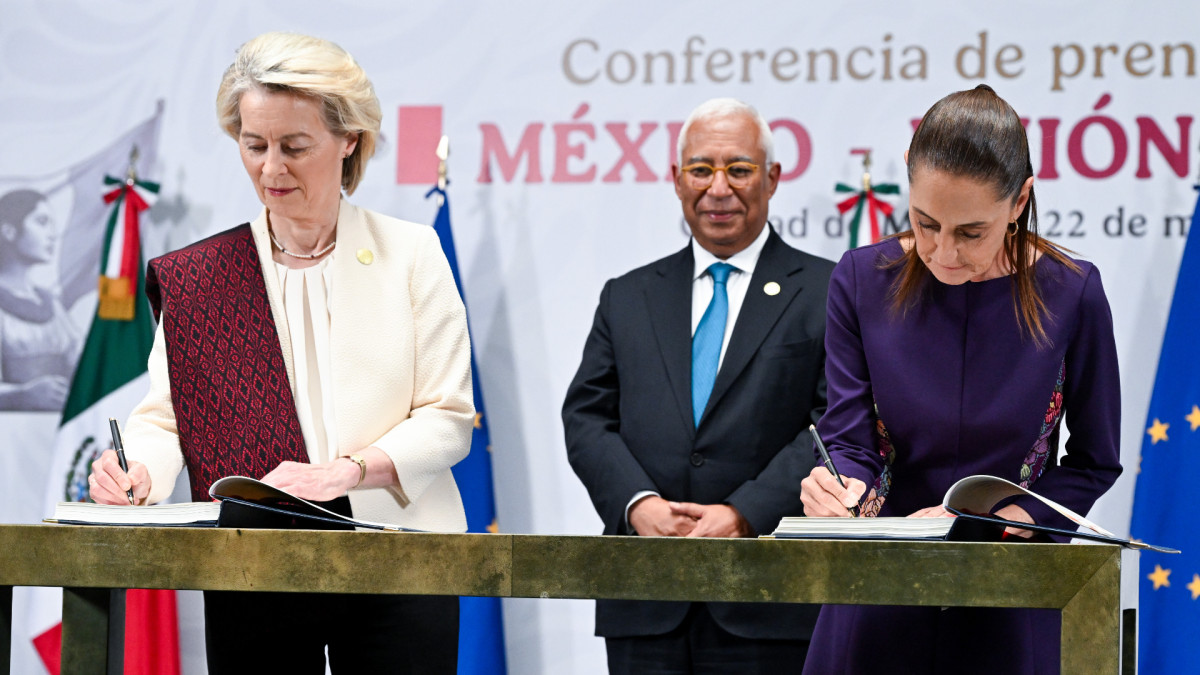
From left to right: Ursula von der Leyen, António Costa, and Claudia Sheinbaum. Photo: European Union
We are on the right track. Then, given that this signing is only one step (a very important one) in the process of getting this agreement started, when will it finally come into force?
Let’s see: the commercial part will come into effect immediately, because, following an experience we had a few years ago with the Canada deal, there was a problem with a regional parliament (in the European system, these things must be approved by national parliaments, but also by some regional ones). It was a conflict that originated in the Parliament of Wallonia, in Belgium, over some Canadian product that represented a conflict of interest in that region. Now, having learned that lesson, realizing we could not be hostage to a regional issue, we decided to adopt the split model, i.e., the model that separates the political from the commercial, and each one continues its process.
“For July, in the European Parliament, the agreement can be approved. Now, however, we will have to wait for approval by the national and regional parliaments”
Soy optimista al respecto. En Europa, todo indica que la discusión política pertinente avanza, por parte de las fuerzas moderadas, que somos la mayoría. Ahora, es cierto también que tenemos extremos, posturas radicales, tanto de izquierda como en la derecha, que son contrarias a estos modelos. No obstante, las mayorías sólidas son las que están a favor de la integración y de la cooperación. Mi cálculo es que, para julio, en el Parlamento Europeo, el acuerdo puede estar aprobado. Ahora bien, luego tendremos que esperar a la aprobación por parte de los parlamentos nacionales y regionales, pues espero que eso tome el menor tiempo posible.
Changing the subject a bit. Do you see this agreement as a counterweight to the tax policies of the current administration in Washington?
This agreement is not against anyone. It is an agreement that benefits Mexican and European societies. Period.
I think Washington has understood it that way too, since we haven’t had a single tweet about it this week (laughs). I have good contacts in the United States, in both the Republican and Democratic Parties, and I have asked about this matter several times, and no one has told me anything negative.
The big problem Washington faces is the advance of Chinese trade. The European Union does not pose a problem for them. They have tariff issues with Europe, yes, but they do not mix that with the agreements Europe has with Mexico.
