
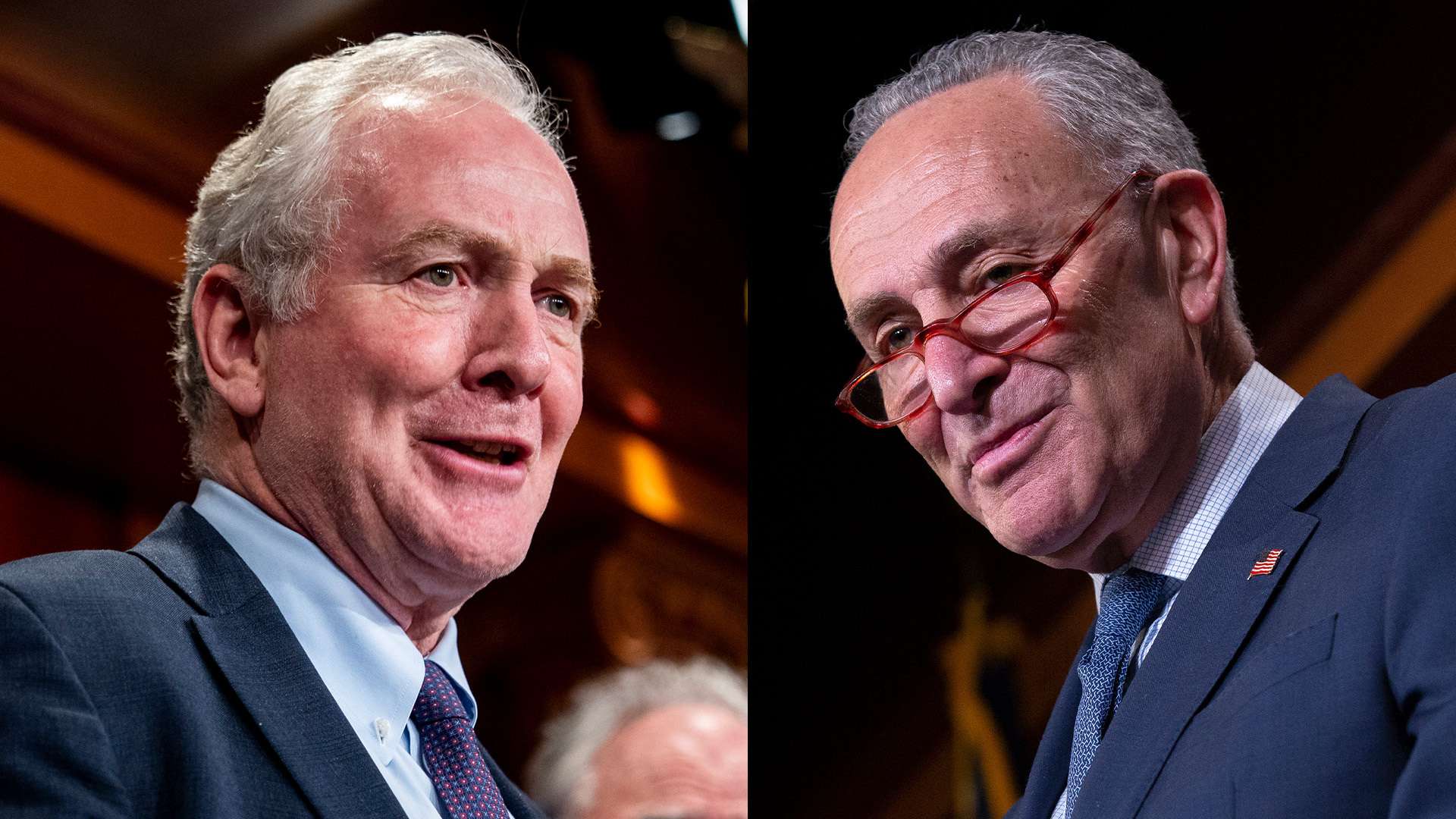
The contest for Senate majority leadership features two longtime politicians who are nearing retirement and both favor broader government sway over everyday life.
Following last week’s decisive conclusion of the remaining race, the Democrats will command 56 seats in the U.S. Senate for the forthcoming term—more than any party has held in nearly twenty years.
One might anticipate that the party would elevate Senate Minority Leader Chuck Schumer (D–N.Y.) to the post of majority leader, a role he has filled on two previous occasions. Yet voices from the party’s progressive flank and some observers are urging for new leadership.
“I think it’s clear that both parties are ready for a fresh generation of leadership,” said Sen.-elect Annie Andrews (D–S.C.) ahead of the election.
“There is a generational shift coming to the Democratic Party, which is essential,” former President Barack Obama added.
Interestingly, the party’s push for renewal appears to be centering on the 67-year-old Sen. Chris Van Hollen (D–Md.).
“In this election, the American people signaled a demand for change,” Van Hollen declared on November 12. “The moment is here, and to respond to it we need new leadership…That is why I am seeking the post of Senate Majority Leader.”
“I believe the Democratic caucus should remain open to novel ideas, a different approach to governance, and a fresh way of engaging in political life,” he later elaborated.
So far, at least five senators and incoming members have voiced support for Van Hollen over Schumer.
Yet if the aim is to disrupt a conservative, time-honored institution—whether the Senate or the Democratic Party—and inject new vitality, it’s hard to argue that replacing a seasoned, 75-year-old career lawmaker with a 67-year-old veteran who has held elected office since 1990 represents a meaningful leap. The latter is old enough to qualify for the full Social Security retirement benefits.
The challenger and his backers have conceded that Van Hollen does not embody the generational shift himself. Nevertheless, they contend he will be its standard-bearer.
“I have never claimed that I embody generational change,” Van Hollen clarified. “What I’m saying is that we have a generational opportunity because of the broad mandate—56 votes—for change.”
“From my current perspective, the real generational transformation is embodied by the remarkably dynamic class of incoming freshmen in the Senate, and the goal of that transformation is something we’ll achieve as we move forward,” Andrews told reporters last week.
Sen.-elect Abdul El-Sayed (D–Mich.) told CNN’s Kaitlin Collins that Van Hollen “strikes a remarkably balanced chord between the kind of generational renewal we’re seeking in leadership and someone who has been in the Senate and the House long enough to understand how to shepherd legislation through the process.”
Indeed, the majority leader’s job involves a substantial amount of procedural maneuvering—arranging votes, lifting certain bills to the forefront, and guiding legislation through the rules—and that demands familiarity with those rules.
But in an era where governance often seems dominated by the oldest members, as Congress faces questions about social media, artificial intelligence, and a host of technologies beyond the public’s day-to-day awareness, it can be disheartening to have the debate steered by figures who have spent decades in Washington.
Is Van Hollen truly the best option for Democrats?
This isn’t a blanket endorsement of Schumer—who, as Reason put it years ago, has frequently weighed in on issues from gun control to cybercurrency while backing security-focused initiatives and cultivating ties with powerful interests on Wall Street.
And Van Hollen has his own merits. He supported resolutions aimed at ending U.S. involvement in Iran, and this month he moved to restrict additional funding for those actions. Last year, after the administration deported Kilmar Abrego Garcia to El Salvador in defiance of a court order, Van Hollen traveled there to press for the individual’s return to the United States and pressed the case to bring him back.
Yet Van Hollen also has aspects that some find unattractive. He has endorsed a federal wealth tax reminiscent of a state proposal that recently failed in California. He joined Schumer in 2010 to co-sponsor the DISCLOSE Act, an attempt to override the Supreme Court’s Citizens United decision and impose burdensome limits on political advertising.
One of President Trump’s more audacious economic moves involved directing the government to acquire equity stakes in private firms—more than four dozen enterprises according to the Cato Institute. While Van Hollen has reservations, his critiques seem to target process more than purpose. “The Trump administration’s approach to holding government equity stakes has lacked transparency and accountability,” he told Semafor in October. “While this is something future administrations might consider, fulfilling a real public-service goal would likely require a fundamentally different approach.”
Demand for fresh leadership in Washington is understandable. Yet the current contest for Senate majority leader pits two career politicians who are near retirement and who both advocate expanding government control over everyday life.
