
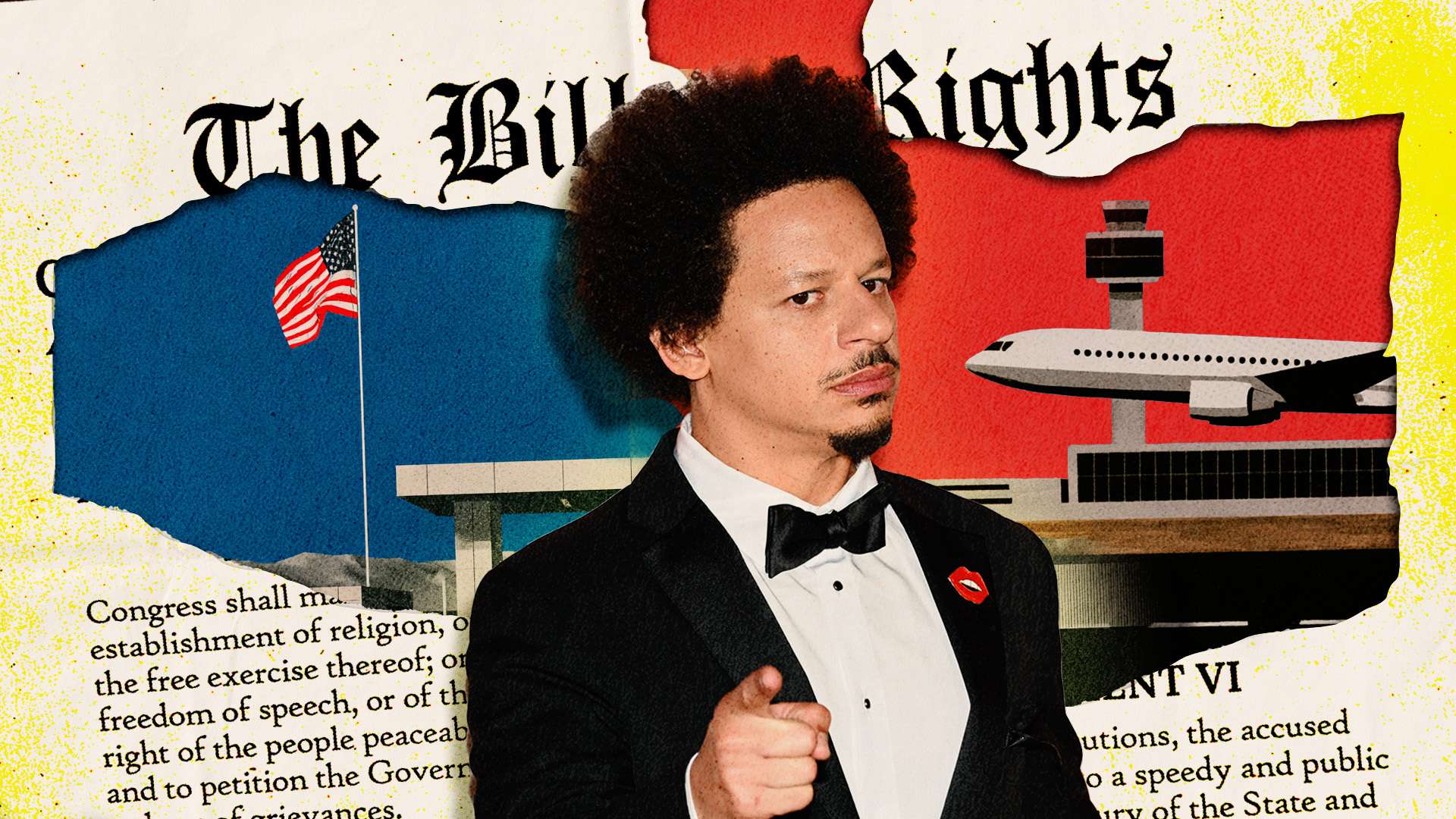
Although the settlement represents progress, it remains true that at airports the Bill of Rights frequently reads as though it were merely a set of recommendations rather than enforceable protections.
Earlier this week, a county police department in Atlanta resolved a lawsuit filed by two comedians who were detained and subjected to a search while at the city’s airport. As part of the accord, the department will no longer engage in such searches.
Regrettably, airports continue to occupy a legal gray area where constitutional safeguards are inconsistently applied and often treated as optional.
“I was just racially profiled by two plain clothes Atlanta PD police in @Delta terminal T3 at the Atlanta airport,” comedian Eric André wrote on Twitter in April 2021. “They stopped me on the way down the bridge to the plane for a ‘random’ search and asked [if] they could search me for drugs.” Atlanta-based comedian Clayton English later contacted André to say he had experienced the same treatment several months earlier.
@Atlanta_Police “I was just racially profiled by two plain clothes Atlanta PD police in @Delta terminal T3 at the Atlanta airport. They stopped me on the way down the bridge to the plane for a “random” search and asked they could search me for drugs. I told them no. Be careful.
— Eric Andre (@ericandre) April 21, 2021
As described by André and English in the subsequent lawsuit, the detentions were part of the so‑called “jet bridge interdiction program” at Hartsfield‑Jackson Atlanta International Airport, the busiest in the world. The suit alleges that jet‑bridge interdictions involve officers from the Clayton County Police Department (CCPD) “waiting in jet bridges—the narrow tunnels linking planes to airport gates—to selectively stop passengers, take their boarding passes and identifications, question them before they board, and search their carry‑on luggage, all under the banner of combating drug trafficking.”
CCPD maintains that these stops are voluntary and consensual, a claim both men dispute. “When two cops stop you, you don’t feel free to walk away, especially when they begin interrogating you about drugs,” André stated at a October 2022 press conference announcing the lawsuit. English added that he felt utterly powerless during his own stop.
Not only was the jet‑bridge interdiction program dehumanizing and unconstitutionally broad, but both complainants—who are Black—argued it was racially targeted: During the eight months of stops, the CCPD conducted 378 passenger interdictions in jet bridges where the department’s records note the race of the passenger stopped, the suit states. “Of those, 56% of the stopped passengers were Black,” even though “only 8% of American airline travelers are Black.”
On its face, the program appears particularly ineffective: those selected had already passed through federally mandated security checks.
In fact, the suit shows that jet‑bridge searches uncovered drugs in just three of 402 stops, and of those three, only two led to charges.
By contrast, the program proved adept at seizing cash from unsuspecting travelers.
“Over the 8‑month period in question,” the suit notes, “the program confiscated $1,036,890.35 in cash and money orders via 25 civil asset forfeitures (with the seized amounts in individual cases ranging from $10,000 to $118,880). Yet, of the 25 passengers from whom cash was seized, 24 were allowed to continue on their journeys—often on the same flight—and only two were ever charged with any related crime.”
Unfortunately, this is not unique to Atlanta: civil asset forfeiture permits law enforcement agencies nationwide to seize substantial sums of cash under the suspicion that it was linked to illicit activity. The burden then falls on the owners to prove a negative in court—namely, that the money was earned legally. While protections differ by state, most jurisdictions offer scant safeguards against abuse.
Last year, the Drug Enforcement Administration terminated its airport interdiction program after years of lawsuits and accusations of constitutional violations. This week, Clayton County announced a similar decision.
“For the first time, the Clayton County Police Department has publicly confirmed that it has ended the airport interdiction program at the center of the lawsuit,” according to a press release from the Policing Project at the New York University School of Law, which helped represent the plaintiffs. “As part of the settlement, the County has also agreed to require all Clayton County Police Department officers assigned to the airport to wear body‑worn cameras and to receive training on the constitutional limits governing police encounters in airports.”
The county also agreed to compensate each comedian with $15,000.
While the discontinuation of the program is a definite win for travelers, it remains the case that constitutional rights do not enjoy the same uniform protection at airports and border crossings as they do elsewhere.
Although the Fourth Amendment shields against unreasonable searches and seizures, airport security personnel may conduct “administrative searches” analogous to DUI checkpoints or metal detectors. “None of these searches requires either probable cause or a search warrant,” wrote University of Michigan Law School professor Eve Brensike Primus in 2012. “Instead, courts evaluating administrative searches balance the government’s interest in conducting the search against the intrusiveness of the privacy invasion to decide whether the search is reasonable. This reasonableness balancing is highly deferential to the government, and the resulting searches are almost always deemed permissible. Consequently, the administrative search exception acts as a broad license for the government to conduct searches without constitutional constraints.”
Even when the Fourth Amendment is thought to apply, officials often behave as though it does not, hence the persistence of “consensual” searches.
“Too long, federal law enforcement has managed to broaden the spectacle of security at airports while leaning on ‘voluntary’ behavior,” observed Matthew Feeney, then affiliated with the Cato Institute, in 2017. “Passengers aren’t required to pass through body scanners at airport security, yet you may not have noticed the signs indicating you can opt out of the scan. In the post‑9/11 era, millions of travelers have come to accept stepping into a body scanner as normal to board a domestic flight. This isn’t due to a legal obligation to undergo the scan; rather, it’s because enough people comply without question.”
Just this week, Reason‘s Matthew Petti recounted his own experience reentering the United States, where border officials detained him for four hours and refused his request to contact counsel. “Crossing the U.S. border is the closest most Americans will come to living under the rule of foreign regimes I report on,” he wrote.
